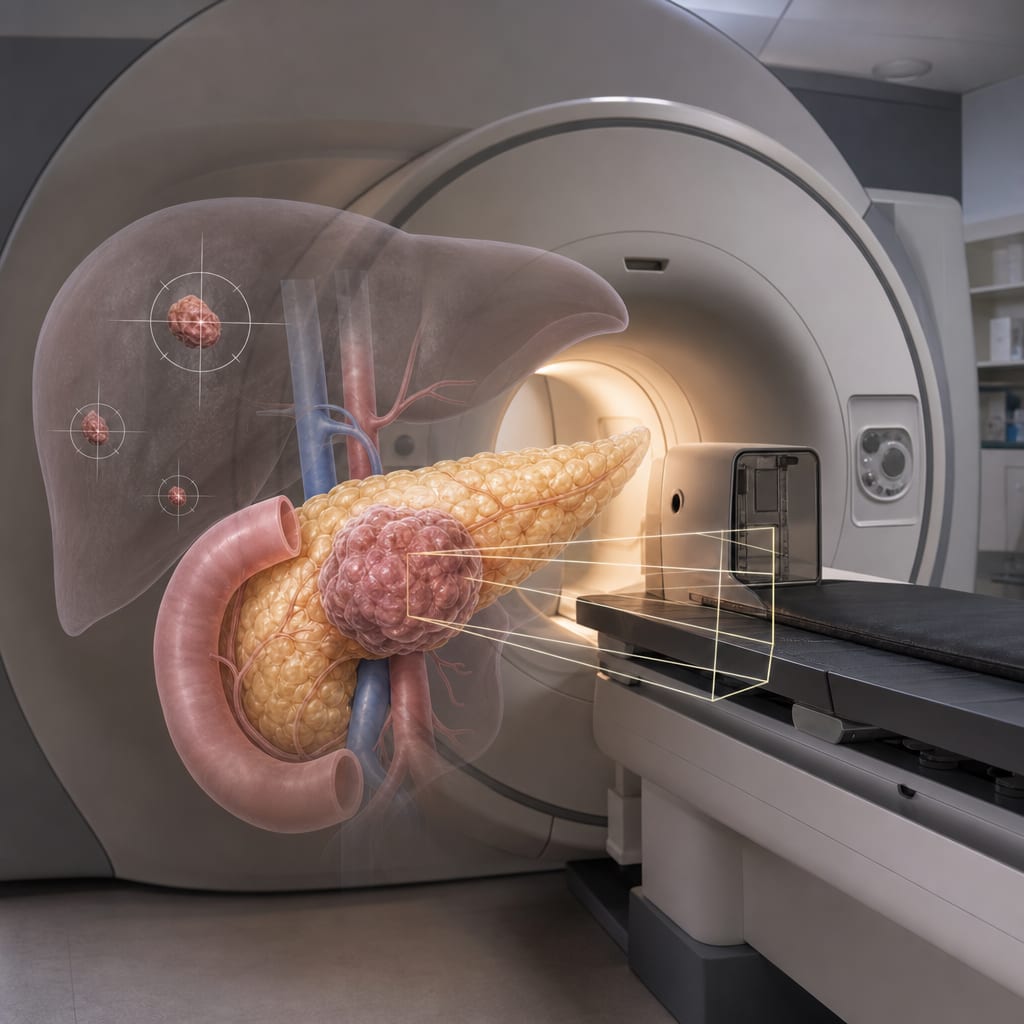
Ablative stereotactic MR-guided radiotherapy for >10 cm solid pseudopapillary tumor of the pancreas with liver oligometastases: a case report and literature review - Scorecard - MDSpire
Advertisement
Ablative stereotactic MR-guided radiotherapy for >10 cm solid pseudopapillary tumor of the pancreas with liver oligometastases: a case report and literature review
Clinical Scorecard: Magnetic Resonance-Guided Ablative Radiotherapy for a Large Solid Pseudopapillary Tumor of the Pancreas with Liver Oligometastases: A Case Study and Review of Existing Literature
At a Glance
Category
Detail
Condition
Key Mechanisms
Low-grade malignancies with potential for local control through dose-escalated MRgRT, particularly in challenging anatomical locations.
Target Population
Care Setting
Key Highlights
MRgRT allows for safe dose escalation in anatomically unfavorable tumors, improving local control.
The case demonstrated favorable long-term efficacy without significant toxicity, with specific metrics on patient outcomes.
The patient achieved a favorable radiographic response in all treated lesions, with details on imaging results.
Guideline-Based Recommendations
Diagnosis
Management
Consider MRgRT for unresectable SPTs to improve local control.
Explore additional systemic therapies and their roles in conjunction with MRgRT.
Monitoring & Follow-up
Risks
Patient & Prescribing Data
Received dose-painted MRgRT with 50.4 Gy and 75.6 Gy to primary tumor and liver metastases, respectively, based on tumor size and location.
Clinical Best Practices
Utilize MRgRT for complex abdominal tumors to enhance therapeutic ratio.
Monitor for toxicity, including specific assessments for liver function and gastrointestinal symptoms, and adjust treatment plans based on individual patient response.
by Robert A. Herrera, Nikolai Strusberg-Fernandez, Eyub Y. Akdemir, Fernando De Zarraga, Horacio Asbun, James McCulloch, Nema Bassiri, Michael D. Chuong