Clinical features and treatment challenges of HER2-positive primary breast squamous cell carcinoma: a case report and literature review - Scorecard - MDSpire
Clinical Scorecard: Characteristics and Treatment Obstacles in HER2-Positive Primary Breast Squamous Cell Carcinoma: A Case Study and Review of Existing Literature
At a Glance
Category
Detail
Condition
HER2-positive primary breast squamous cell carcinoma (PBSCC)
Key Mechanisms
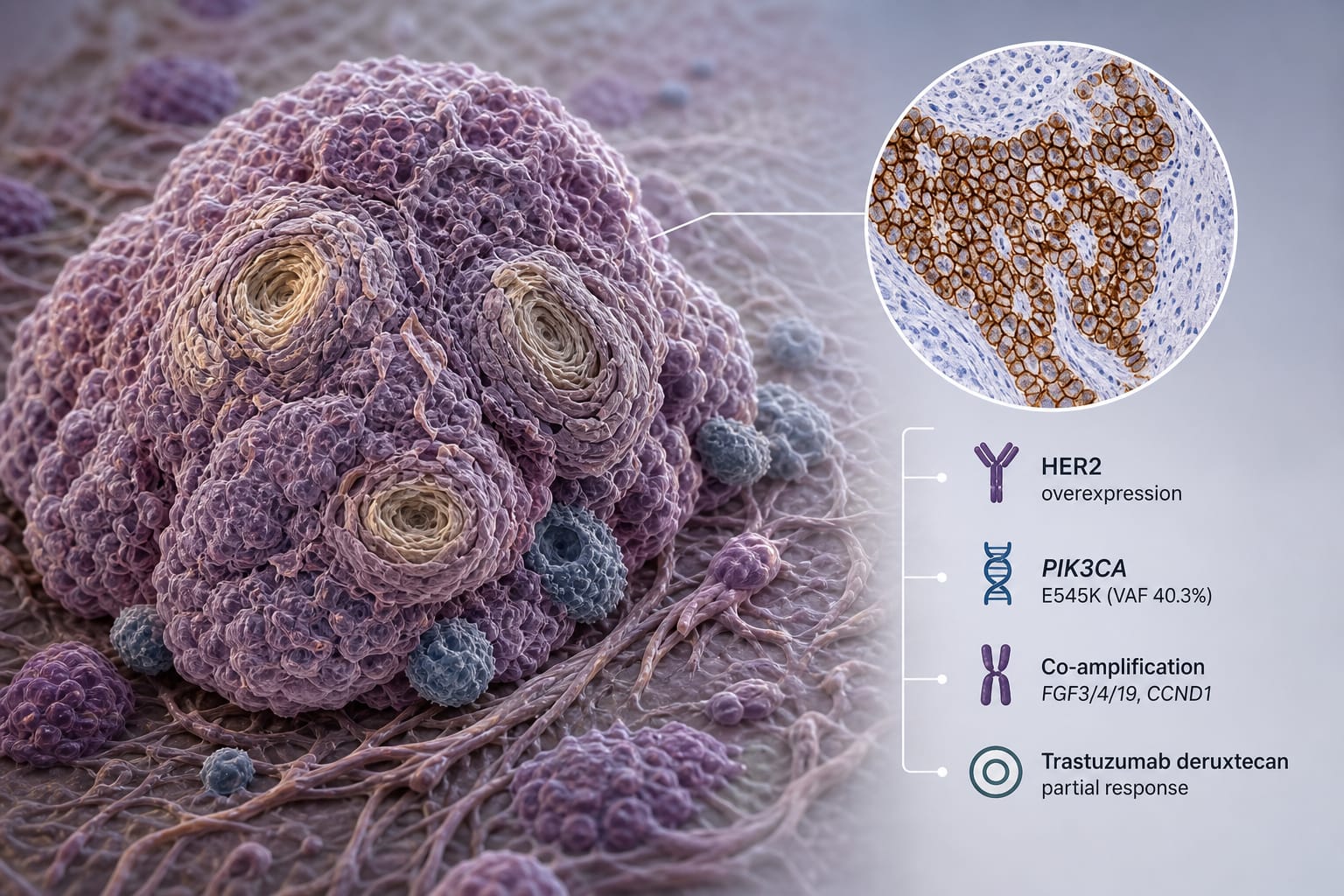
Acquired resistance due to HER2 antigen loss and molecular alterations (e.g., PIK3CA mutation).
Target Population
Patients with HER2-positive PBSCC, a rare subtype of breast cancer.
Care Setting
Oncology clinics managing rare breast cancer cases.
Key Highlights
HER2-positive PBSCC is extremely rare, with fewer than 100 cases reported globally.
Standard HER2-targeted therapies show low efficacy in PBSCC, with a pathological complete response rate of only 12.5%.
Acquired resistance mechanisms include HER2 antigen loss and PIK3CA mutations.
Molecularly-guided precision therapy is recommended after failure of HER2-targeted treatments.
Trastuzumab deruxtecan (T-DXd) has limited efficacy in HER2-positive PBSCC.
Guideline-Based Recommendations
Diagnosis
Confirm HER2 positivity through immunohistochemistry and fluorescence in situ hybridization.
Management
Consider neoadjuvant therapy with TCHP regimen, but be aware of potential inadequate responses.
Monitoring & Follow-up
Regular imaging and molecular profiling to assess treatment response and resistance mechanisms.
Risks
High risk of local recurrence and metastasis despite treatment.
Patient & Prescribing Data
Patients diagnosed with HER2-positive PBSCC.
Second-line therapy with pyrotinib plus capecitabine may provide disease control; however, response duration is variable.
Clinical Best Practices
Utilize molecular profiling to guide therapy after initial HER2-targeted treatment failure.
Prioritize agents targeting specific molecular alterations over continued HER2-targeted therapies.
he U.S. Food and Drug Administration (FDA) has approved daraxonrasib, an oral multi-selective RAS(ON) inhibitor, for adults with metastatic pancreatic adenocarcinoma who have received at least one prior systemic therapy or are not candidates for multiagent systemic therapy.