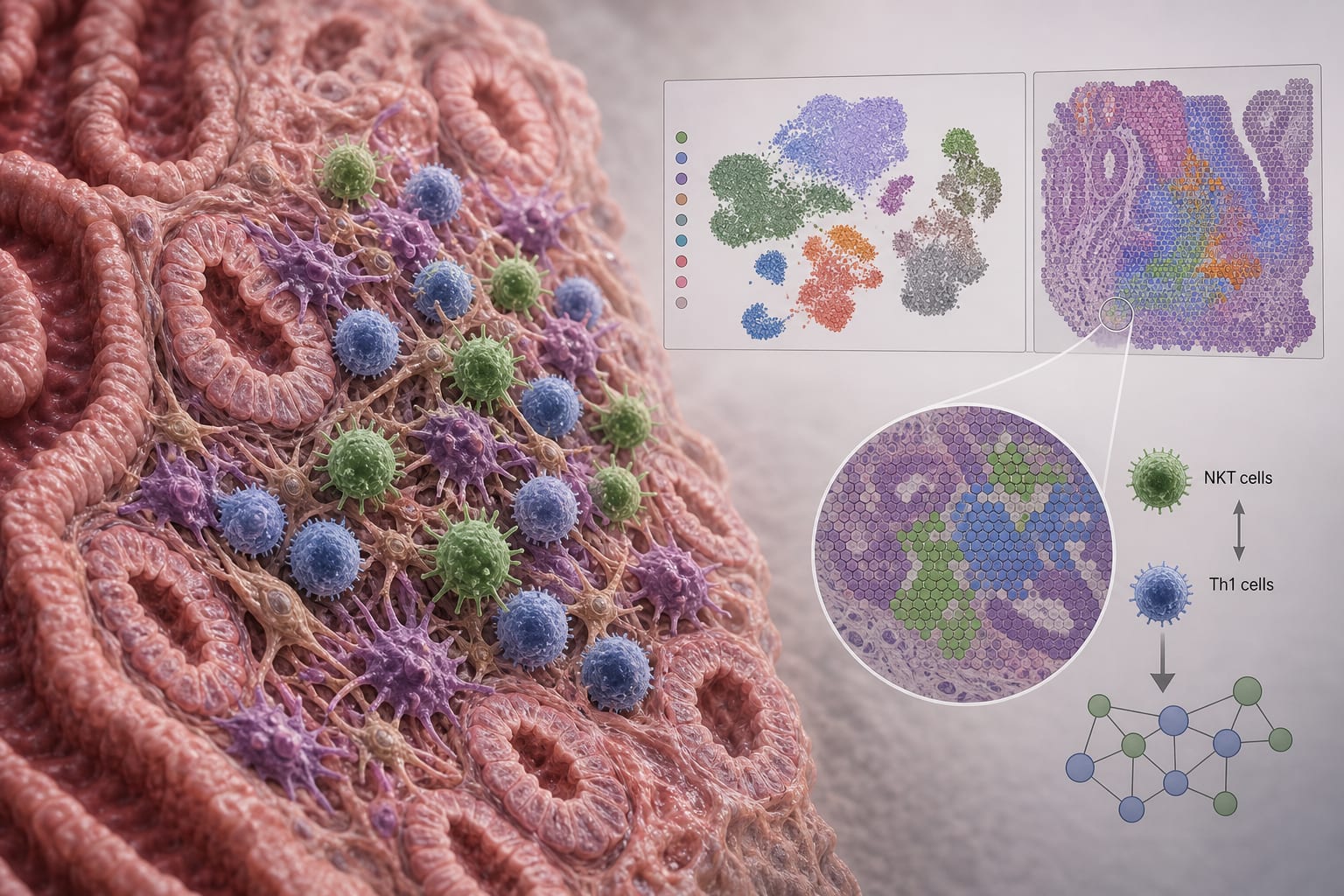
Integrated single-cell and spatial transcriptomics reveal immune landscape and NKT–Th1 signatures in colorectal cancer
-
By
-
Cunen Wu
-
Yuanyuan Xu
-
Ming Zhao
-
Lihuiping Tao
-
Dayue Darrel Duan
-
Jun Qian
-
Shumin Zhao
-
Shenlin Liu
-
Jin-yong Zhou
-
June 10, 2026
-
Clinical Scorecard: Combined Single-Cell and Spatial Transcriptomics Uncover Immune Profiles and NKT–Th1 Signatures in Colorectal Cancer
At a Glance
| Category | Detail |
|---|
| Condition | |
| Key Mechanisms | NKT cell infiltration and Th1 cell interaction. |
| Target Population | Patients with colorectal cancer, particularly those with microsatellite stable (MSS) and mismatch repair proficient (pMMR) tumors. |
| Care Setting | |
Key Highlights
- Elevated NKT cell infiltration observed in CRC tissues.
- The NTRG score quantifies tumor–immune properties.
- High NTRG scores linked with overall survival and immunotherapy response.
- NKT and Th1 cells co-localize in CRC tissues.
- Differential NTRG expression observed between normal and cancerous tissues.
Guideline-Based Recommendations
Diagnosis
- Assess NKT cell infiltration and NTRG score.
Management
- Consider immunotherapy options for patients with elevated NKT cell infiltration.
Monitoring & Follow-up
- Monitor NTRG score and immune cell profiles.
Risks
- High NTRG scores may correlate with overall survival outcomes.
Patient & Prescribing Data
Colorectal adenocarcinoma patients, particularly those with MSS and pMMR.
Immunotherapy may be more effective in patients with elevated NKT cell infiltration.
Clinical Best Practices
- Integrate single-cell and spatial transcriptomics for immune profiling in CRC.
- Utilize NTRG score as a biomarker for immunotherapy response.
Related Resources & Content