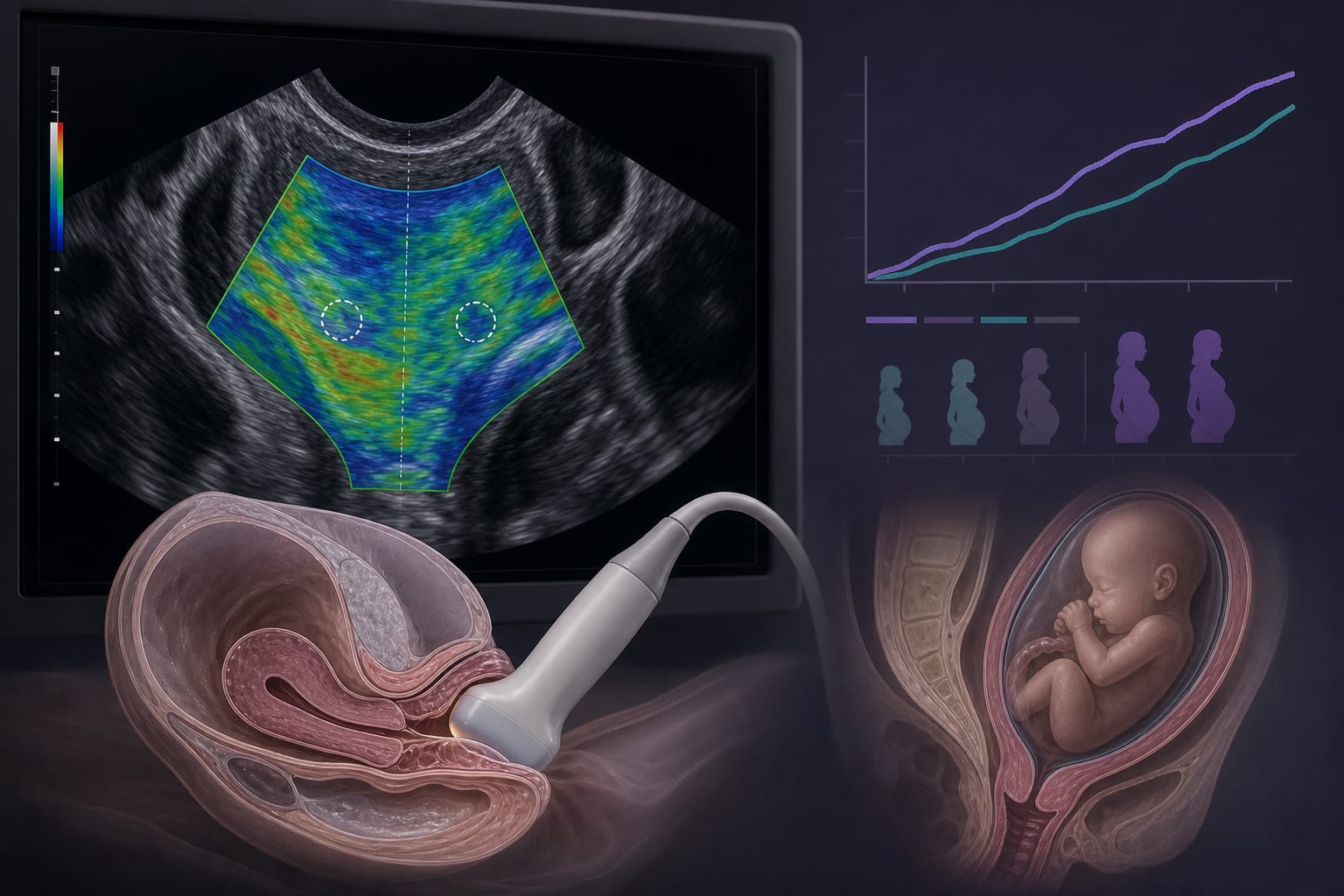
Cervical strain elastography improves mid-trimester prediction of spontaneous preterm birth beyond cervical length: a single-center cohort study
-
By
-
Dongmei Zhang
-
Li Hou
-
Chunrong Li
-
Shiyue Peng
-
Liuying Zhou
-
Tongyong Luo
-
June 17, 2026
-
Clinical Scorecard: Enhancing Mid-Trimester Prediction of Spontaneous Preterm Birth Through Cervical Strain Elastography Beyond Cervical Length: Findings from a Single-Center Cohort Investigation
At a Glance
| Category | Detail |
|---|
| Condition | Spontaneous Preterm Birth (sPTB) |
| Key Mechanisms | Cervical strain elastography parameters (hardness ratio, internal os strain, external os strain, IOS/EOS ratio) combined with cervical length. |
| Target Population | Singleton pregnancies at 18 + 0 to 23 + 6 weeks of gestation. |
| Care Setting | Single-center cohort study in obstetrics. |
Key Highlights
- sPTB occurred in 13.5% of participants (37 of 275 women).
- IOS showed the best discrimination for sPTB with an AUC of 0.797.
- Combining CL with IOS/EOS achieved an AUC of 0.828.
- The combined model demonstrated a sensitivity of 73% and specificity of 82%.
- Decision curve analysis indicated superior net benefit for the combined model.
Guideline-Based Recommendations
Diagnosis
- Use cervical length (CL) and cervical strain elastography parameters for predicting sPTB.
Management
- Consider combined models of CL and elastography for improved risk stratification.
Monitoring & Follow-up
- Monitor cervical strain elastography metrics alongside CL in mid-trimester assessments.
Risks
- sPTB remains a leading cause of neonatal morbidity and mortality.
Patient & Prescribing Data
Asymptomatic women with singleton pregnancies.
Cervical strain elastography may enhance prediction of sPTB beyond traditional methods.
Clinical Best Practices
- Incorporate cervical strain elastography in routine mid-trimester assessments.
- Utilize combined models for better predictive accuracy in sPTB risk.
Related Resources & Content