Comparison of ultrasound-guided percutaneous radiofrequency ablation and reoperation for nerve-adjacent cervical lymph node recurrence of papillary thyroid carcinoma: a propensity score–matched study - Scorecard - MDSpire
Advertisement
Comparison of ultrasound-guided percutaneous radiofrequency ablation and reoperation for nerve-adjacent cervical lymph node recurrence of papillary thyroid carcinoma: a propensity score–matched study
Clinical Scorecard: Evaluation of Ultrasound-Guided Percutaneous Radiofrequency Ablation Versus Surgical Reoperation for Recurrence of Papillary Thyroid Carcinoma in Proximal Cervical Lymph Nodes: A Propensity Score-Matched Analysis
At a Glance
Category
Detail
Condition
Recurrent Papillary Thyroid Carcinoma with Solitary Cervical Lymph Node Metastasis
Key Mechanisms
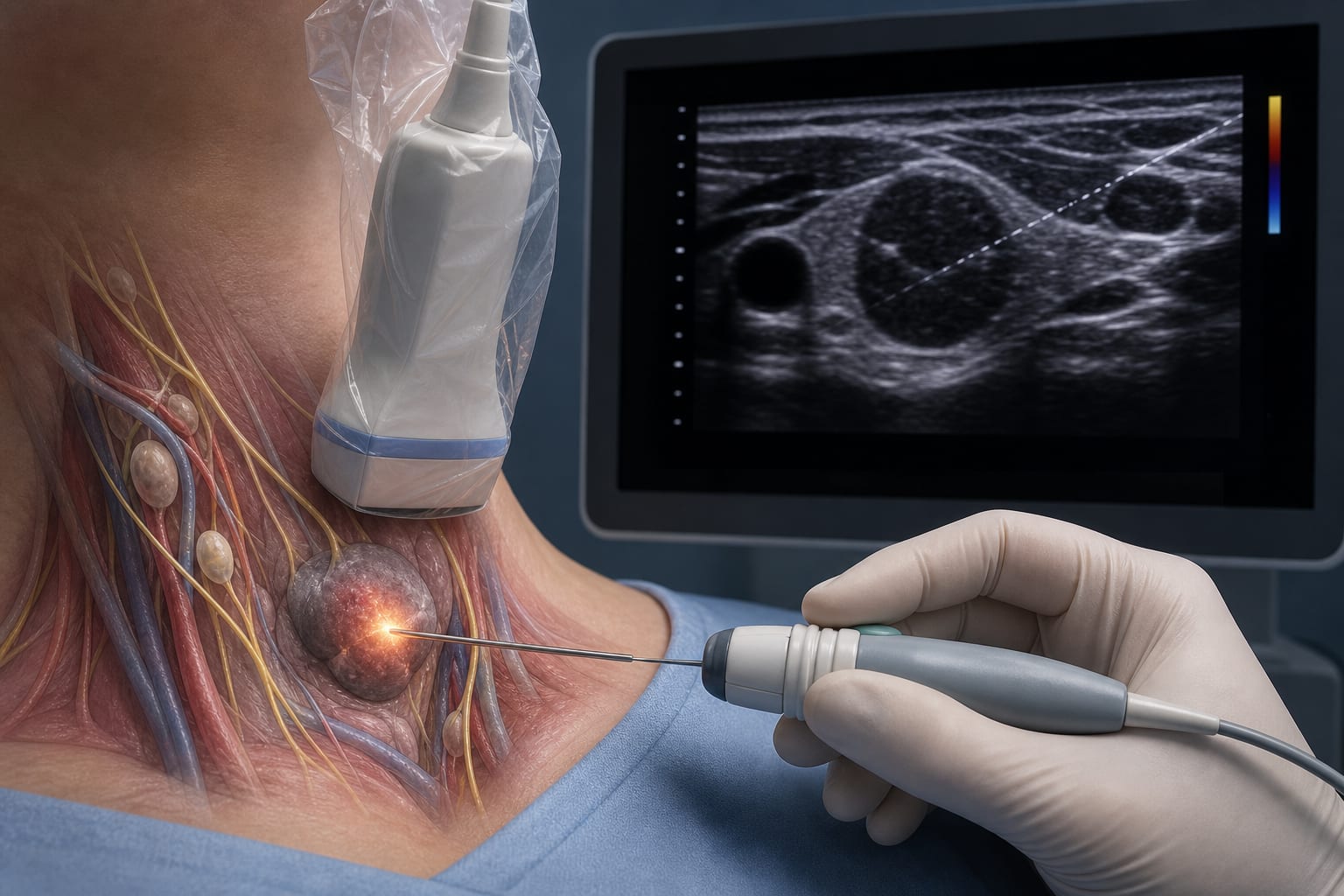
Ultrasound-guided percutaneous radiofrequency ablation (RFA) vs. surgical reoperation (RO)
Target Population
Patients with recurrent papillary thyroid carcinoma in perineural regions
Care Setting
Retrospective study at Fujian Provincial Hospital
Key Highlights
RFA showed a mean volume reduction ratio of 0.97 ± 0.04 at 24 months.
42.3% of metastatic lymph nodes in the RFA group completely disappeared.
RFA had significantly lower overall complication rates compared to RO (P<0.001).
RFA associated with shorter procedure time, hospital stay, and less intraoperative blood loss.
Subgroup analysis indicated safety differences were most evident in Type II lesions.
Guideline-Based Recommendations
Diagnosis
Diagnosis of recurrent papillary thyroid carcinoma confirmed through imaging and biopsy.
Management
Consider RFA as a minimally invasive option for patients unsuitable for or unwilling to undergo reoperation.
Monitoring & Follow-up
Follow-up for local recurrence and complications post-treatment.
Risks
Potential for nerve injury and complications associated with surgical reoperation.
Patient & Prescribing Data
Patients with recurrent papillary thyroid carcinoma in cervical perineural regions.
RFA provides a low-trauma treatment option with faster recovery.
Clinical Best Practices
Careful selection of patients for RFA based on lesion visibility and safety of hydrodissection.
Utilization of ultrasound guidance for precise needle placement during RFA.