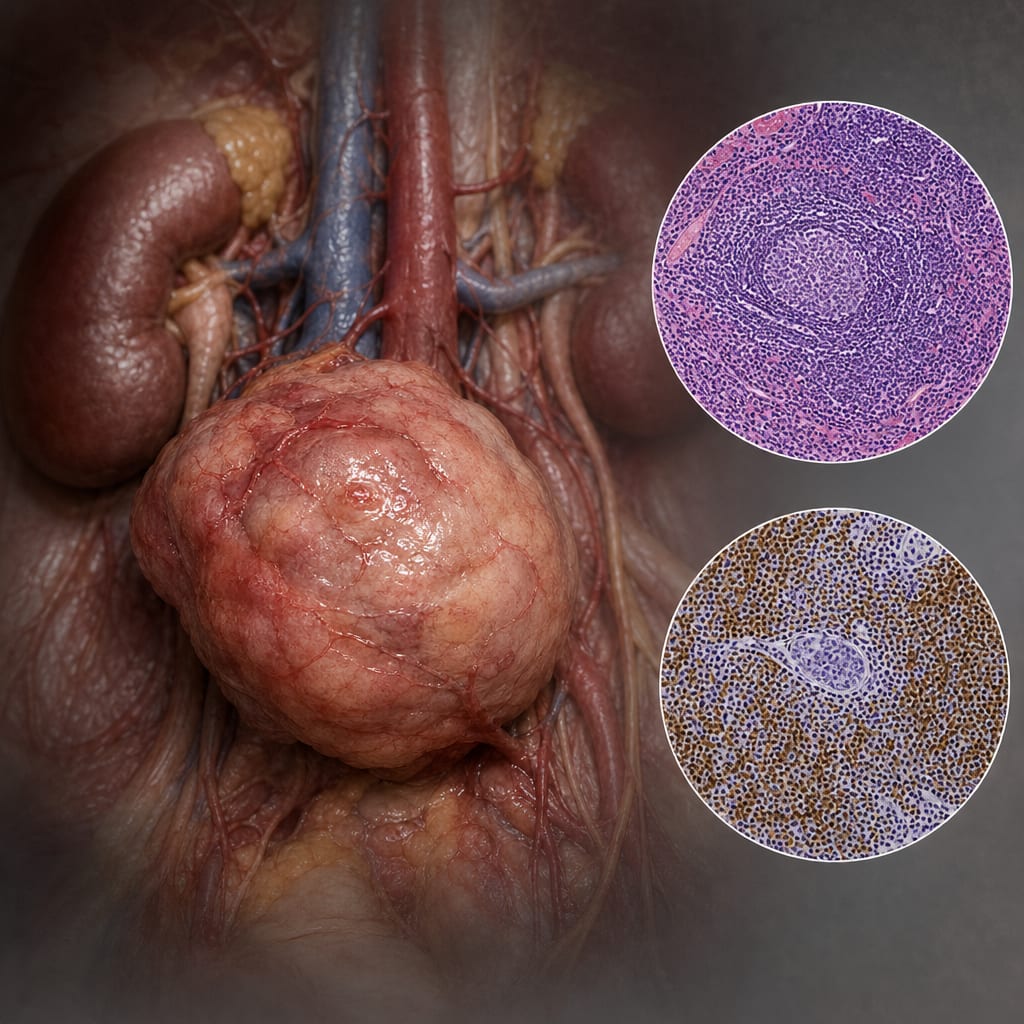
Clinical Scorecard: Clinical Case Study: An Uncommon Instance of Unicentric Castleman Disease with Mixed Features in the Retroperitoneum
At a Glance
Category
Detail
Condition
Key Mechanisms
Benign lymphoproliferative disorder characterized by lymphoid tissue hyperplasia, with specific histopathological features such as expanded follicular mantles and interfollicular plasma cell infiltrate.
Target Population
Care Setting
Key Highlights
Rare presentation of mixed type unicentric Castleman disease in the retroperitoneum.
Diagnosis confirmed through postoperative pathological examination.
Laparoscopic resection resulted in uncomplicated postoperative recovery.
Immunohistochemical staining was crucial for definitive diagnosis.
Guideline-Based Recommendations
Diagnosis
Preoperative diagnosis can be challenging; definitive diagnosis often requires pathological analysis.
Utilize imaging studies (CT/MRI) for better preoperative assessment.
Management
Monitoring & Follow-up
Risks
Patient & Prescribing Data
Adults, particularly those presenting with retroperitoneal masses.
Surgical resection is the primary treatment modality for localized unicentric Castleman disease.
Clinical Best Practices
Conduct thorough imaging studies (CT/MRI) for accurate assessment of retroperitoneal masses.
Utilize immunohistochemical staining for definitive diagnosis post-surgery.
Consider differential diagnoses such as teratomas, lymphomas, and other retroperitoneal masses.