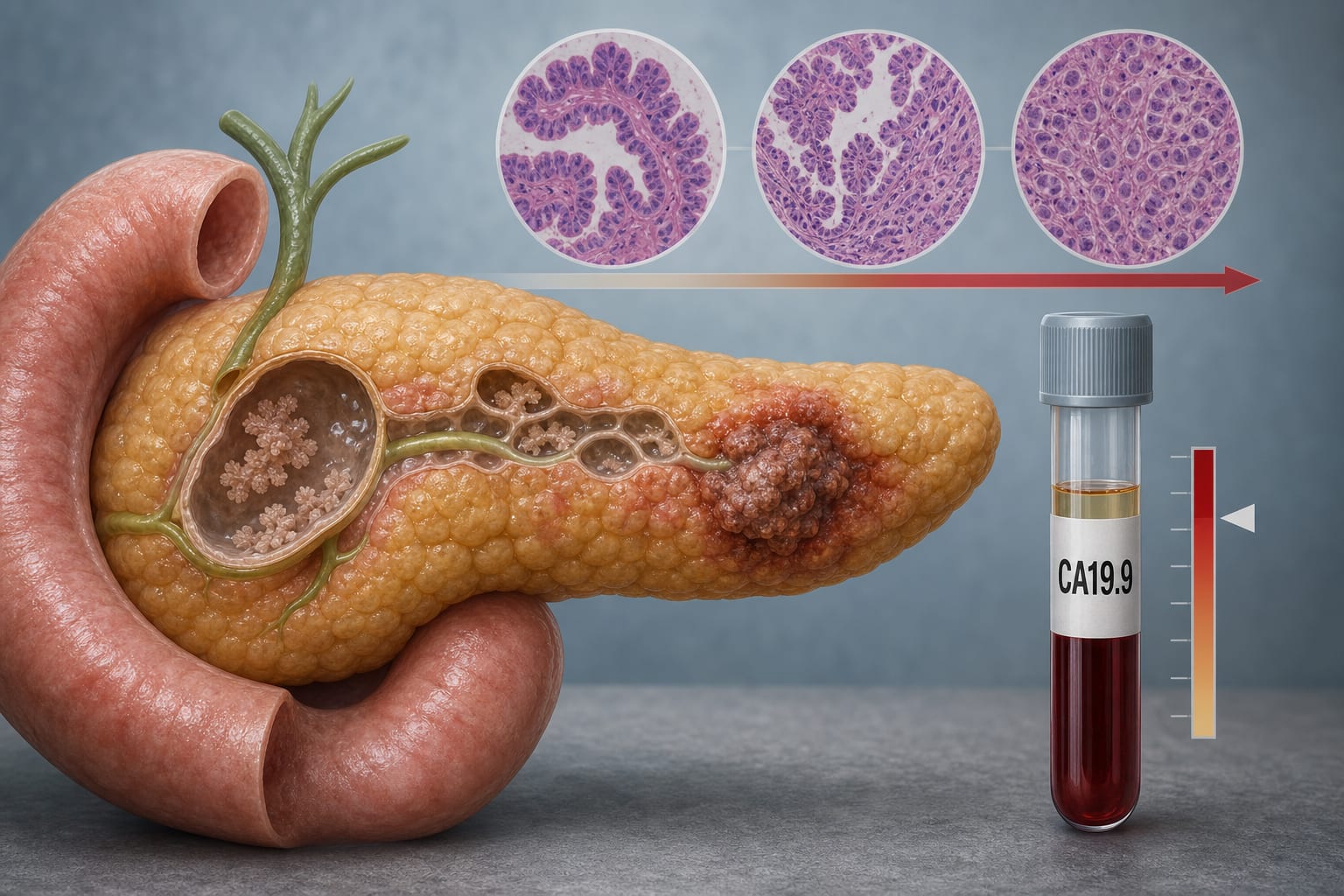
Serum CA19.9 for Detecting High-Grade Dysplasia and Invasive Carcinoma in Patients With Intraductal Papillary - Scorecard - MDSpire

Serum CA19.9 for Detecting High-Grade Dysplasia and Invasive Carcinoma in Patients With Intraductal Papillary

  • By

  • Charlotte A. Leseman

  • Alessandro M. Bonomi

  • Job Schuitema

  • Stefano Granieri

  • Margaret Sällberg Chen

  • Ajay V. Maker

  • Zeeshan Ateeb

  • Laura D. Wood

  • Rogier P. Voermans

  • Giovanni Marchegiani

  • Marco Del Chiaro

  • Johannes C. F. Ket

  • Anne Marie Lennon

  • Marc G. Besselink

  • Global Evidence-Based Guidelines for the Management of Pancreatic Cystic Neoplasms Group

  • June 26, 2026

  • 0 min

Share

Clinical Scorecard: Evaluating Serum CA19.9 Levels for Identifying High-Grade Dysplasia and Invasive Carcinoma in Individuals with Intraductal Papillary Neoplasms

At a Glance

CategoryDetail
ConditionIntraductal Papillary Mucinous Neoplasm (IPMN)
Key MechanismsSerum CA19.9 levels may indicate progression to high-grade dysplasia (HGD) or invasive carcinoma (IC).
Target PopulationPatients with IPMN undergoing surgical resection.
Care SettingClinical decision-making in the context of pancreatic cystic neoplasms.

Key Highlights

  • CA19.9 levels ≥37 U/mL are considered a relative indication for surgery.
  • Elevated CA19.9 levels are defined as a worrisome feature in IPMN management.
  • The role of CA19.9 in IPMN diagnosis is controversial due to biological heterogeneity.

Guideline-Based Recommendations

Diagnosis

  • Routine assessment of serum CA19.9 during diagnostic workup for IPMN.

Management

  • Consider surgical intervention for patients with elevated CA19.9 levels.

Monitoring & Follow-up

  • Monitor CA19.9 levels in patients with IPMN to assess risk of progression.

Risks

  • Current recommendations are based on retrospective studies, which may introduce selection bias.

Patient & Prescribing Data

Adult patients diagnosed with IPMN who are candidates for surgical resection.

CA19.9 levels can aid in identifying patients at risk for HGD or IC.

Clinical Best Practices

  • Utilize CA19.9 levels as part of a comprehensive diagnostic approach for IPMN.
  • Consider the biological variability of IPMN when interpreting CA19.9 results.

Related Resources & Content

Original Source(s)

Related Content