Editorial: Advances in Targeted Nanomaterial-Based Drug Delivery
-
By
-
Mandeep Kaur Marwah
-
November 20, 2026
Clinical Scorecard: Editorial: Advances in Targeted Nanomaterial-Based Drug Delivery
At a Glance
| Category | Detail |
|---|---|
| Condition | Clinical topic addressed by the source article: Editorial |
| Key Mechanisms | Mechanisms or clinical associations described in the source article. |
| Target Population | Patients or participants described in the source article. |
| Care Setting | Preclinical formulation, storage, and in vitro research; the collection includes formulation studies and cell-based testing, with translational potential discussed. |
Key Highlights
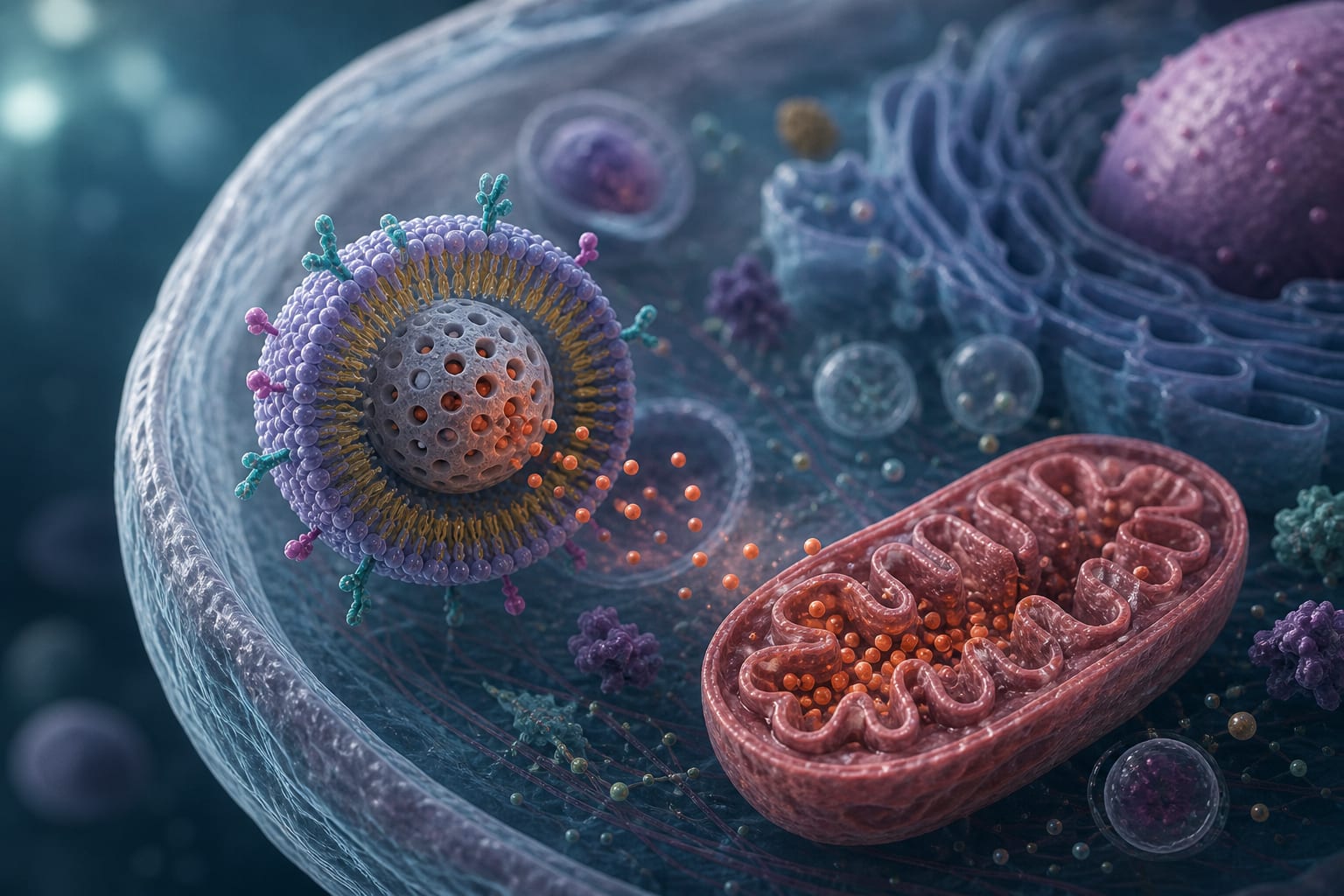
- The collection covers nanomaterial design, cell- and organelle-specific delivery, and carrier stability, biocompatibility, biological interactions, and toxicity.
- Mitochondrial delivery faces barriers including reticuloendothelial-system clearance, endosomal escape, and passage across mitochondrial membranes.
- Mesoporous silica loading varied by drug and solvent: octreotide recovery reached 71%, while albumin recovery reached a maximum of 32%.
- Cefdinir silica formulations retained more than 95% of drug content and remained amorphous under tested storage conditions, while dissolving more slowly than the other formulations.
- The withaferin A liposomal gel showed slower release than solution or plain gel and reduced IL-6 secretion and intracellular reactive oxygen species in stimulated cells, as reported in the available source excerpt.
Guideline-Based Recommendations
Diagnosis
Management
- The mitochondrial-targeting review discusses mitochondria-penetrating peptides, triphenylphosphonium cations, and nanocarrier-based approaches.
- The mesoporous silica review discusses PEGylation, targeting ligands, stimulus-triggered release, and photodynamic approaches.
- The cefdinir formulation study used Hansen solubility parameters and Flory–Huggins theory to inform excipient selection.
- In the tested SYLOID tablet formulations, a binder and superdisintegrant were required to meet pharmacopoeial limits for both friability and disintegration.
Monitoring & Follow-up
- The carbon quantum dot review identifies batch variability, limited long-term toxicity and biodistribution evidence, and lack of standardised characterisation as translational barriers.
- The article states that further ex vivo permeation and retention studies are needed for the withaferin A liposomal gel.
Risks
- The source notes that oral proteins may be degraded by gastric acid and intestinal enzymes; silica protects protein located within its pores, not protein adsorbed on the surface.
- Accelerated humid storage caused recrystallisation and an approximately 50% reduction in cefdinir content over 6 months for the solid dispersion and co-amorphous formulations.
- SYLOID fragmented under pressure rather than forming tablets; increasing silica content increased porosity while reducing tensile strength and slowing disintegration.
- The carbon quantum dot review notes limited long-term evidence on toxicity and biodistribution.
Patient & Prescribing Data
No patient population or clinical prescribing data are reported.
The described work concerns preclinical formulations and in vitro testing. The article does not report clinical efficacy, dosing, or prescribing recommendations.
Clinical Best Practices
- The collection examines carrier loading, stability, release, biocompatibility, toxicity, and biological interactions in relation to translational potential.
- The octreotide and albumin study reports that loading varied with protein size and solvent viscosity; albumin aggregated in alcohols and remained predominantly at the particle surface.
- The formulation studies report trade-offs involving dissolution, storage stability, tablet strength, porosity, and disintegration.
- The source describes the collection as including formulation research and in vitro testing; it does not report clinical efficacy or prescribing recommendations.
Related Resources & Content
Based on findings from:
Editorial: Insights into targeting nanomaterials for drug delivery
Mandeep Kaur Marwah. British Journal Of Biomedical Science, 2026.
https://www.frontierspartnerships.org/journals/british-journal-of-biomedical-science/articles/10.3389/bjbs.2026.18080/full
This content is an AI-generated, fully rewritten summary based on a published scholarly article. It does not reproduce the original text and is not a substitute for the original publication. Readers are encouraged to consult the source for full context, data, and methodology.