Individualized physiological readiness over an admission-time denominator - a reply to comments on rapid sequence versus early surgical stabilization of severe chest wall injuries - Scorecard - MDSpire
Conexiant’s news site is now MDSpire News. Learn more
Advertisement
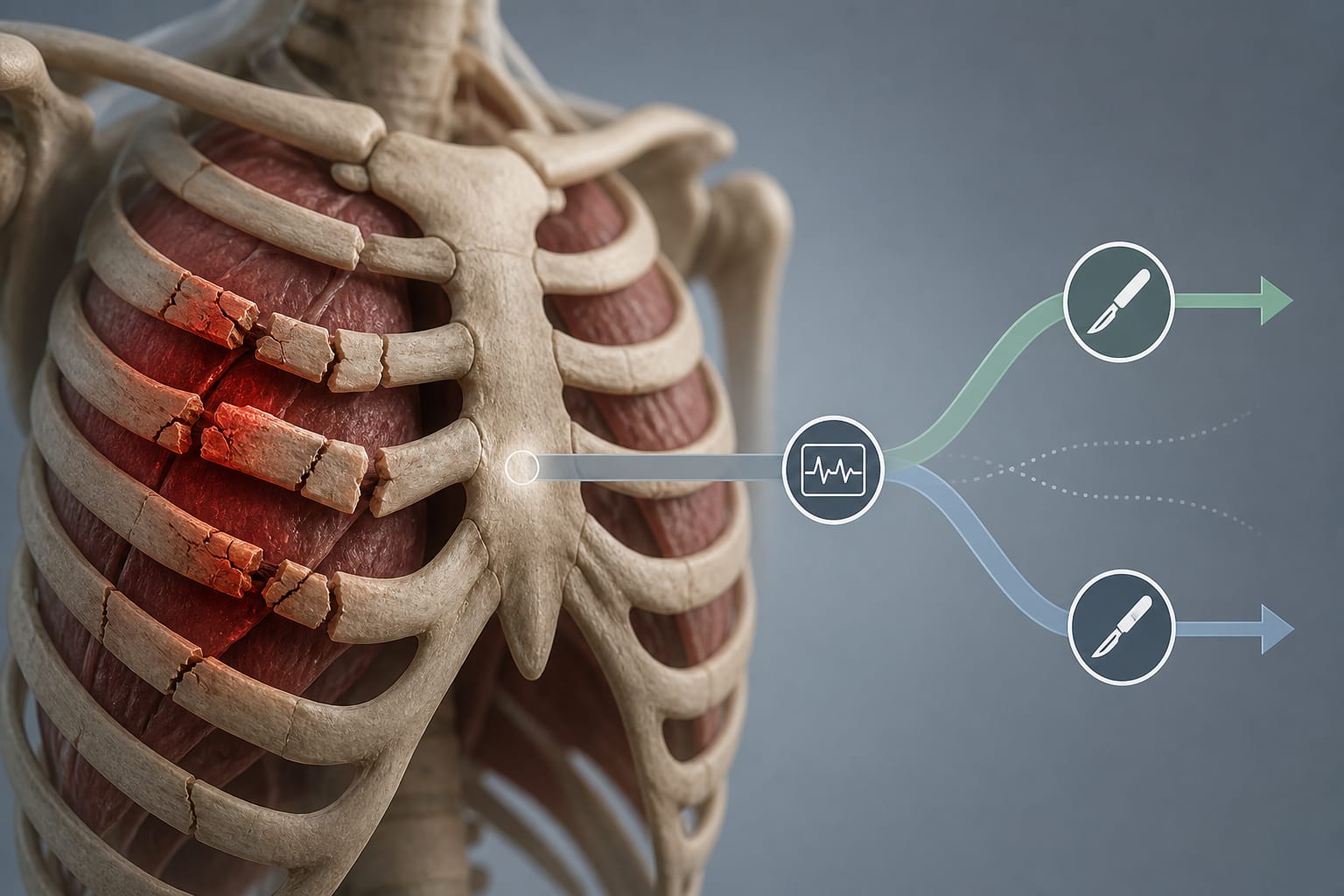
Tailored Physiological Readiness Based on Admission Timing - A Response to Discussions on Rapid Sequence Versus Early Surgical Stabilization for Severe Chest Wall Injuries
Clinical Scorecard: Tailored Physiological Readiness Based on Admission Timing - A Response to Discussions on Rapid Sequence Versus Early Surgical Stabilization for Severe Chest Wall Injuries
At a Glance
Category
Detail
Condition
Severe Chest Wall Injuries
Key Mechanisms
Operative intent and physiological readiness are critical for determining timing of chest wall reconstruction (CWR).
Target Population
Patients with severe chest wall injuries requiring surgical intervention.
Care Setting
Trauma care and surgical stabilization settings.
Key Highlights
Day-0 CWR is associated with a sicker patient phenotype requiring immediate intervention.
Survivorship bias affects comparisons between Day-0 and delayed CWR.
Existing registries lack the capability to accurately define CWR eligibility and timing.
Physiological readiness must be assessed individually, considering life-threatening concomitant injuries.
Guideline-Based Recommendations
Diagnosis
Assess physiological readiness and operative intent at admission.
Management
CWR should be individualized based on patient stability and injury burden.
Monitoring & Follow-up
Utilize surrogate measures for assessing complex conditions like massive bleeding.
Risks
Consider the risk of confounding by indication and survivorship bias in retrospective analyses.
Patient & Prescribing Data
Patients with severe chest wall injuries requiring surgical intervention.
CWR within approximately 72 hours is generally beneficial when indicated.
Clinical Best Practices
Implement rigorous methods like propensity score matching to account for confounding.
Avoid arbitrary timing targets; focus on physiological stability.