Accuracy of Artificial Intelligence in Diagnosing Obstructive Sleep Apnea Using Photoplethysmography: Systematic Review and Meta-Analysis - Scorecard - MDSpire
Clinical Scorecard: Evaluating the Precision of AI in Diagnosing Obstructive Sleep Apnea Through Photoplethysmography: A Systematic Review and Meta-Analysis
At a Glance
Category
Detail
Condition
Obstructive Sleep Apnea (OSA)
Key Mechanisms
Recurrent partial or complete collapse of the upper airway during sleep leading to reduced or absent airflow.
Target Population
Adults aged 18 years or older.
Care Setting
Clinical diagnostics utilizing AI and photoplethysmography.
Key Highlights
AI models are increasingly evaluated as substitutes for traditional polysomnography in diagnosing OSA.
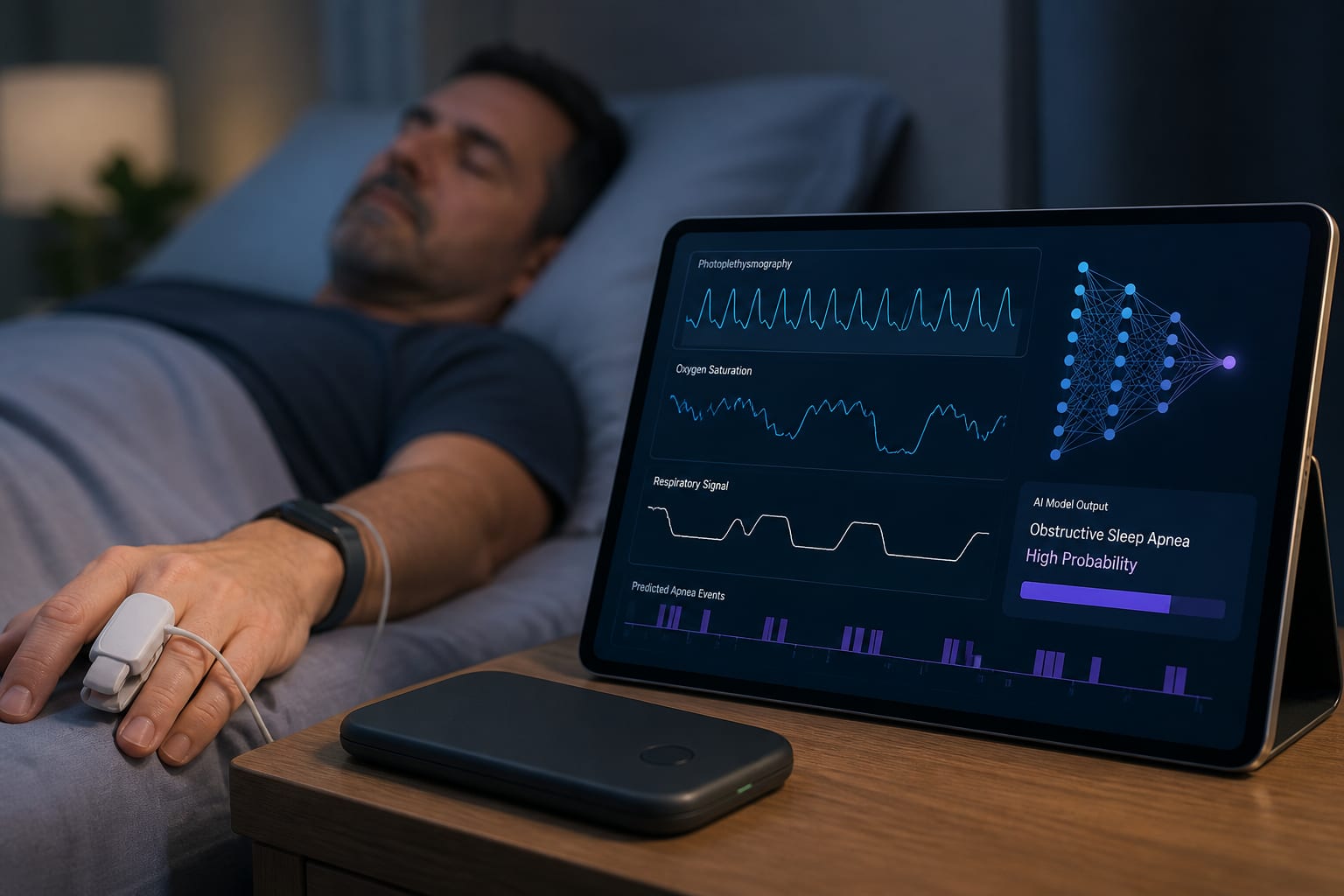
Photoplethysmography (PPG) is a noninvasive, cost-effective method for measuring blood oxygen saturation.
Existing studies show divergent views on the accuracy of AI-based OSA diagnosis using PPG.
The systematic review aims to synthesize evidence on the diagnostic accuracy of AI models using PPG.
The study adheres to PRISMA guidelines for systematic reviews.
Guideline-Based Recommendations
Diagnosis
Diagnosis can involve home-based or laboratory-based sleep testing.
Polysomnography (PSG) is regarded as the gold standard diagnostic tool.
Management
Monitoring & Follow-up
Risks
High operating costs and restricted outpatient accessibility limit the use of PSG.
Patient & Prescribing Data
Adults diagnosed with obstructive sleep apnea.
AI-based methods for OSA diagnosis are being explored for their effectiveness.
Clinical Best Practices
Utilize established testing approaches for OSA diagnosis, including PSG and home sleep apnea testing.
Consider AI models trained on diverse data sources for improved diagnostic accuracy.
by Brian Sheng Yep Yeo, Esther Yanxin Gao, Joan Ern Xin Tan, Jun Yuan Koo, Yi Siang Lee, Nicole Kye Wen Tan, Adele Chin Wei Ng, Zhou Hao Leong, Thun How Ong, Leong Chai Leow, Guang-Bin Huang, Benjamin Kye Jyn Tan, Song Tar Toh
In adults diagnosed with pulmonary arterial hypertension within the previous year, adding sotatercept to background therapy reduced the risk of clinical worsening events by 76% compared with placebo.