Three-Year Efficacy and Safety of Lebrikizumab in Patients with Moderate-to-Severe Atopic Dermatitis: A Long-Term Extension (ADjoin) - Scorecard - MDSpire
Clinical Scorecard: Long-Term Efficacy and Safety of Lebrikizumab in Moderate-to-Severe Atopic Dermatitis Patients: Results from a Three-Year Extension Study (ADjoin)
At a Glance
Category
Detail
Condition
Atopic Dermatitis (AD)
Key Mechanisms
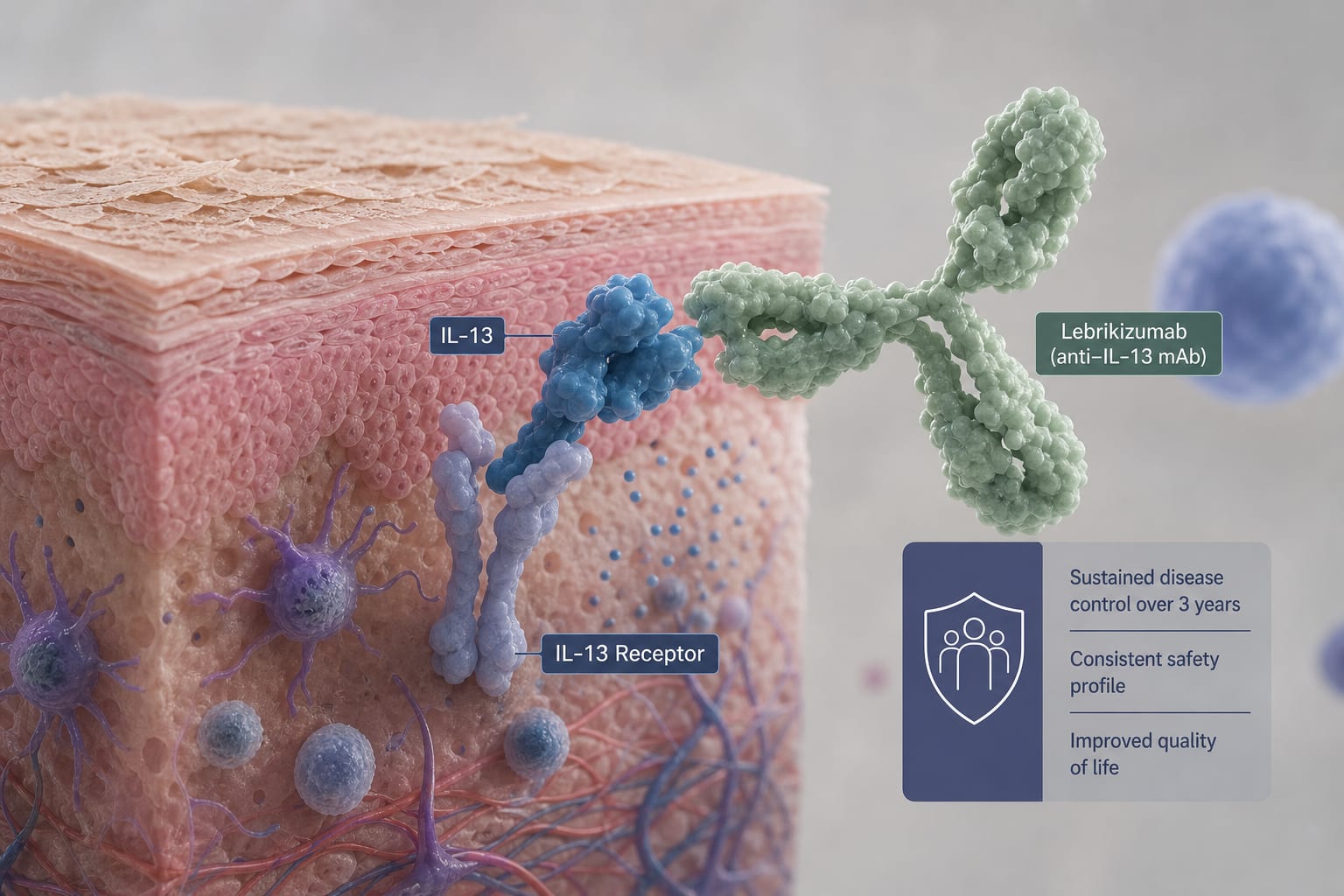
Lebrikizumab is a monoclonal antibody that binds to interleukin (IL)-13, blocking its downstream effects.
Target Population
Adults and adolescents 12 years and older with moderate-to-severe AD.
Care Setting
Clinical trials and long-term treatment settings.
Key Highlights
Lebrikizumab demonstrated durable improvement in AD symptoms through 3 years.
Safety profile consistent with previously reported data.
Long-term treatment supports disease control and quality of life improvement.
Guideline-Based Recommendations
Diagnosis
Diagnosis of moderate-to-severe AD based on clinical criteria.
Management
Lebrikizumab is recommended as a treatment option for moderate-to-severe AD.
Monitoring & Follow-up
Monitor for efficacy and safety during long-term treatment.
Risks
Potential for uncontrolled AD in patients not achieving sustained long-term clinical benefit.
Patient & Prescribing Data
Patients with moderate-to-severe AD who have previously completed specific studies.
Lebrikizumab is effective for long-term management of AD symptoms.
Clinical Best Practices
Consider lebrikizumab for patients who have not achieved adequate control with other therapies.
Assess patient response at week 16 to determine eligibility for continued treatment.
by Emma Guttman-Yassky, Alan D. Irvine, Melinda Gooderham, Stephan Weidinger, Lynda Spelman, Jonathan I. Silverberg, Heidi Crane, Hany ElMaraghy, Louise DeLuca-Carter, Maria Lucia Buziqui Piruzeli, Georgia Martimianaki, Evangeline Pierce, Helena Agell, Diamant Thaçi