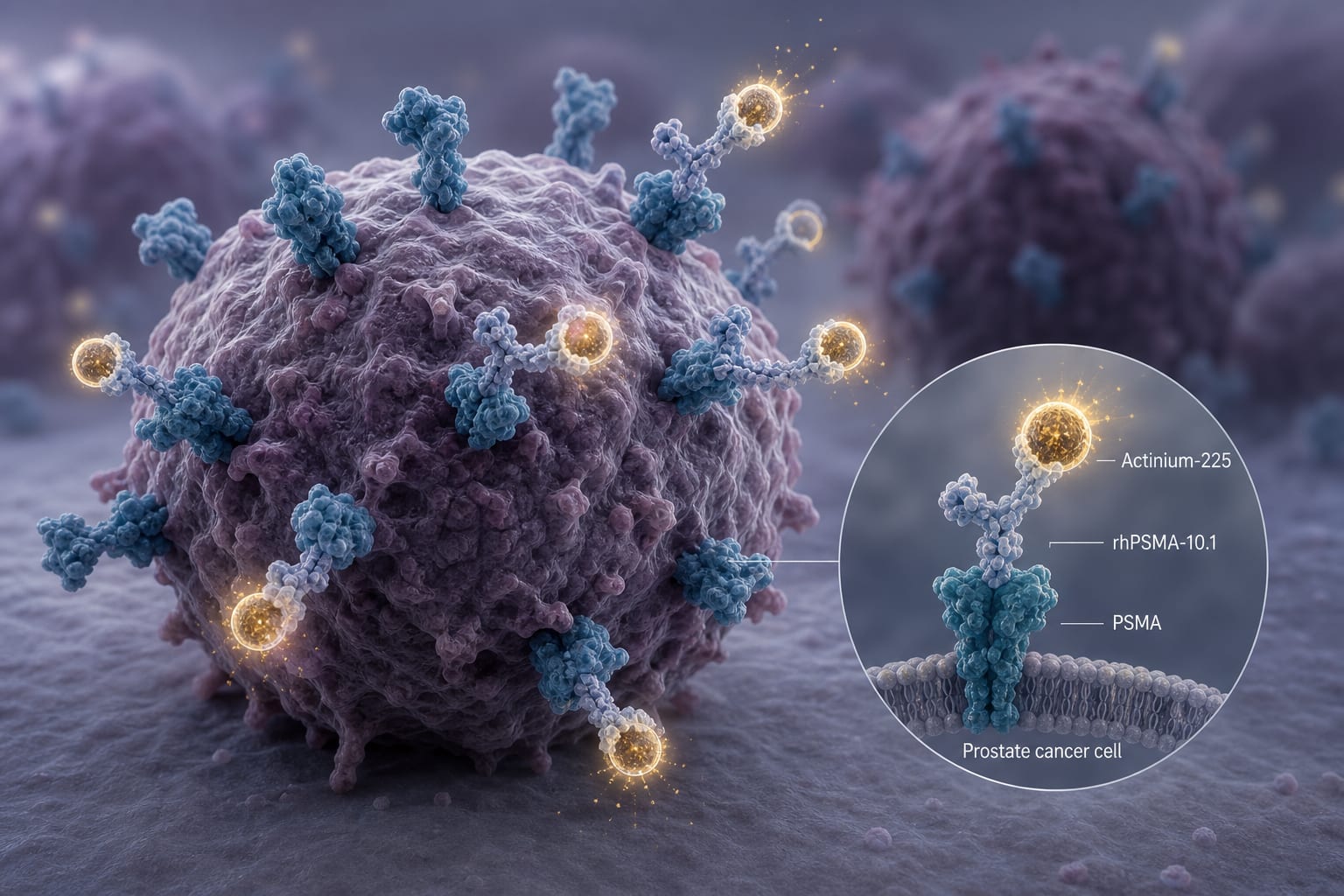
Actinium-225-rhPSMA-10.1 as a novel, alpha-particle-emitting therapy for prostate cancer: results of a preclinical evaluation
By
Caroline Foxton
Bradley Waldron
Alexander Wurzer
Calogero D’Alessandria
Alfred Morgenstern
Frank Bruchertseifer
Tea Kirkegaard Nielsen
Rikke Veggerby Grønlund
Mathias Wikke Hallund
Daniel J. Stevens
July 16, 2026
Clinical Scorecard: Evaluation of Actinium-225-rhPSMA-10.1 as a New Alpha-Particle Therapy for Prostate Cancer: Findings from Preclinical Studies
At a Glance
Category Detail
Condition Prostate Cancer Key Mechanisms Alpha-particle-emitting, PSMA-targeted radiopharmaceutical therapy Target Population Patients with metastatic castration-resistant prostate cancer (mCRPC) Care Setting Preclinical assessment of radiopharmaceutical therapies
Key Highlights
[225Ac]Ac-rhPSMA-10.1 significantly reduced tumor growth and prolonged survival in preclinical models. In vitro profiles of [225Ac]Ac-rhPSMA-10.1 and [177Lu]Lu-rhPSMA-10.1 were similar. Both radiopharmaceuticals were well tolerated with no significant differences in efficacy. Guideline-Based Recommendations
Diagnosis
Evaluate PSMA expression in prostate cancer for targeted therapy. Management
Consider PSMA-targeted radiopharmaceutical therapy for mCRPC. Monitoring & Follow-up
Monitor tumor growth and patient survival following treatment. Risks
Assess potential radiation exposure and side effects from alpha-particle therapy. Patient & Prescribing Data
Men with metastatic castration-resistant prostate cancer (mCRPC)
Both [225Ac]Ac-rhPSMA-10.1 and [177Lu]Lu-rhPSMA-10.1 show promise, with ongoing investigations into their comparative efficacy.
Clinical Best Practices
Utilize PSMA-targeted therapies in patients with confirmed PSMA expression. Conduct thorough preclinical evaluations before clinical application. Related Resources & Content