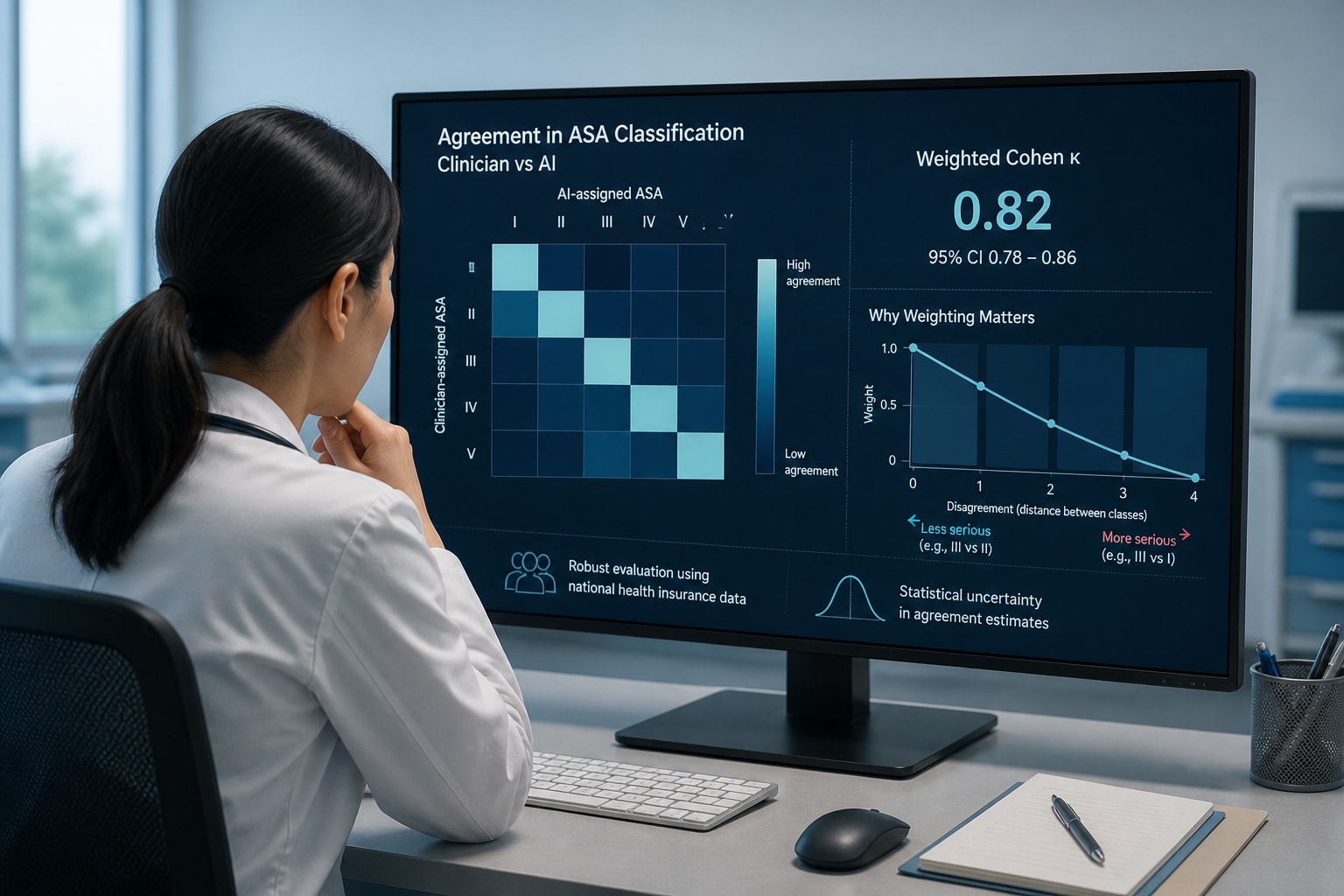
Understanding Agreement Between AI and Clinicians in American Society of Anesthesiologists (ASA) Classification
-
By
-
Hakan Emirkadı
-
October 21, 2026
Clinical Scorecard: Understanding Agreement Between AI and Clinicians in American Society of Anesthesiologists (ASA) Classification
At a Glance
| Category | Detail |
|---|---|
| Condition | Clinical topic addressed by the source article: Understanding Agreement Between AI and Clinicians in American Society of Anesthesiologists (ASA) Classification |
| Key Mechanisms | Mechanisms or clinical associations described in the source article. |
| Target Population | The study included 600 patients. The source reports 498 classified as ASA II, 57 as ASA III, and 6 as ASA IV; these counts do not account for all 600 patients. |
| Care Setting | Preanesthetic evaluation; the article discusses relevance to perioperative risk assessment. |
Key Highlights
- The cited study reported high agreement between clinicians and a GPT-4o-powered preanesthetic AI system.
- The report does not specify whether its Cohen κ estimate was weighted.
- The report does not present patient-level cross-tabulation, so the distribution and severity of classification disagreements are unclear.
- κ increased from 0.518 without Taiwan NHI data to 0.883 with NHI data, a reported difference of 0.365.
- No confidence interval or other uncertainty measure was provided for the difference in κ estimates from the same 600 patients.
Guideline-Based Recommendations
Diagnosis
- The article discusses ASA physical status classification and agreement between clinician and AI assignments; it does not provide diagnostic guidelines.
Management
- The article does not provide treatment or management recommendations.
Monitoring & Follow-up
Risks
Patient & Prescribing Data
The study included 600 patients; clinician-assigned classifications included 498 ASA II, 57 ASA III, and 6 ASA IV.
No prescribing or treatment data are reported. The article evaluates AI–clinician classification agreement, including comparisons with and without Taiwan NHI data.
Clinical Best Practices
Related Resources & Content
- Lin et al. GPT-4o-powered preanesthetic AI: development and validation study
- Cohen J. Weighted kappa: nominal scale agreement with provision for scaled disagreement or partial credit
Based on findings from:
Interpreting Agreement in AI-Assisted American Society of Anesthesiologists (ASA) Classification
Hakan Emirkadı. Jmir Medical Informatics, 2026.
https://medinform.jmir.org/2026/1/e111973
This content is an AI-generated, fully rewritten summary based on a published scholarly article. It does not reproduce the original text and is not a substitute for the original publication. Readers are encouraged to consult the source for full context, data, and methodology.