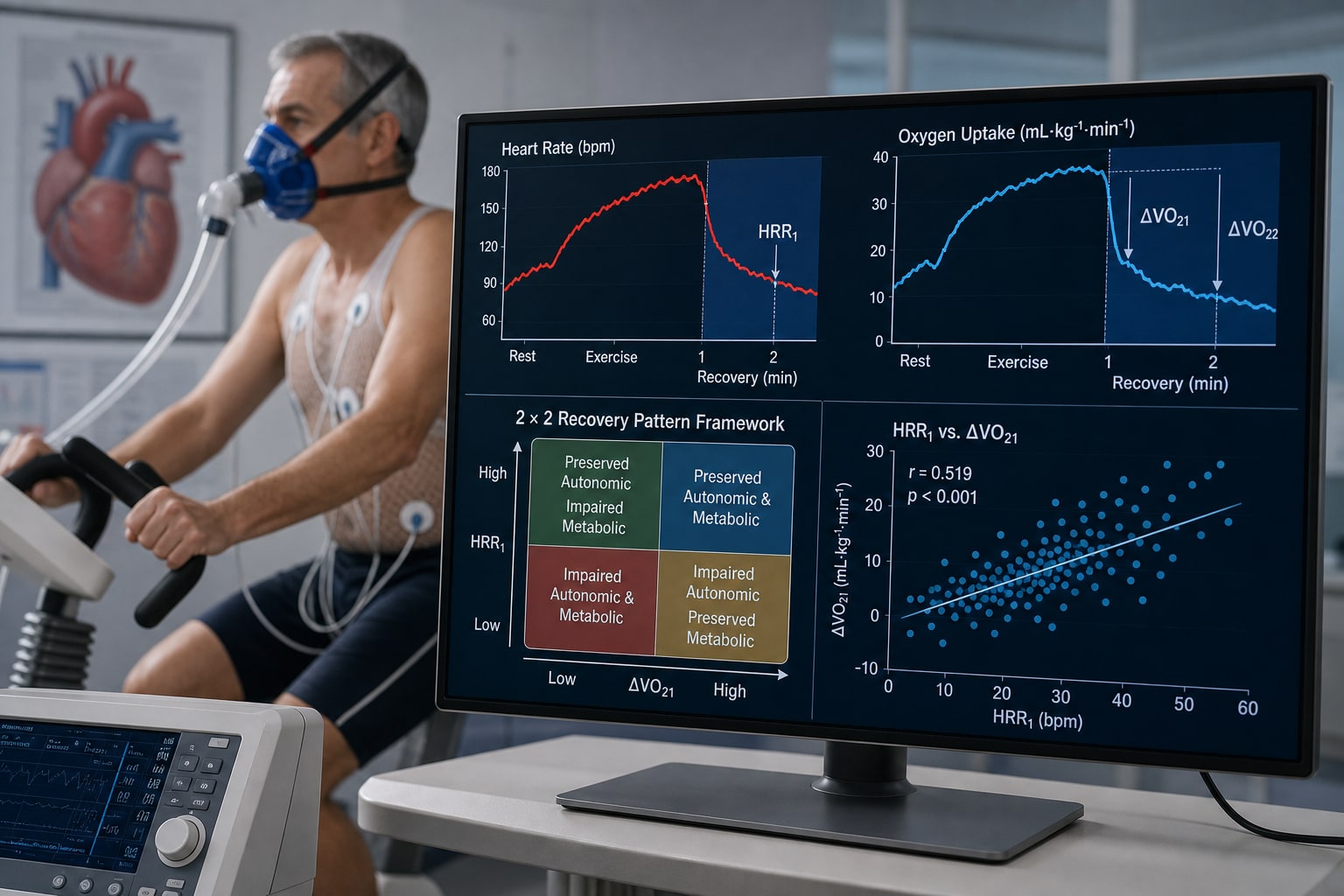
Integrated heart rate and oxygen uptake recovery phenotypes reveal heterogeneous recovery patterns in coronary artery disease
By
Benil Nesli Ata
Baris Unal
Merve Celik
Bugra Ince
Ece Cinar
July 9, 2026
Clinical Scorecard: Combined Analysis of Heart Rate and Oxygen Uptake Recovery Profiles Uncovers Diverse Recovery Patterns in Coronary Artery Disease
At a Glance
Category Detail
Condition Coronary Artery Disease Key Mechanisms Heart rate recovery (HRR) and oxygen uptake (VO₂) recovery as indicators of autonomic and metabolic recovery post-exercise. Target Population Patients with stable coronary artery disease (CAD) undergoing cardiopulmonary exercise testing (CPET). Care Setting Tertiary cardiac rehabilitation center.
Key Highlights
HRR at 1 min (HRR1) significantly correlated with ΔVO₂ values and VO₂ recovery indices. Distinct recovery phenotypes identified, indicating heterogeneity in post-exercise recovery dynamics. Significantly lower VO₂ recovery in the Good HRR–Poor VO₂ phenotype compared to the Poor HRR–Good VO₂ phenotype. Guideline-Based Recommendations
Diagnosis
Assessment of heart rate recovery and oxygen uptake recovery should be integrated for better characterization of post-exercise recovery. Management
Consider integrated assessment of HRR and VO₂ recovery before cardiac rehabilitation. Monitoring & Follow-up
Monitor post-exercise recovery dynamics as they may provide prognostic information independent of peak exercise performance. Risks
Impaired HRR is associated with increased cardiovascular mortality; delayed VO₂ recovery indicates reduced aerobic efficiency. Patient & Prescribing Data
Adult patients (≥18 years) with stable coronary artery disease.
Patients with stable CAD should undergo symptom-limited CPET to evaluate recovery patterns.
Clinical Best Practices
Utilize a phenotype-based approach to capture heterogeneity in post-exercise recovery. Integrate HRR and VO₂ recovery assessments for comprehensive evaluation. Related Resources & Content