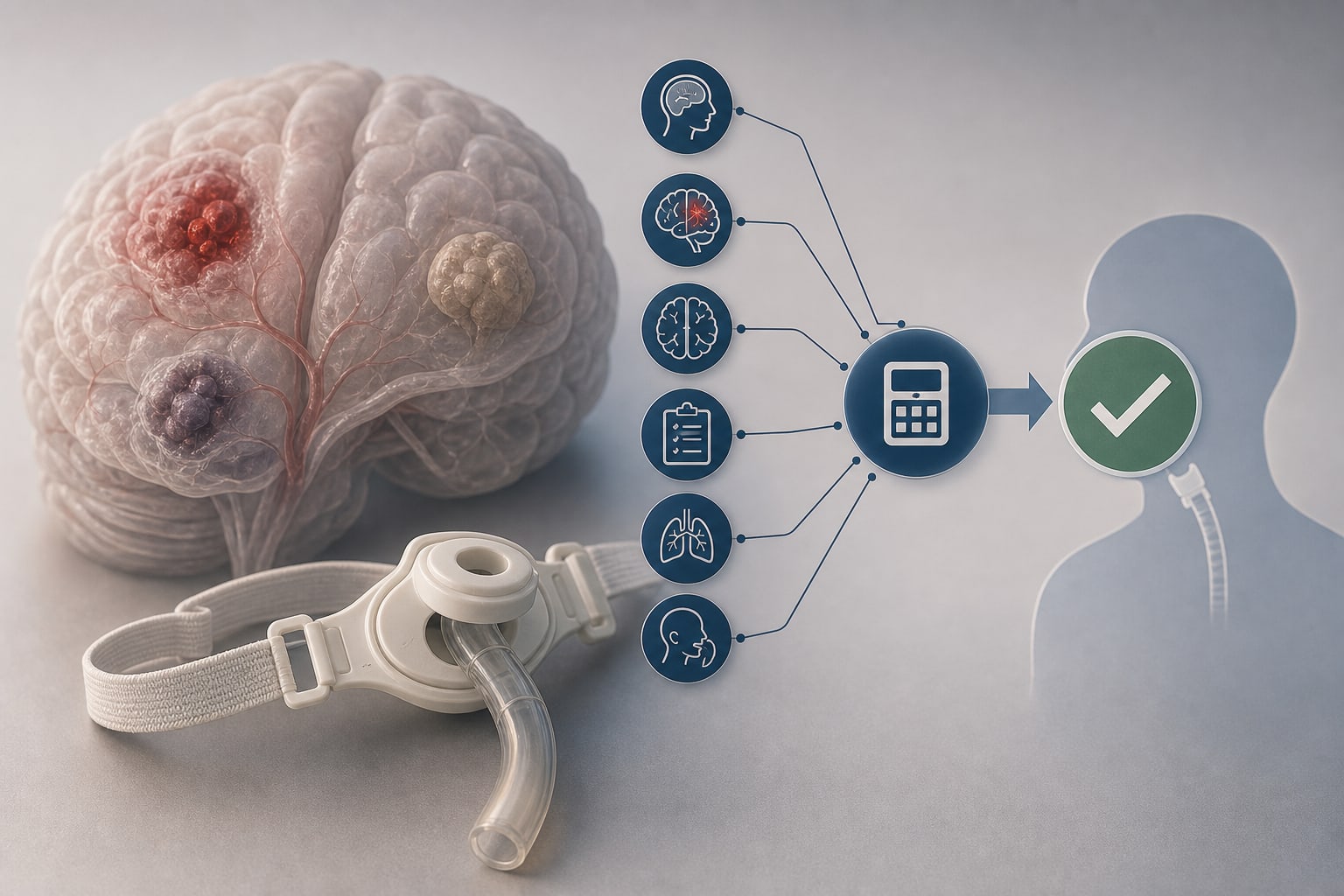
Establishment and evaluation of a predictive scoring system for successful decannulation of tracheostomy in neurosurgery patients
By
Yin Hu
Lifang Mao
Qing Liu
Yanhua Jiang
Shun Li
May 22, 2026
Clinical Scorecard: Development and assessment of a scoring model to predict successful tracheostomy decannulation in neurosurgical patients
At a Glance
Category Detail
Condition Key Mechanisms Predictive scoring system based on multivariate logistic regression, as per study findings. Target Population Care Setting
Key Highlights
Overall decannulation success rate of 63.9%, as reported in the study. Independent predictive factors include GCS >8, <6 airway suctioning episodes, and serum albumin ≥35 g/L, based on study results. Scoring system achieved an AUC of 0.933 in training and 0.930 in validation sets, according to study data. Cut-off of ≥10 points yielded sensitivity of 91.9% and specificity of 84.3%, as per study findings. Guideline-Based Recommendations
Diagnosis
Patients diagnosed with cerebrovascular disease, traumatic brain injury, or brain tumor, as per study criteria. Management
Follow standardized decannulation protocol including prerequisites and capping trial, as outlined in the study. Monitoring & Follow-up
Monitor vital signs and oxygenation closely for 48 hours post-decannulation, as recommended in the study. Risks
Potential complications include pulmonary infection, tracheal stenosis, and tracheoesophageal fistula, as noted in the study. Patient & Prescribing Data
Adults aged ≥18 years undergoing first-time tracheostomy
Decannulation should be performed when patients no longer depend on the tracheostomy tube
Clinical Best Practices
Ensure patients are off mechanical ventilation for ≥48 hours before decannulation, as per study protocol. Confirm hemodynamic stability and absence of active infection prior to decannulation, based on study guidelines. Conduct a 24-hour capping trial before attempting decannulation, as specified in the study. Related Resources & Content