Application of a posterior tibial artery perforator-based fasciocutaneous flap with a broad fascial pedicle in reconstruction of complex lower-leg wounds: a retrospective clinical study - Scorecard - MDSpire
Advertisement
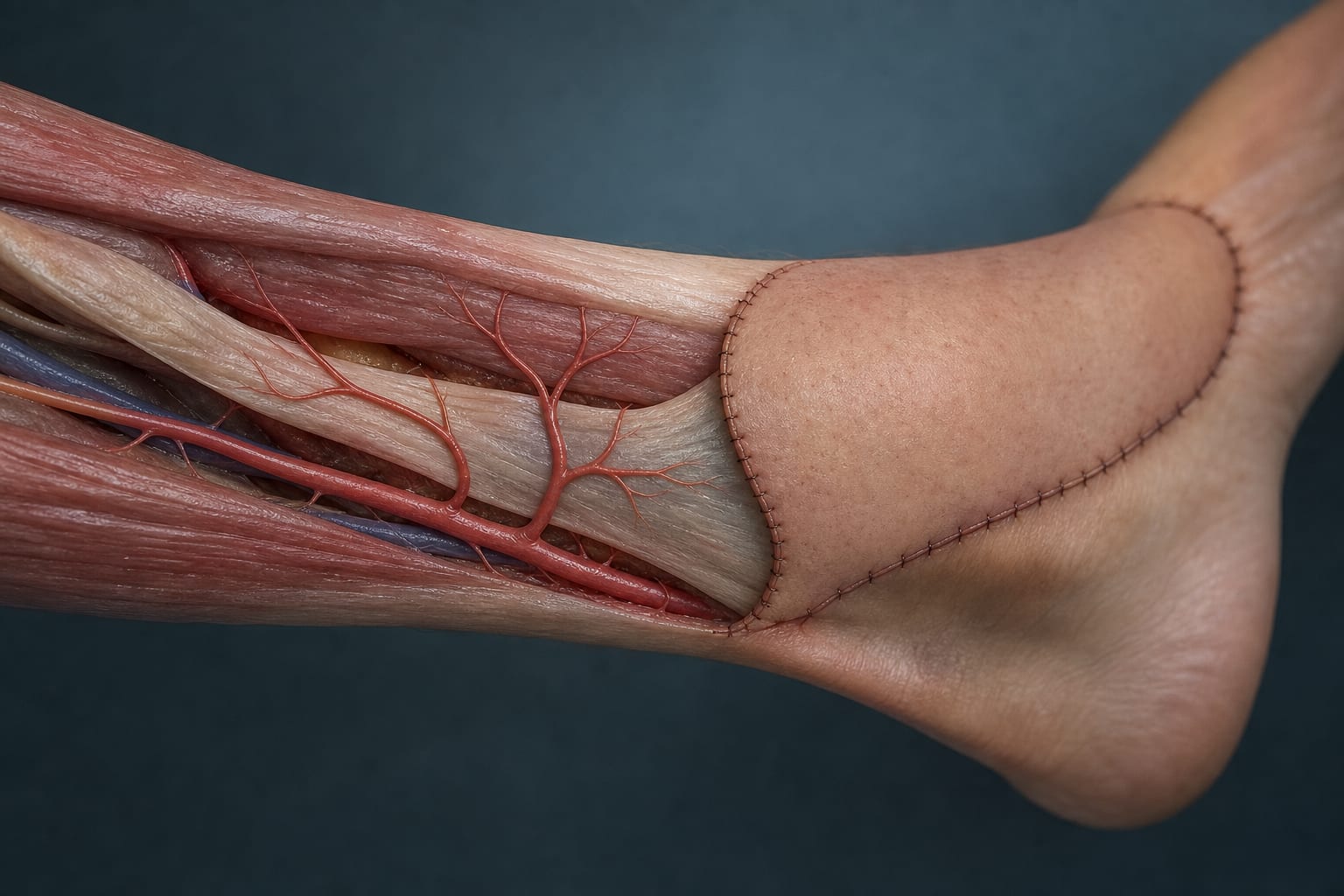
Application of a posterior tibial artery perforator-based fasciocutaneous flap with a broad fascial pedicle in reconstruction of complex lower-leg wounds: a retrospective clinical study
Clinical Scorecard: Utilization of a fasciocutaneous flap based on posterior tibial artery perforators with an extensive fascial pedicle for the reconstruction of intricate lower leg wounds: a retrospective analysis
At a Glance
Category
Detail
Condition
Complex lower leg wounds
Key Mechanisms
Posterior tibial artery perforator-based fasciocutaneous flap with broad fascial pedicle
Target Population
Patients with complex medial or distal lower-leg wounds
Care Setting
Single-center observational clinical study
Key Highlights
All 15 flaps survived completely with no necrosis.
No complications such as hematoma or infection occurred.
Sensory recovery assessed using the Medical Research Council scale showed varying degrees of recovery.
Active ankle motion was preserved in all patients.
Donor-site morbidity was minimal with acceptable scarring.
Guideline-Based Recommendations
Diagnosis
Preoperative handheld Doppler mapping to localize posterior tibial artery perforators.
Management
Use of posterior tibial artery perforator-based fasciocutaneous flap for reconstruction.
Monitoring & Follow-up
Assessment of flap viability and donor-site morbidity during follow-up.
Risks
Potential for venous congestion, marginal necrosis, or delayed healing in perforator flaps.
Patient & Prescribing Data
15 patients (11 males, 4 females; mean age 43.5 years)
Flap design preserved the main posterior tibial artery and utilized a broad fascial sleeve.
Clinical Best Practices
Consideration of anatomical studies for flap design.
Evaluation of local blood supply before flap selection.