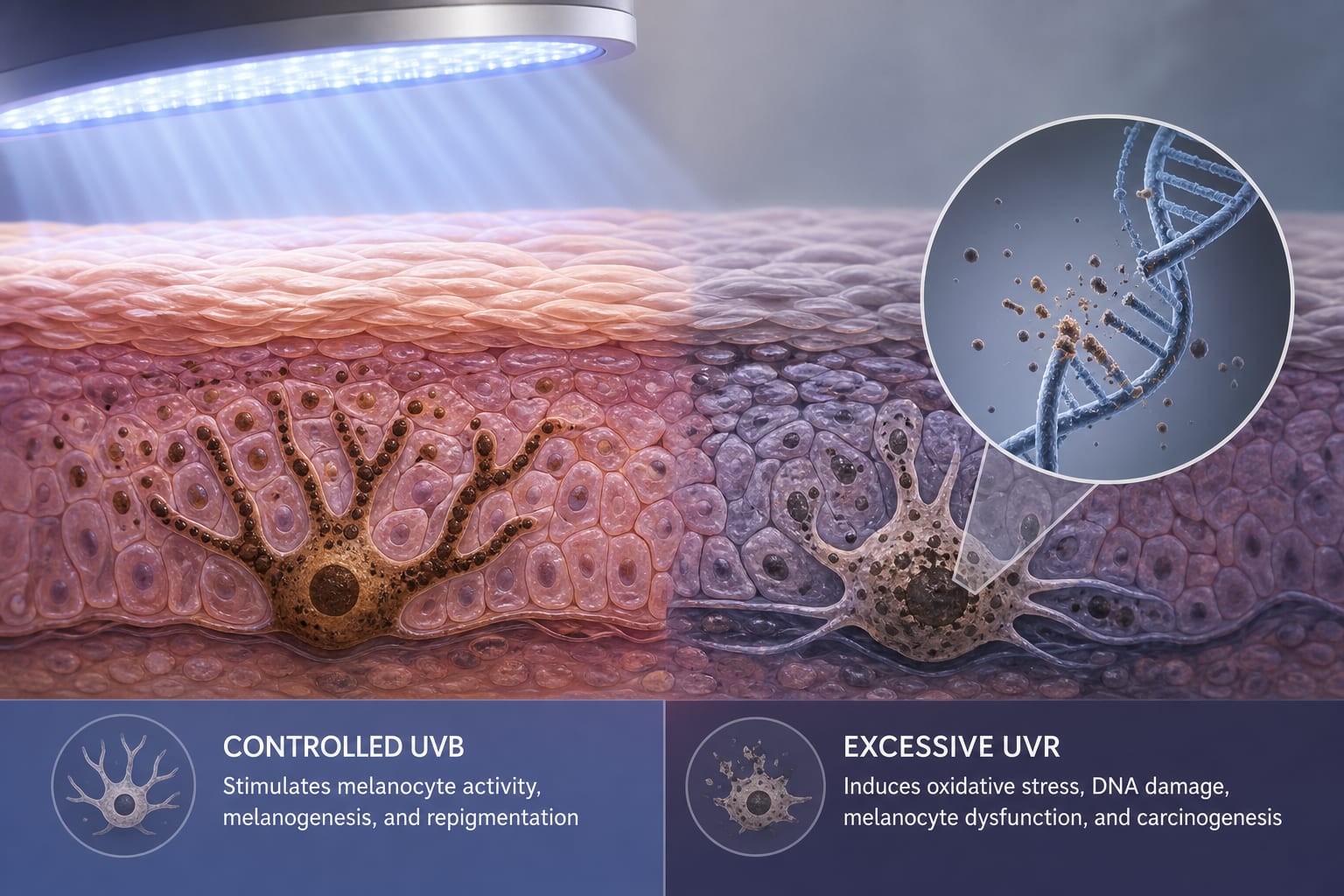
The Role of Ultraviolet Radiation in Modulating Melanocyte Activity in Vitiligo Treatment and Melanoma Development
-
By
-
Heng-Heng Fan
-
Yan-Yan Chen
-
Yun Geng
-
Yi-Fei Yang
-
Hui Xu
-
Yu-Yun Xiong
-
Yun-Wen Zheng
-
Yu-Mei Li
-
June 1, 2026
Clinical Scorecard: The Role of Ultraviolet Radiation in Modulating Melanocyte Activity in Vitiligo Treatment and Melanoma Development
At a Glance
| Category | Detail |
|---|
| Condition | Vitiligo |
| Key Mechanisms | UVR stimulates melanocyte proliferation and melanin synthesis; excessive UVR induces oxidative stress and genomic instability. |
| Target Population | Individuals with vitiligo and at risk for melanoma. |
| Care Setting | Clinical practice involving dermatology and phototherapy. |
Key Highlights
- NB-UVB and excimer-based phototherapy are standard treatments for vitiligo.
- Controlled UVR exposure enhances epidermal pigmentation and melanin content.
- Excessive UVR exposure can lead to melanocyte dysfunction and increased cancer risk.
- Combination therapies, including JAK inhibitors and platelet-rich plasma, are being explored.
- UVR has bidirectional effects on melanocyte biology.
Guideline-Based Recommendations
Diagnosis
- Diagnosis of vitiligo is based on clinical examination and patient history.
Management
- Standard treatments include NB-UVB and excimer laser therapies.
Monitoring & Follow-up
- Monitor for signs of skin barrier impairment and potential carcinogenesis.
Risks
- Excessive UVR exposure can lead to photoaging, DNA damage, and melanoma.
Patient & Prescribing Data
Patients with vitiligo requiring repigmentation therapies.
Combination strategies may enhance treatment efficacy while minimizing risks.
Clinical Best Practices
- Balance therapeutic UVR exposure with the risk of long-term skin damage.
- Incorporate protective measures against excessive UVR exposure.
Related Resources & Content