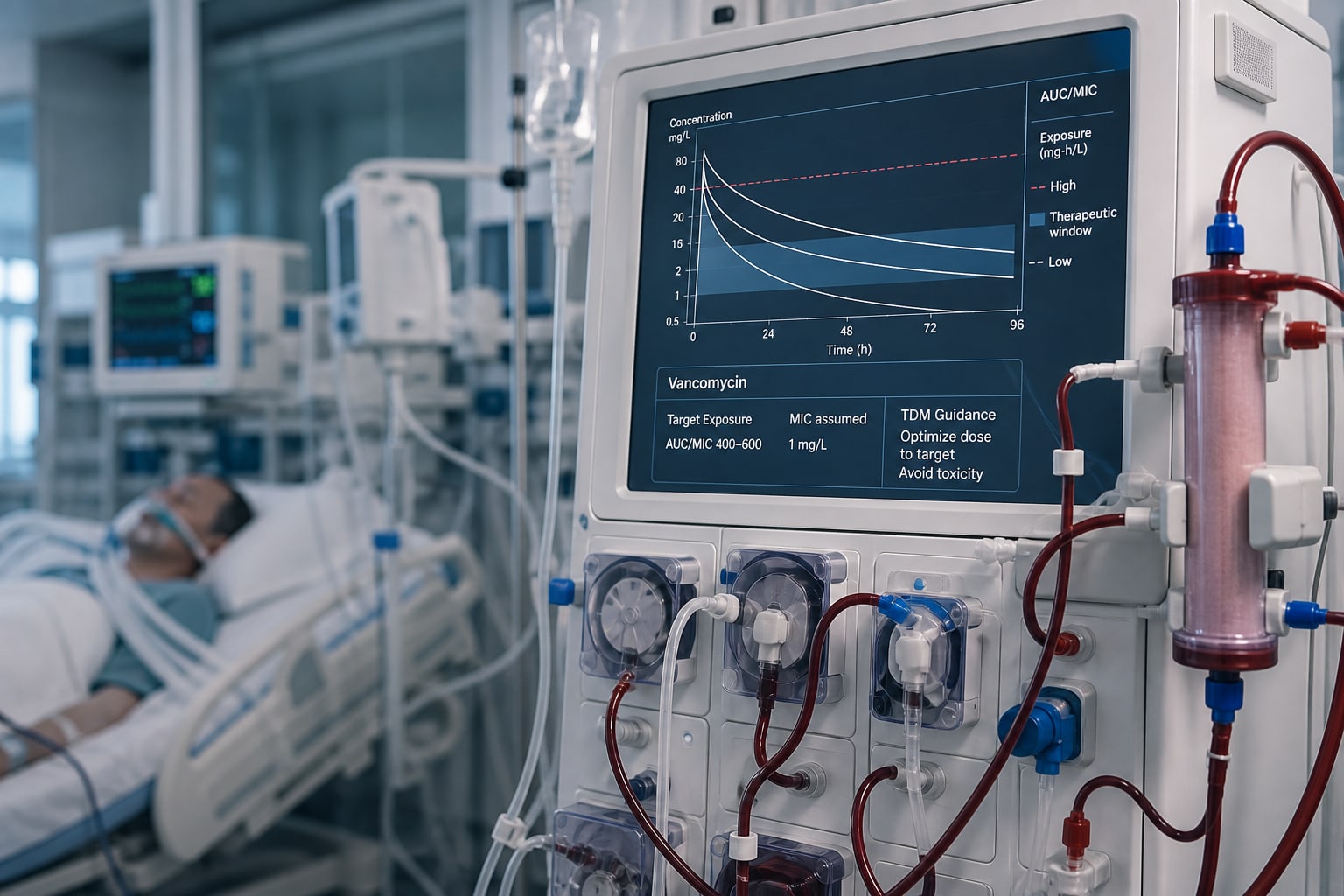
Evaluating Vancomycin Dosage in Critically Ill Patients Undergoing Renal Replacement Therapy: Insights on Toxicity Thresholds and External Validation
By
Jiaojiao Zhou
Haibo Lei
Ronghui Li
Xiang Liu
Guanghui Chen
September 22, 2026
Clinical Scorecard: Evaluating Vancomycin Dosage in Critically Ill Patients Undergoing Renal Replacement Therapy: Insights on Toxicity Thresholds and External Validation
At a Glance
Category Detail
Condition Vancomycin dosing in critically ill patients Key Mechanisms Toxicity thresholds and pharmacokinetics in renal replacement therapy Target Population Critically ill patients with renal replacement therapy Care Setting Critical care and nephrology
Key Highlights
Proposed nomograms for vancomycin dosing may overestimate safe AUC thresholds. Current guidelines recommend AUC below 600 mg·h/L to minimize nephrotoxicity. External validation datasets indicate potential overprediction of vancomycin concentrations. Residual urine output is a significant factor affecting vancomycin clearance. Therapeutic drug monitoring is essential for patients with significant urine output. Guideline-Based Recommendations
Diagnosis
Monitor vancomycin levels in critically ill patients undergoing RRT. Management
Use AUC thresholds below 600 mg·h/L to minimize nephrotoxicity. Monitoring & Follow-up
Implement therapeutic drug monitoring, especially in patients with urine output exceeding 500 mL/24 h. Risks
Potential for nephrotoxicity if AUC exceeds 600 mg·h/L. Patient & Prescribing Data
Critically ill patients with acute kidney injury requiring RRT.
Dosing nomograms should be cautiously interpreted, particularly in patients with residual urine output.
Clinical Best Practices
Incorporate urine output as a stratification variable in dosing nomograms. Acknowledge limitations of predictive performance in external validation datasets. Related Resources & Content