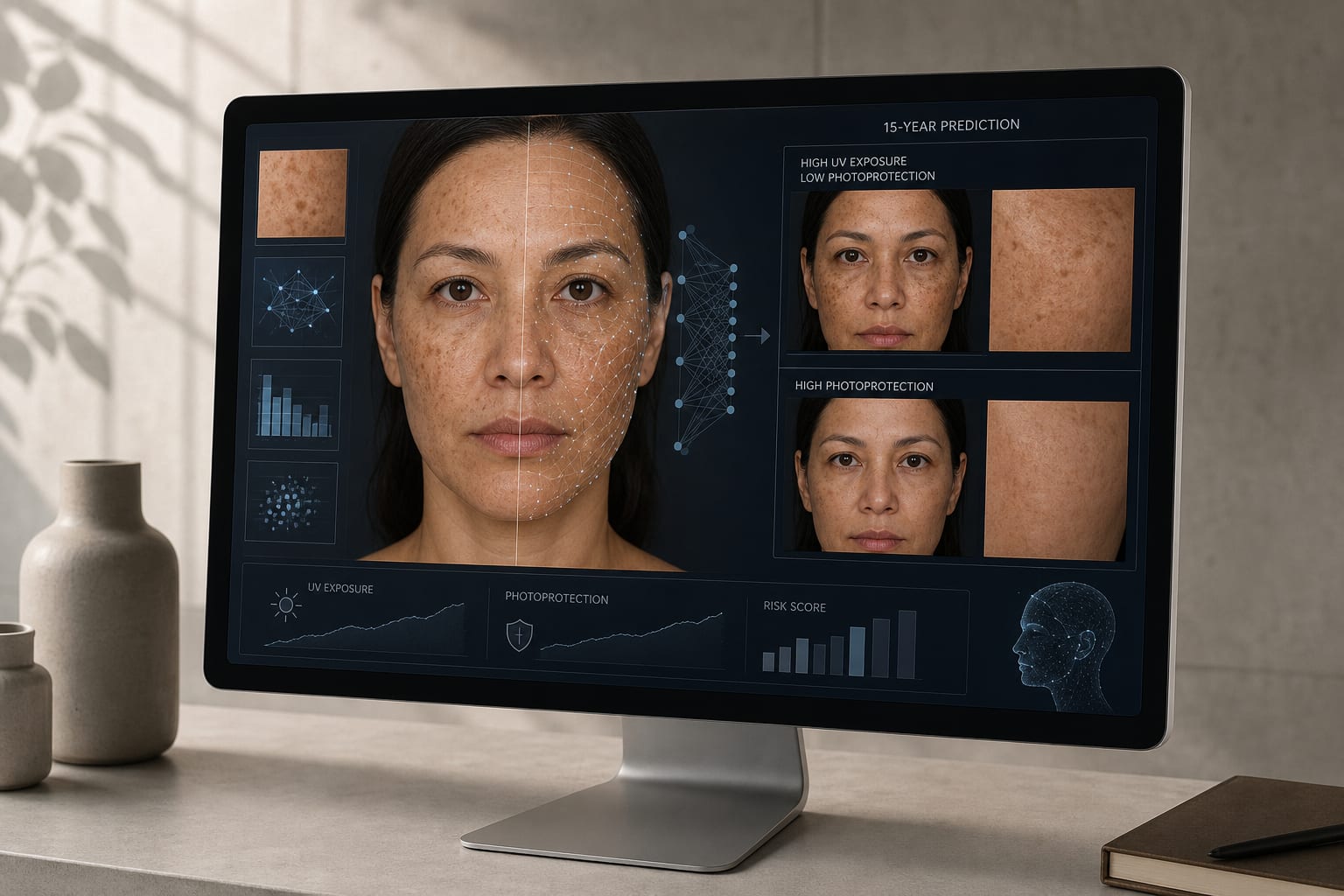
Forecasting Age-Related Facial Hyperpigmentation Through Expert Dermatologist Insights and Generative Modeling Techniques
Clinical Scorecard: Forecasting Age-Related Facial Hyperpigmentation Through Expert Dermatologist Insights and Generative Modeling Techniques
At a Glance
| Category | Detail |
|---|
| Condition | Facial Hyperpigmentation |
| Key Mechanisms | Age-related progression influenced by UV exposure and photoprotection. |
| Target Population | Women of Asian, European, and African descent, particularly Asian women. |
| Care Setting | Dermatology and research settings. |
Key Highlights
- Introduction of a novel simulator for predicting facial hyperpigmentation.
- Utilizes expert dermatologist insights and machine learning techniques.
- Focuses on the impact of sun exposure and photoprotection on aging.
- Developed through a consensus-based data elicitation process.
- Validations conducted by independent dermatologists.
Guideline-Based Recommendations
Diagnosis
- Assessment of facial hyperpigmentation as a marker of aging.
Management
- Daily photoprotection as a preventive strategy against premature aging.
Monitoring & Follow-up
- Use of predictive simulations to visualize aging progression.
Risks
- Increased density of facial pigmentary spots with age.
Patient & Prescribing Data
Women experiencing age-related facial hyperpigmentation.
Emphasis on individualized predictions based on sun exposure and photoprotection.
Clinical Best Practices
- Incorporate dermatologist expertise in predictive modeling.
- Utilize validated imaging systems for baseline assessments.
- Employ generative models for personalized visualizations of aging.
Related Resources & Content