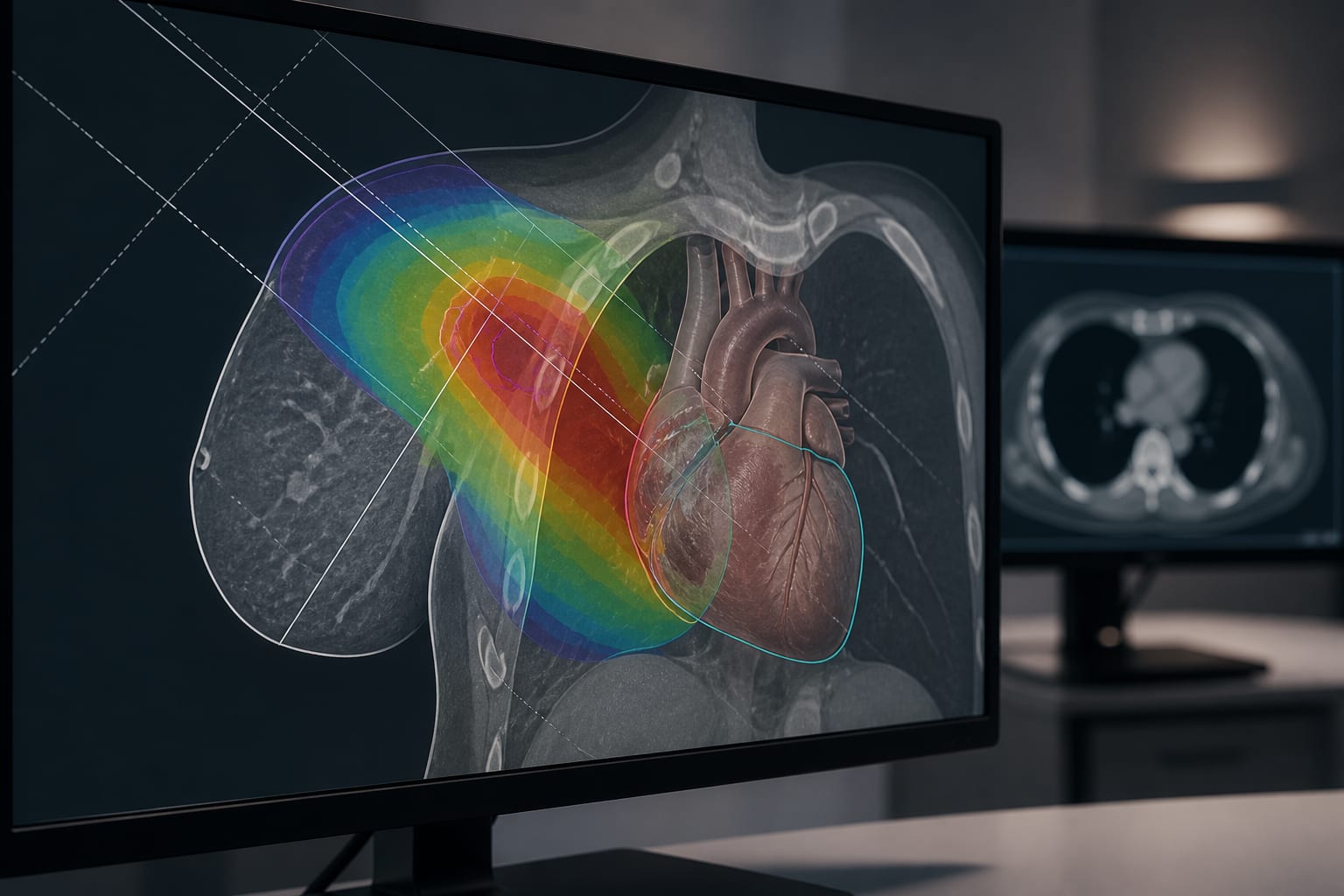
Advancing Precision Cardio-Oncology in Breast Cancer Radiotherapy
-
By
-
Avirup Guha
-
September 2, 2026
Clinical Scorecard: Advancing Precision Cardio-Oncology in Breast Cancer Radiotherapy
At a Glance
Category | Detail |
|---|---|
Condition | Breast Cancer Radiotherapy |
Key Mechanisms | Cardiovascular risk associated with left-sided versus right-sided radiotherapy, influenced by patient vulnerability and baseline cardiovascular risk factors. |
Target Population | Women undergoing postoperative breast radiotherapy without a history of ischemic heart disease. |
Care Setting | Oncology and Cardiology clinics |
Key Highlights
Left-sided radiotherapy is associated with a higher risk of ischemic heart disease (IHD) compared to right-sided treatment in women with multiple cardiovascular risk factors.
The 8-year cumulative incidence of IHD was 20.3% for left-sided versus 15.2% for right-sided treatment.
A 6-item cardiovascular risk burden score includes age, obesity, smoking, hypertension, diabetes, and dyslipidemia.
Treatment planning should be individualized based on absolute cardiovascular risk rather than laterality alone.
Concurrent management of cardiometabolic risk factors is essential for patients undergoing left-sided breast cancer radiotherapy.
Guideline-Based Recommendations
Diagnosis
Assess cardiovascular risk factors prior to radiotherapy planning.
Management
Implement cardiac-sparing radiotherapy planning for patients with multiple cardiovascular risk factors.
Monitoring & Follow-up
Ongoing assessment of cardiovascular health and risk factor control during survivorship.
Risks
Increased risk of IHD associated with left-sided radiotherapy, particularly in patients with multiple cardiovascular risk factors.
Patient & Prescribing Data
Women with breast cancer undergoing postoperative radiotherapy.
Cardiac-sparing techniques and concurrent management of cardiovascular risk factors may mitigate risks.
Clinical Best Practices
Utilize a multidisciplinary approach involving oncology and cardiology for treatment planning.
Consider advanced treatment planning techniques such as intensity-modulated radiotherapy and proton therapy.
Encourage lifestyle modifications and management of cardiovascular risk factors in breast cancer survivors.
Related Resources & Content
Chung and Noh, JAMA Network Open, 2026 -- Laterality of Breast Radiotherapy and Ischemic Heart Disease by Cardiovascular Risk Burden
American Heart Association, PubMed, 2026 -- Coronary Atherosclerosis in Patients With Cancer and Survivors: A Scientific Statement
ASTRO, PubMed, 2026 -- Dose-Volume Histogram Compendium of Dose Constraints for Treatment Planning
ASTRO-ASCO-SSO, PubMed, 2026 -- Postmastectomy Radiation Therapy: An ASTRO-ASCO-SSO Clinical Practice Guideline
the asco post — Cardio-Oncology Is a Growing Subspecialty, but Where Are the Oncologists?
the asco post — Accelerated Radiation Therapies Move Forward in Early Breast Cancer
The ASCO Post — Reducing Incidental Cardiac Irradiation during Breast Radiotherapy
The ASCO Post — Breast Cancer Radiotherapy Leads to Moderate Cardiac Function Decline Over Years
Cardio-Oncology Is a Growing Subspecialty, but Where Are the Oncologists?
Accelerated Radiation Therapies Move Forward in Early Breast Cancer
Reducing Incidental Cardiac Irradiation during Breast Radiotherapy
Coronary Atherosclerosis in Patients With Cancer and Survivors: A Scientific Statement From the American Heart Association - PubMed
Dose-Volume Histogram Compendium of Dose Constraints for Treatment Planning: An ASTRO Consensus Paper - PubMed
Postmastectomy Radiation Therapy: An ASTRO-ASCO-SSO Clinical Practice Guideline - PubMed
Concurrent Versus Sequential Radiation Dose Escalation to the Surgical Cavity for Conservative Treatment of High-Risk Early Breast Cancer: NRG/RTOG 1005 Phase III Trial | Journal of Clinical Oncology
Deep inspiration breath hold versus free breathing in postoperative radiotherapy strategy for patients with left-sided breast cancer treated with volumetric modulated arc therapy: A meta-analysis and systematic review - PubMed
Laterality of Breast Radiotherapy and Ischemic Heart Disease by Cardiovascular Risk Burden | Oncology | JAMA Network Open | JAMA Network
Based on findings from:
Toward Precision Cardio-Oncology in Breast Radiotherapy
Avirup Guha. Jama Network Open, 2026.
https://jamanetwork.com/journals/jamanetworkopen/fullarticle/2853522
This content is an AI-generated, fully rewritten summary based on a published scholarly article. It does not reproduce the original text and is not a substitute for the original publication. Readers are encouraged to consult the source for full context, data, and methodology.