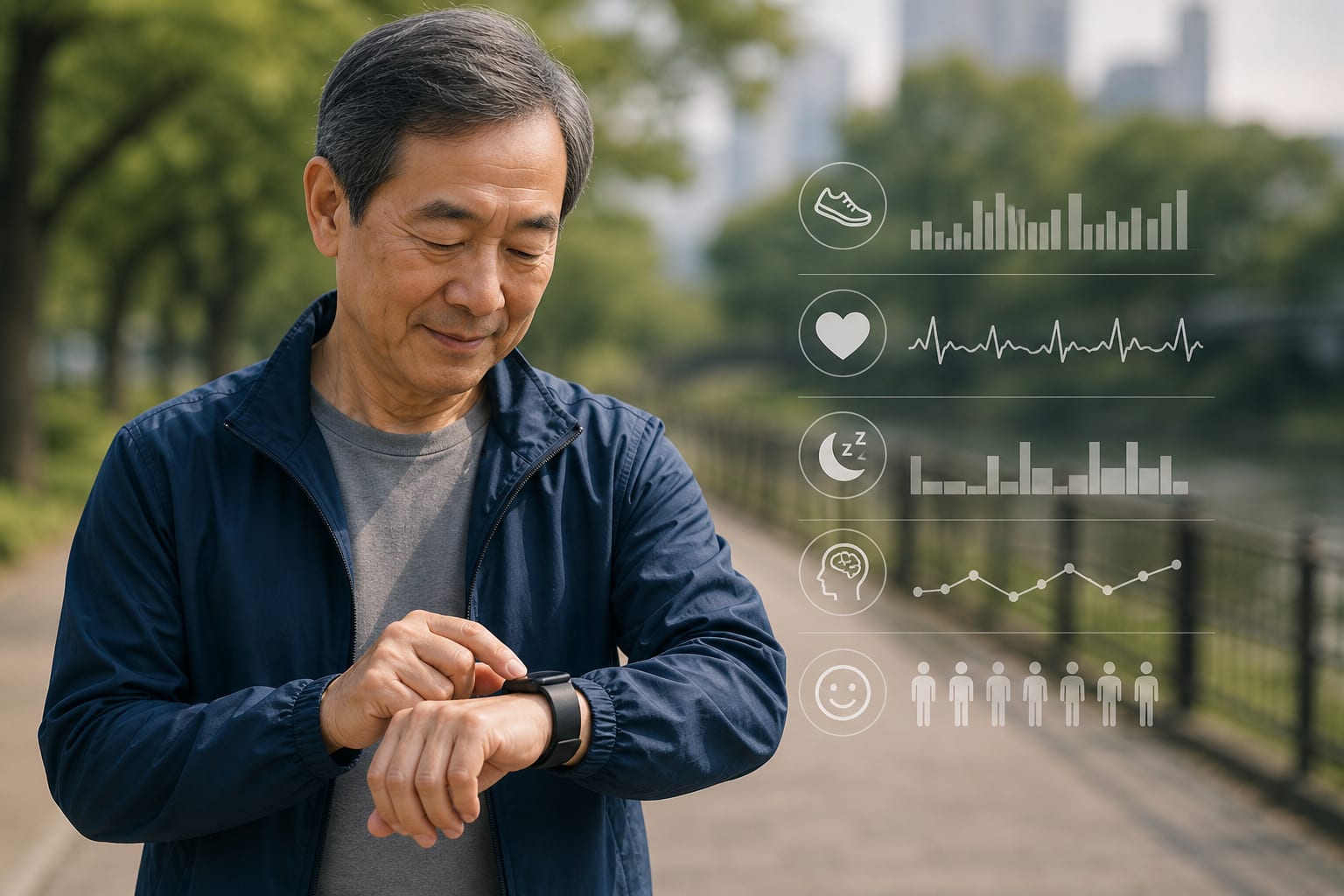
Clinical Scorecard: One-Year Health Outcomes Following a Smartwatch-Based Health Program for Community-Dwelling Older Adults: The SWING-Japan Study
At a Glance
Category
Detail
Condition
Association between smartwatch use and one-year changes in comprehensive health outcomes among community-dwelling older adults
Key Mechanisms
The study examined whether smartwatch use was associated with changes in physical, mental, and cognitive function and health-related awareness.
Target Population
Community-dwelling older adults in Itabashi and Chiyoda wards, Tokyo, Japan
Care Setting
Nonrandomized controlled study with 12 months of follow-up
Key Highlights
The study examined associations between smartwatch use and one-year changes in physical, mental, and cognitive function and health-related awareness.
The study was nonrandomized and conducted in community-dwelling older adults in Tokyo.
Guideline-Based Recommendations
Diagnosis
Management
Monitoring & Follow-up
Risks
The study was nonrandomized, so group comparisons may be affected by selection differences.
Patient & Prescribing Data
Community-dwelling older adults recruited in Itabashi and Chiyoda wards, Tokyo.
The study examined associations between smartwatch use and one-year health outcomes. The supplied excerpt does not describe device-use instructions or report outcome results.
Investigators linked distinct odor patterns to life stage, sex, and skin microbes, while limited longitudinal evidence leaves their clinical utility uncertain.