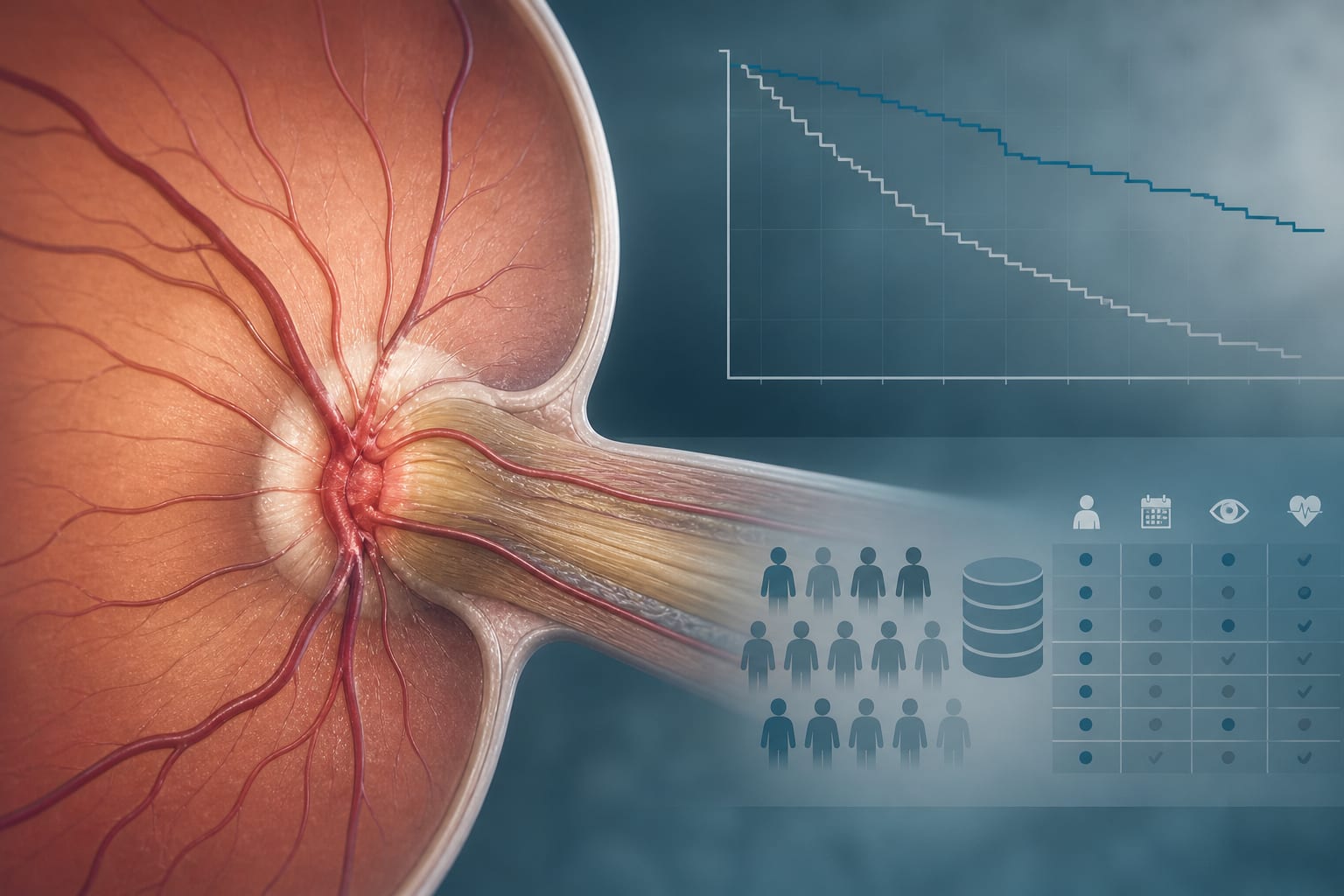
Non-arteritic anterior ischaemic optic neuropathy (NAION) with optic disc drusen (ODD) or hyperreflective lines (HRLs) identified on enhanced-depth imaging optical coherence tomography (EDI-OCT).
Key Mechanisms
The introduction states that ODD-related disc crowding may impair optic nerve head perfusion. HRLs have been described in NAION, but their clinical significance remains uncertain.
Target Population
Patients with NAION evaluated at Byers Eye Institute, Stanford University, from 2020 through 2025.
Care Setting
Specialist neuro-ophthalmology assessment and optic nerve imaging at Byers Eye Institute, Stanford University.
Key Highlights
In this retrospective analysis, ODD-like features were identified in 42 of 177 NAION patients (23.7%): 25 had HRLs and 17 had ODD.
ODD-like features were defined as ODD or HRLs on EDI-OCT. ODD-AION required an ODD measuring at least 100 µm; HRL-AION required an HRL without an ODD measuring at least 100 µm.
Diagnosis before age 50 occurred in 26% of patients with ODD-like features and 2.2% of those without them (adjusted p = 0.010).
The median age at diagnosis was 62 years in patients with ODD-like features and 65 years in those without; the adjusted p value was 0.060.
Guideline-Based Recommendations
Diagnosis
In this study, NAION was diagnosed by a neuro-ophthalmologist after comprehensive ophthalmic assessment.
The study used EDI-OCT to identify ODD and HRLs; the methods describe EDI-OCT as the Optic Disc Drusen Studies Consortium’s recommended gold standard for ODD imaging.
Management
Monitoring & Follow-up
Risks
The introduction identifies diabetes mellitus, hypertension, and hyperlipidaemia as vascular risk factors associated with NAION.
The introduction describes ODD as an independent NAION risk factor and states that drusen-related disc crowding may impair optic nerve head perfusion.
Patient & Prescribing Data
Retrospective analysis of a prospectively recruited Stanford dataset: 42 NAION patients with ODD-like features (58 eyes) and 45 NAION patients without these features (66 eyes).
The provided source excerpt reports diagnostic and imaging methods and does not provide medication or treatment recommendations.
Clinical Best Practices
The study used EDI-OCT to assess for ODD and HRLs in patients with NAION; it does not establish a clinical recommendation for routine use.
The introduction states that the clinical significance of HRLs in NAION remains uncertain.
The study classified ODD-AION eyes as having at least one ODD measuring ≥100 µm and HRL-AION eyes as having at least one HRL without an ODD measuring ≥100 µm.