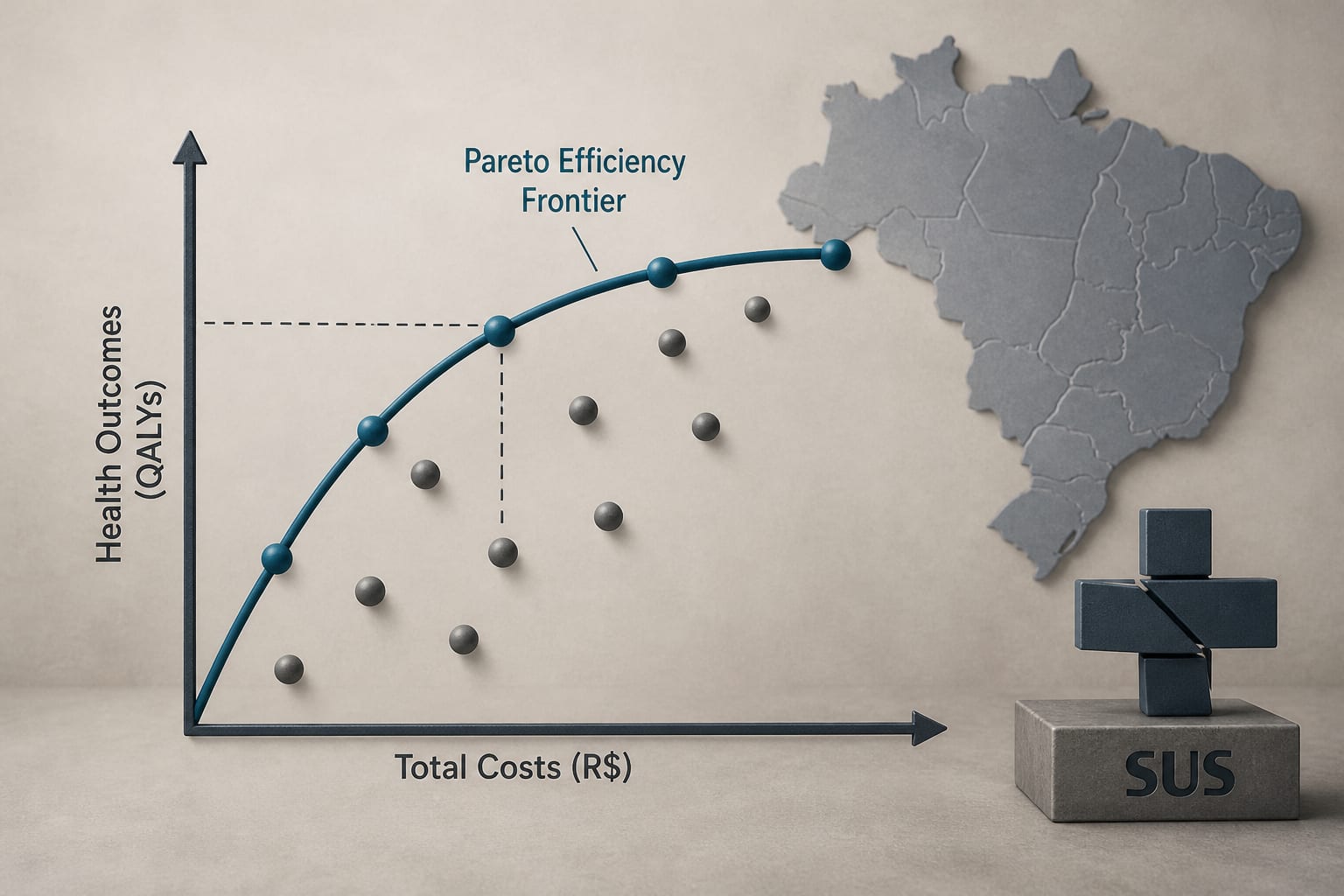
Clinical Scorecard: Using a Pareto Efficiency Frontier to Guide Value-Based Pricing of Gaucher Disease Therapies in Brazil
At a Glance
Category
Detail
Condition
Clinical topic addressed by the source article: Using a Pareto Efficiency Frontier to Guide Value-Based Pricing of Gaucher Disease Therapies in Brazil
Key Mechanisms
Mechanisms or clinical associations described in the source article.
Target Population
Population described in the source article.
Care Setting
Brazilian Unified Health System (SUS) context; exploratory analysis of annual drug acquisition costs and selected hematologic outcomes.
Key Highlights
The analysis included imiglucerase, velaglucerase alfa, taliglucerase alfa, and miglustat; eliglustat was excluded because it was not provided by SUS during the study period.
The Pareto-based frontier retained directly non-dominated therapies and described the relationship between annual treatment costs and selected hematologic benefits.
The analysis focused on hematologic outcomes, including hemoglobin and platelet counts, identified in Brazilian treatment guidelines as principal therapeutic objectives.
The study excluded utilities, QALYs, long-term survival modeling, budget impact analysis, and probabilistic uncertainty analysis.
The authors describe the approach as exploratory and state that regulatory use would require comparative efficacy evidence, formal uncertainty analysis, and assessment of clinical value beyond hematologic outcomes.
Guideline-Based Recommendations
Diagnosis
The article describes Gaucher disease as resulting from glucocerebrosidase deficiency, with clinical features that can include hepatosplenomegaly, anemia, thrombocytopenia, and osseous complications.
Management
The article describes intravenous enzyme replacement therapy as targeting systemic manifestations, particularly visceral and hematologic features.
Miglustat is indicated in Brazil for selected adults with Gaucher disease Type 1 when enzyme replacement therapy is not considered suitable.
Monitoring & Follow-up
Brazil’s Clinical Protocol and Therapeutic Guidelines specify eligibility and follow-up parameters; hematologic normalization, especially hemoglobin and platelet counts, is identified as a principal treatment objective.
Risks
The article notes that substantial treatment costs create challenges for healthcare systems, including SUS.
The analysis does not include formal probabilistic uncertainty analysis or evaluate clinical value beyond selected hematologic outcomes.
Patient & Prescribing Data
The economic analysis covered therapies authorized for Gaucher disease and available for prescription within SUS in January 2023; it did not define a single patient-level treatment cohort.
Included therapies were imiglucerase, velaglucerase alfa, taliglucerase alfa, and miglustat. The article states that miglustat is indicated for selected adults with Type 1 disease when enzyme replacement therapy is unsuitable.
Clinical Best Practices
Use the Brazilian Clinical Protocol and Therapeutic Guidelines for treatment eligibility and follow-up parameters.
Assess hematologic outcomes, particularly hemoglobin and platelet counts, in line with the stated therapeutic objective of hematologic normalization.
Interpret the Pareto-based frontier as a descriptive price–benefit benchmark, not as an optimization rule or standalone pricing criterion.
Do not interpret the analysis as a full economic evaluation: it excluded QALYs, survival modeling, budget impact, and probabilistic uncertainty analysis.