Validation of a 2-Gene Blood Test for Kawasaki Disease in Febrile Children - Scorecard - MDSpire

Validation of a 2-Gene Blood Test for Kawasaki Disease in Febrile Children

  • By

  • Ho-Chang Kuo

  • Xing Xue

  • Fang Liu

  • Richard D. Mortensen

  • C. James Chou

  • Bo Jin

  • Juan Wei

  • Qiong Luo

  • Ken-Pen Weng

  • Mindy Ming-Huey Guo

  • Kuender D. Yang

  • Kuo-Jung Su

  • Shih-Ting Kang

  • Sun Kim

  • Weiwei Li

  • James Schilling

  • Zhi Han

  • Naoto Ozawa

  • Takumi Ichikawa

  • Henry Chubb

  • Scott R. Ceresnak

  • Gary L. Darmstadt

  • Doff McElhinney

  • Harvey J. Cohen

  • Xuefeng B. Ling

  • May 28, 2026

  • 0 min

Share

Clinical Scorecard: Assessment of a Two-Gene Blood Test for Diagnosing Kawasaki Disease in Children with Fever

At a Glance

CategoryDetail
ConditionKawasaki Disease (KD)
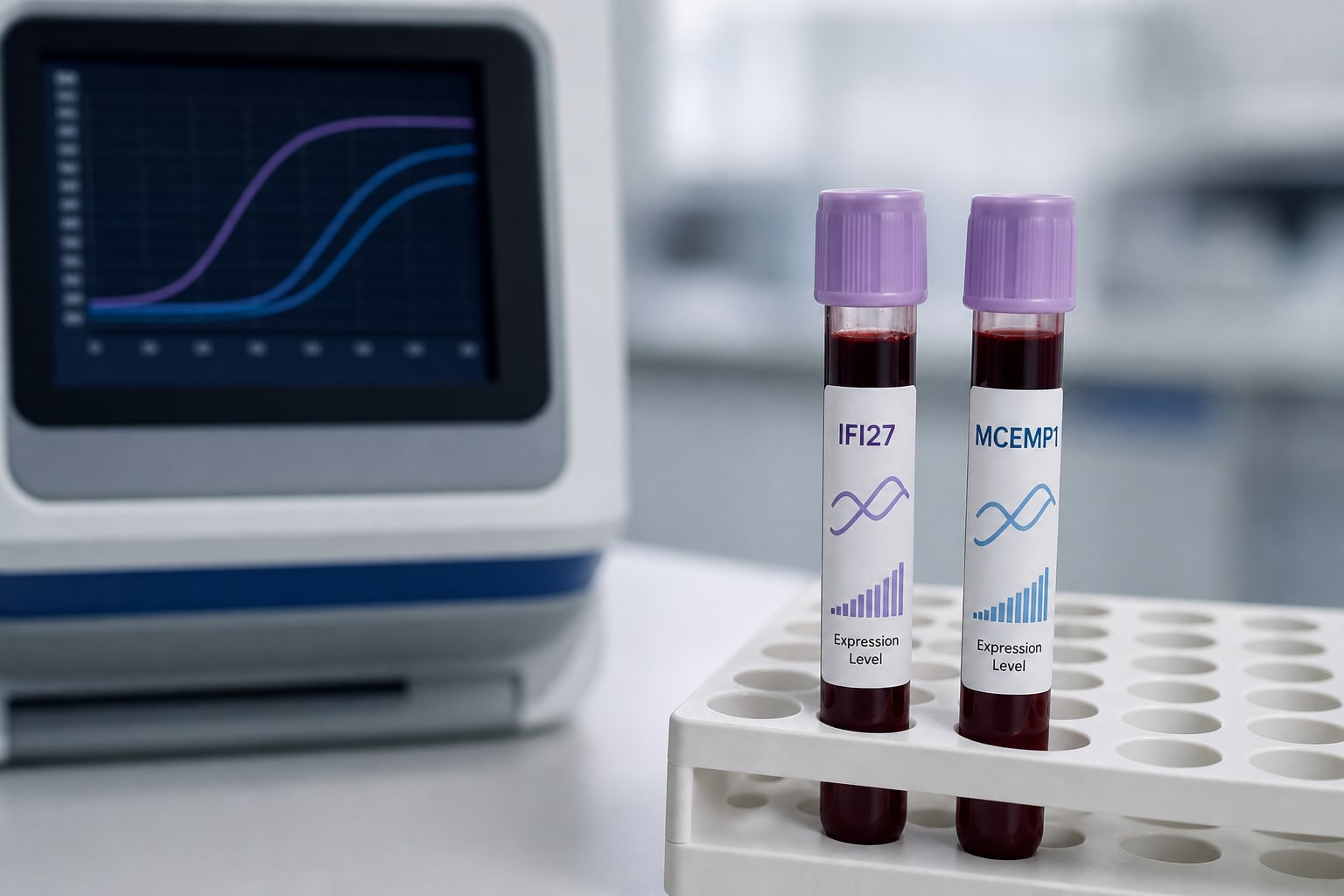
Key MechanismsTwo-gene blood test measuring IFI27 and MCEMP1 expression.
Target PopulationChildren younger than 8 years with fever for at least 3 days.
Care SettingTertiary referral hospitals in Taiwan and Shanghai.

Key Highlights

  • KD is the leading cause of acquired heart disease in children in developed countries.
  • A two-gene signature (IFI27 and MCEMP1) was evaluated for diagnostic accuracy.
  • The study included 541 participants, with 243 diagnosed with KD.
  • Diagnostic thresholds were established to optimize clinical decision-making.
  • The study adhered to STARD reporting guidelines.

Guideline-Based Recommendations

Diagnosis

  • KD diagnoses were based on 2017 AHA criteria for complete or incomplete KD.

Management

  • Timely treatment with intravenous immunoglobulin is recommended to reduce coronary complications.

Monitoring & Follow-up

  • Clinical features, laboratory findings, and echocardiographic data should be monitored.

Risks

  • Up to 25% of children may present with incomplete features, leading to diagnostic delays.

Patient & Prescribing Data

Children with suspected Kawasaki disease presenting with fever.

Intravenous immunoglobulin treatment is crucial for reducing complications.

Clinical Best Practices

  • Use a dual-threshold model for KD diagnosis to optimize clinical decision-making.
  • Ensure blinded adjudication of KD diagnoses to minimize bias.

Related Resources & Content

Original Source(s)

Related Content