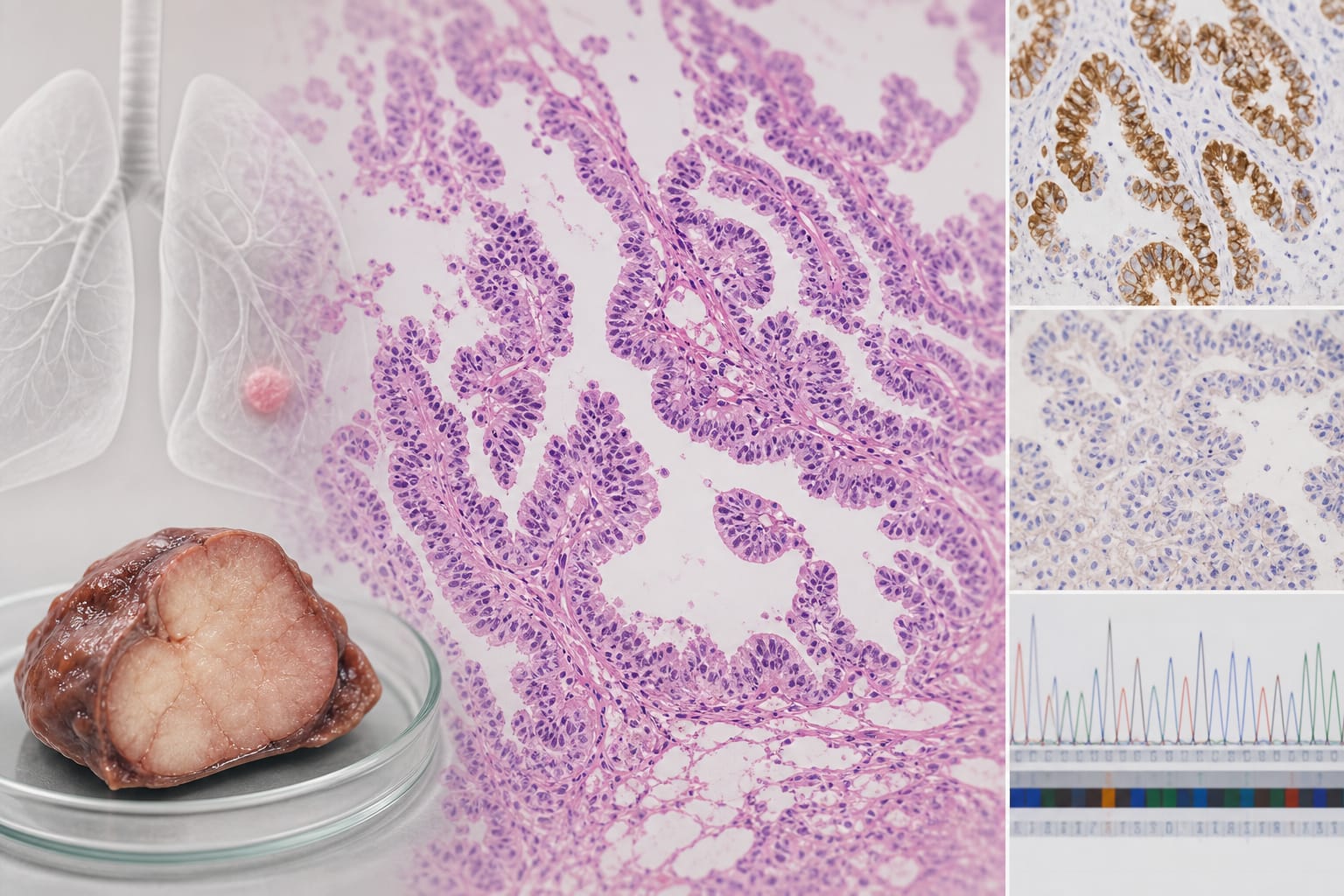
Case Report: Pulmonary alveolar adenoma: a case series from a single institution and literature review
-
By
-
Martina Maione
-
Jose Coelho Lima
-
Giuseppe Maggioni
-
Chiara Giraudo
-
Federica Pezzuto
-
Fiorella Calabrese
-
June 29, 2026
-
Clinical Scorecard: Clinical Insights: A Series of Pulmonary Alveolar Adenoma Cases from One Institution and a Review of Existing Literature
At a Glance
| Category | Detail |
|---|
| Condition | Alveolar Adenoma |
| Key Mechanisms | Benign epithelial lung neoplasm, often asymptomatic, may mimic metastasis. |
| Target Population | Middle-aged women, but can occur in younger patients. |
| Care Setting | Pathology and oncology departments in hospitals. |
Key Highlights
- Alveolar adenomas are extremely rare, accounting for less than 1% of pulmonary neoplasms.
- Typically discovered incidentally in asymptomatic patients.
- Histologically characterized by cystic spaces lined by cuboidal cells.
- Immunohistochemical profile includes positivity for cytokeratins and TTF-1.
- Incidence at the reporting institution was 0.2%.
Guideline-Based Recommendations
Diagnosis
- Diagnosis confirmed through histological and immunohistochemical analysis.
Management
- Surgical resection is indicated for symptomatic lesions or those mimicking malignancy.
Monitoring & Follow-up
- Clinical surveillance recommended post-surgery, especially in patients with co-existing malignancies.
Risks
- Potential misdiagnosis as metastatic disease, necessitating careful evaluation.
Patient & Prescribing Data
Primarily middle-aged women, with cases in younger patients.
Surgical excision is the primary treatment; no significant genetic alterations identified.
Clinical Best Practices
- Consider alveolar adenoma in differential diagnosis of lung nodules, especially in patients with a history of malignancy.
- Utilize imaging and histological evaluation for accurate diagnosis.
Related Resources & Content