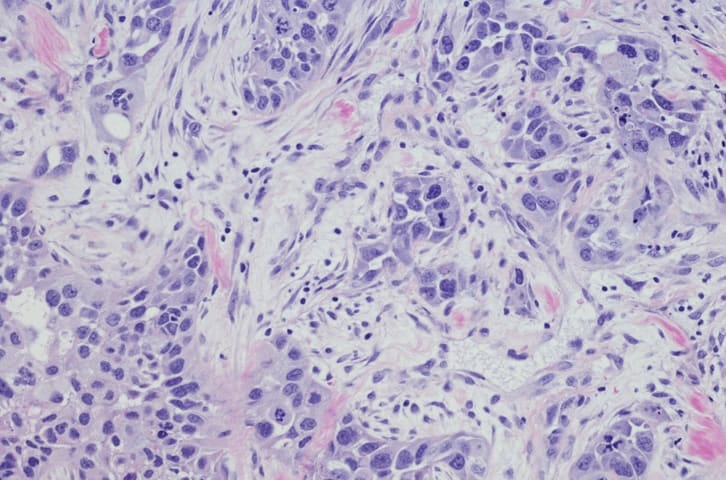
Poorly differentiated tumor with variable squamous differentiation and epithelial-marker expression; diagnosis is supported by NUT protein immunohistochemistry or molecular testing.
Target Population
Patients with poorly differentiated pulmonary tumors, including tumors with inconspicuous squamous differentiation or negative keratin staining.
Care Setting
Pathology evaluation of pulmonary tumors, with clinical follow-up for disease progression and treatment response.
Key Highlights
Two pulmonary NUT carcinomas had markedly different morphology and immunohistochemical profiles.
Squamous differentiation was limited or absent in some areas and is not consistently present in NUT carcinoma.
Keratin staining was limited in one case and absent for CAM5.2; the authors cautioned that negative keratin staining does not exclude NUT carcinoma.
Both reported patients had aggressive disease progression and died within 5 months to 1 year.
The report was limited to 2 patients and cannot establish how frequently these features occur.
Guideline-Based Recommendations
Diagnosis
The authors emphasized considering NUT carcinoma in poorly differentiated pulmonary tumors even when squamous differentiation is inconspicuous.
The authors cautioned that negative keratin staining does not exclude NUT carcinoma.
The report states that diagnosis relies on positive NUT protein immunohistochemistry or molecular testing; p63 and p40 positivity may occur but are not sufficient alone.
Management
The report describes treatment courses but does not establish a management recommendation.
In the reported cases, the first patient's tumor was resistant to cisplatin and gemcitabine. The second patient's chemotherapy had limited effectiveness; she later received palliative radiotherapy and underwent resection of an ovarian metastasis to prevent intestinal obstruction.
Monitoring & Follow-up
The report documented metastatic progression and survival but did not specify a monitoring protocol.
Risks
NUT carcinoma may be mistaken for other poorly differentiated tumors, including lymphoma or undifferentiated sarcoma.
Variable staining, including occasional expression of thyroid transcription factor-1 or neuroendocrine markers, may complicate diagnosis.
Both patients in this report developed metastatic progression.
Patient & Prescribing Data
Two patients with pulmonary NUT carcinoma: a man in his 20s and a woman in her 30s.
The first patient's tumor was resistant to cisplatin and gemcitabine. The second had limited effectiveness with carboplatin, pemetrexed, and bevacizumab, followed by palliative radiotherapy and resection of an ovarian metastasis.
Clinical Best Practices
The authors described substantial morphological and immunohistochemical variability in the two cases.
The authors stated that diagnosis relies on NUT protein immunohistochemistry or molecular testing when NUT carcinoma is suspected.
The authors cautioned against relying on a single epithelial or squamous marker to exclude NUT carcinoma.
Combining IL-17 with TNF-alpha showed strong discrimination between carious lesions and healthy controls, but performance was more modest against gingival inflammation.