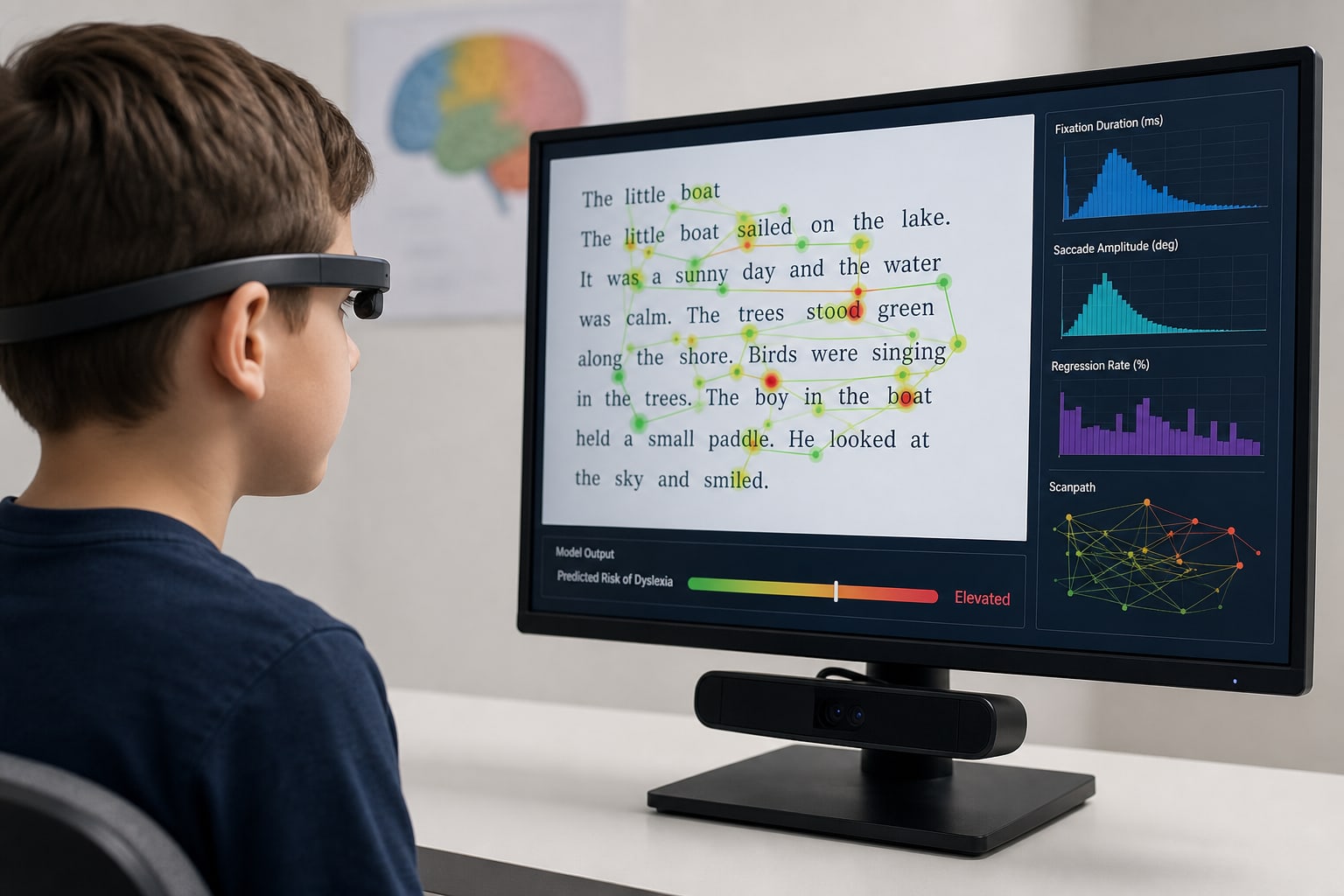
AI-enabled eye-movement and emerging multimodal frameworks for precision dyslexia screening and reading pattern analysis
Clinical Scorecard: Utilizing AI and Multimodal Approaches for Enhanced Screening and Analysis of Reading Patterns in Dyslexia
At a Glance
| Category | Detail |
|---|
| Condition | Developmental Dyslexia |
| Key Mechanisms | Eye-movement behavior and machine-learning algorithms for screening and risk identification. |
| Target Population | School-aged children with suspected dyslexia. |
| Care Setting | Educational and clinical screening contexts. |
Key Highlights
- Dyslexia affects reading accuracy and fluency, requiring early identification.
- Eye-tracking technologies provide objective measures of reading processes.
- Machine-learning algorithms show classification accuracies of 80-95%.
- Longer fixation durations and increased regression behavior are common in dyslexic readers.
- Emerging multimodal approaches combine gaze data with other features.
Guideline-Based Recommendations
Diagnosis
- Formal confirmation of dyslexia requires standardized assessment and professional interpretation.
Management
- Gaze-based and computational approaches should be considered adjunctive risk-identification tools.
Monitoring & Follow-up
- Eye-movement measures can provide insights into reading-related visual and cognitive processing.
Risks
- Heterogeneity in datasets and methods may introduce risks of overfitting and performance inflation.
Patient & Prescribing Data
Children at risk for dyslexia.
Early identification is critical to mitigate long-term academic difficulties.
Clinical Best Practices
- Utilize eye-tracking technologies for objective screening.
- Combine multiple data sources for comprehensive assessment.
- Ensure reliability and validity of screening tools before implementation.
Related Resources & Content