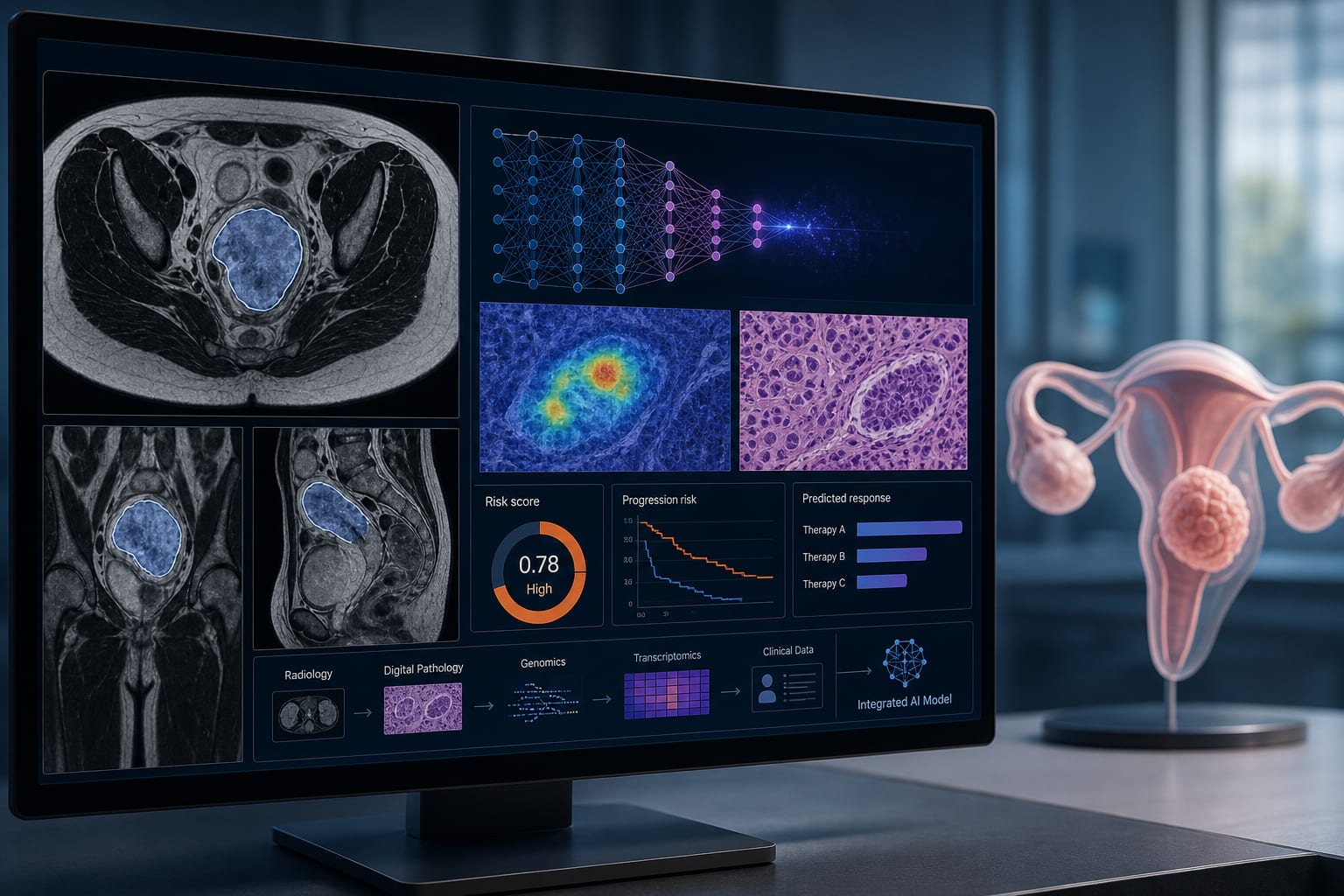
Artificial intelligence in ovarian cancer: advancing in precision diagnosis and clinical management
-
By
-
Mingjun Shao
-
Tong Wang
-
Limei Ji
-
Lili Xu
-
Yanfei Zhang
-
Dongge Wang
-
Cenlin Jia
-
Lin Chen
-
Heng Zhang
-
Wei Yan
-
Xuehao Cui
-
Ran Tong
-
May 7, 2026
-
Clinical Scorecard: The Role of Artificial Intelligence in Enhancing Precision Diagnosis and Treatment Strategies for Ovarian Cancer
At a Glance
| Category | Detail |
|---|
| Condition | |
| Key Mechanisms | Artificial Intelligence (AI) for tumor detection, classification, prognostic risk stratification, treatment response prediction, and spatial-temporal multi-omics. |
| Target Population | |
| Care Setting | |
Key Highlights
- AI enhances early detection and treatment response prediction in ovarian cancer.
- Multimodal models integrate imaging, molecular profiling, and clinical data.
- AI can achieve diagnostic performance comparable to human experts in pathology and imaging.
- Challenges such as biases and limitations in AI models must be acknowledged.
Guideline-Based Recommendations
Diagnosis
- Utilize AI-enhanced imaging techniques for improved tumor detection and classification.
Management
- Incorporate AI models for individualized treatment strategies based on tumor heterogeneity.
Monitoring & Follow-up
- Employ AI for ongoing assessment of treatment response and disease progression.
Risks
- Be aware of potential biases and limitations in AI models affecting clinical decision-making.
- Ensure prospective validation of AI models before clinical implementation.
Patient & Prescribing Data
Patients with High-Grade Serous Ovarian Carcinoma (HGSOC) and other ovarian cancer subtypes.
AI can predict treatment responses based on integrated clinical and molecular data.
Clinical Best Practices
- Balance sensitivity and specificity in AI applications to avoid unnecessary treatments.
- Ensure prospective validation of AI models before clinical implementation.
- Address biases in AI applications to enhance clinical decision-making.
Related Resources & Content