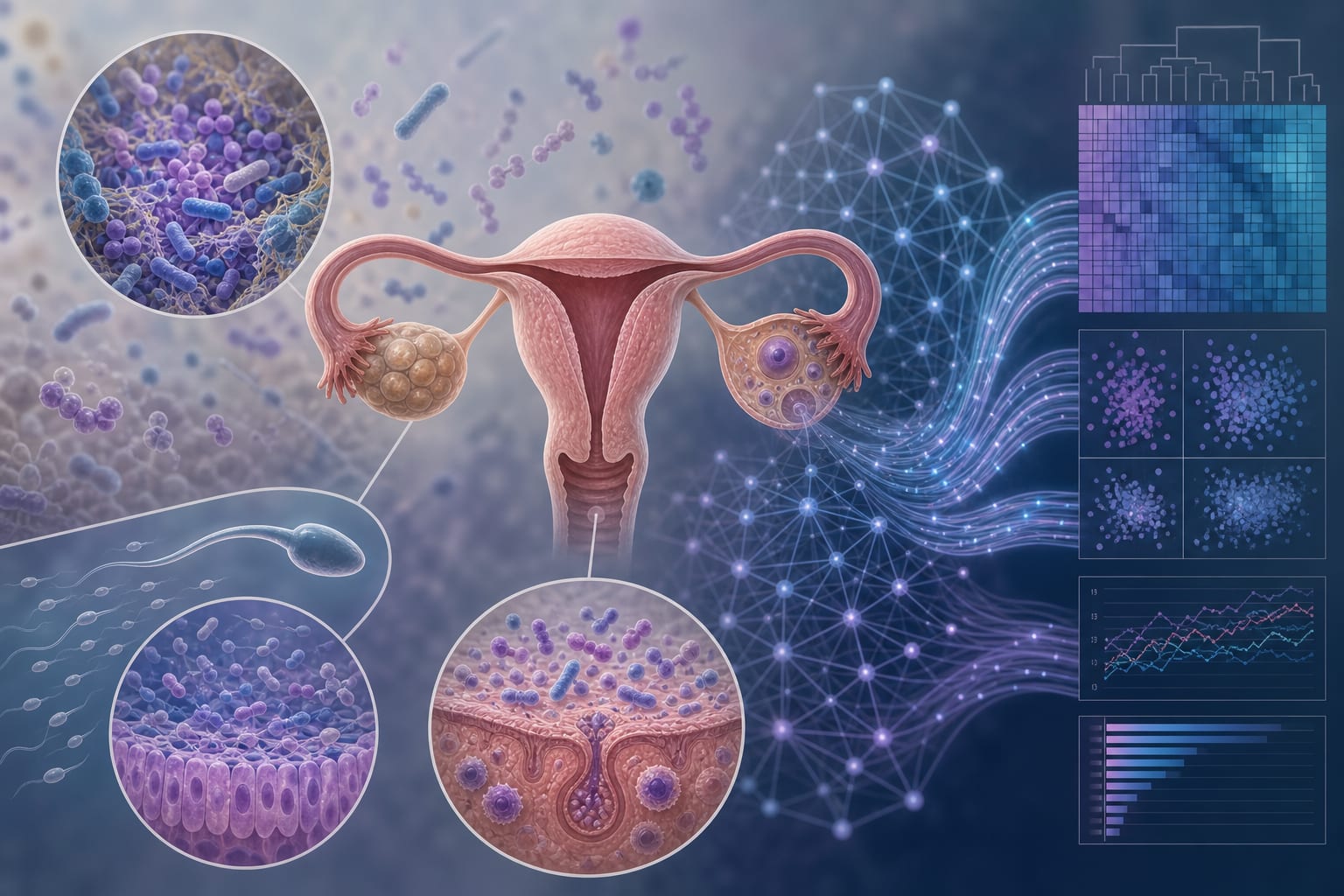
Unraveling the reproductive microbiome: leveraging machine and deep learning for clinical and biological understanding
By
Ignacio Garach Vélez
Irene Leonés-Baños
Bárbara A. Folch
Laura Antequera
Ignacio Rojas
Francisco Ortuño
María José Sáez Lara
Signe Altmäe
Luis Javier Herrera
June 15, 2026
Clinical Scorecard: Unraveling the reproductive microbiome: leveraging machine and deep learning for clinical and biological understanding
At a Glance
Category Detail
Condition Reproductive health and functions Key Mechanisms Microbial regulation of sperm quality, ovarian function, endometrial receptivity, embryo implantation, and pregnancy outcomes. Target Population Individuals seeking reproductive health insights, including those experiencing infertility or pregnancy complications. Care Setting Clinical and research settings focused on reproductive medicine.
Key Highlights
Microbiome linked to reproductive health outcomes such as miscarriage and preterm birth. Machine learning (ML) and deep learning (DL) can identify non-linear patterns in microbiome data. Challenges include low biomass environments and the need for standardized sampling protocols. Emphasis on Explainable Artificial Intelligence (XAI) for biological interpretability. Integration of independent datasets is crucial for overcoming small cohort sizes. Guideline-Based Recommendations
Diagnosis
Utilize advanced computational frameworks to translate microbial signatures into predictive insights. Management
Adopt ensemble-based differential abundance and feature selection methods. Monitoring & Follow-up
Standardize analytical workflows to enhance reproducibility and interpretability. Risks
Data leakage must be prevented by confining synthetic data generation to training sets. Patient & Prescribing Data
Individuals undergoing reproductive health assessments.
Potential applications of ML/DL methods to predict reproductive success.
Clinical Best Practices
Integrate and harmonize datasets across different samples and anatomical sites. Account for hormonal fluctuations and age-related shifts in microbiome data. Ensure biological interpretability of computational findings for clinical relevance. Related Resources & Content