A homozygous splice-site variant in SAMHD1 shows variable expressivity of Aicardi-Goutières Syndrome Type 5: a case report and literature review - Scorecard - MDSpire
Advertisement
A homozygous splice-site variant in SAMHD1 shows variable expressivity of Aicardi-Goutières Syndrome Type 5: a case report and literature review
Clinical Scorecard: A case report and literature review on a homozygous splice-site variant in SAMHD1 revealing variable expressivity in Aicardi-Goutières Syndrome Type 5
At a Glance
Category
Detail
Condition
Aicardi-Goutières Syndrome Type 5 (AGS5)
Key Mechanisms
Loss-of-function variants in the SAMHD1 gene
Target Population
Pediatric patients with early-onset neurodevelopmental delay
Care Setting
Pediatric neurology and genetics
Key Highlights
AGS5 is characterized by microcephaly, leukodystrophy, and developmental delay.
Phenotypic heterogeneity includes atypical systemic manifestations.
A homozygous splice-site variant in SAMHD1 was identified in affected siblings.
Affected individuals presented with neurodevelopmental delay but lacked spasticity and seizures.
Importance of considering AGS in children with congenital microcephaly.
Guideline-Based Recommendations
Diagnosis
Whole-exome sequencing to identify pathogenic variants in SAMHD1.
Management
Supportive care focusing on developmental and educational needs.
Monitoring & Follow-up
Regular neurodevelopmental assessments and supportive therapies.
Risks
Potential for variable expressivity and atypical presentations.
Patient & Prescribing Data
Children with congenital microcephaly and neurodevelopmental impairment.
No specific treatments; management is supportive.
Clinical Best Practices
Consider genetic testing in cases of unexplained neurodevelopmental delay.
Monitor for developmental milestones and provide early intervention services.
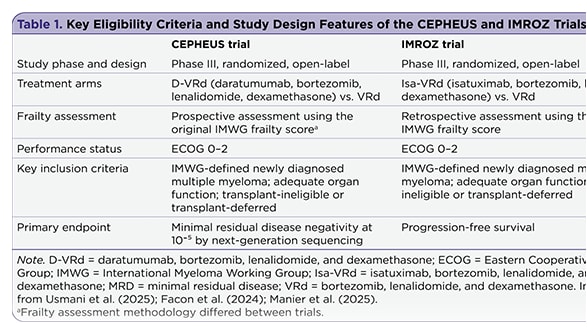
The management of newly diagnosed transplant-ineligible multiple myeloma remains challenging, in part due to the complexity of treatment decisions for frail patients. Recent subgroup analyses provide insight into whether quadruplet therapy may offer advantages over triplet therapy in this population.
Colorectal cancer (CRC) impacts about 1 in 13,000 pregnancies in the United States. This article follows the case of a 36-year-old woman diagnosed with CRC while pregnant and highlights considerations around CRC diagnosis and cancer treatment during pregnancy.