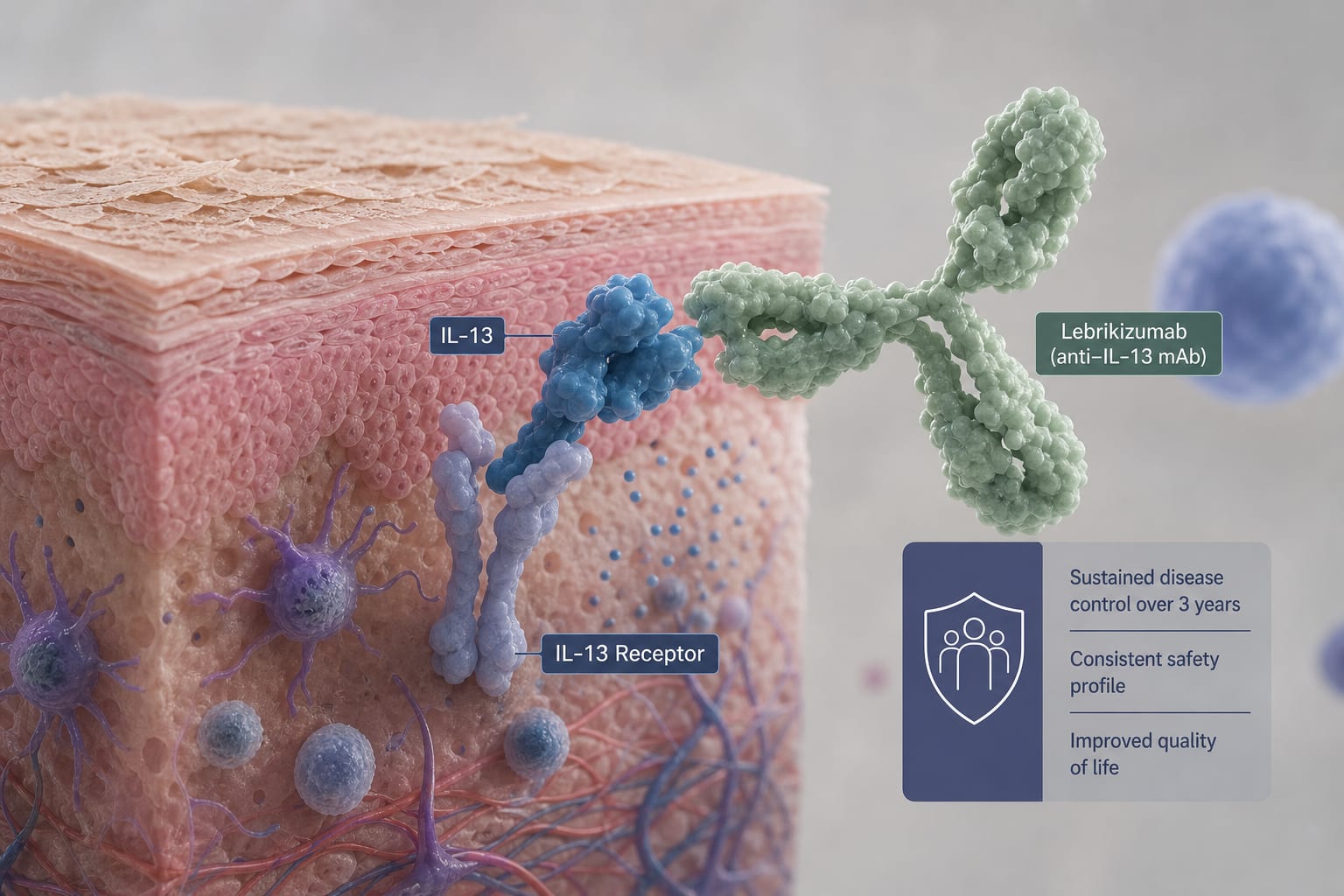
Clinical Scorecard: Atopic Dermatitis Treatment Targets Defined
At a Glance
Category
Detail
Condition
Atopic Dermatitis (AD)
Key Mechanisms
Standardized definitions of disease activity and control using clinician-assessed and patient-reported measures
Target Population
Patients with atopic dermatitis
Care Setting
Clinical trials and translational research
Key Highlights
International Eczema Council developed consensus definitions for low disease activity, very low disease activity, on-drug complete control, and off-drug remission in AD.
Framework uses validated Investigator Global Assessment for Atopic Dermatitis (vIGA-AD), Eczema Area and Severity Index (EASI), and Peak Pruritus Numerical Rating Scale (PP-NRS) for assessment.
On-drug complete control defined as vIGA-AD 0 or EASI 0 plus PP-NRS 0 or 1 maintained for 6 months on therapy; off-drug remission requires same criteria maintained for at least 12 months off therapy.
Guideline-Based Recommendations
Diagnosis
Use validated clinician-reported measures: vIGA-AD and EASI to assess disease activity.
Incorporate patient-reported itch severity using PP-NRS.
Management
Aim for treatment targets defined by disease activity states: low disease activity, very low disease activity, on-drug complete control, and off-drug remission.
Recognize on-drug complete control as sustained disease control during active therapy.
Exclude nonmedicated moisturizers and emollients from 'drug' definition.
Monitoring & Follow-up
Assess disease activity at single time points using vIGA-AD, EASI, and PP-NRS.
Confirm on-drug complete control by maintaining target scores for 6 months during treatment.
Confirm off-drug remission by maintaining target scores for at least 12 months after treatment discontinuation.
Risks
No specific risks detailed; framework emphasizes standardized outcome measures to improve trial comparability and treatment evaluation.
Patient & Prescribing Data
Patients with atopic dermatitis undergoing clinical trials or treatment evaluation
Treatment success defined by achieving and maintaining specific thresholds in clinician and patient-reported measures; sustained control is feasible with current therapies.
Clinical Best Practices
Combine vIGA-AD and EASI assessments to balance clinical judgment with detailed disease evaluation.
Use PP-NRS to quantify itch, with thresholds of 0 or 1 considered aspirational but clinically meaningful.
Adopt standardized definitions to harmonize clinical trial design and regulatory evaluation.
Recognize limitations of numeric cutoffs and incorporate clinical context in disease assessment.
Engage patient-reported outcomes alongside clinician measures for comprehensive evaluation.