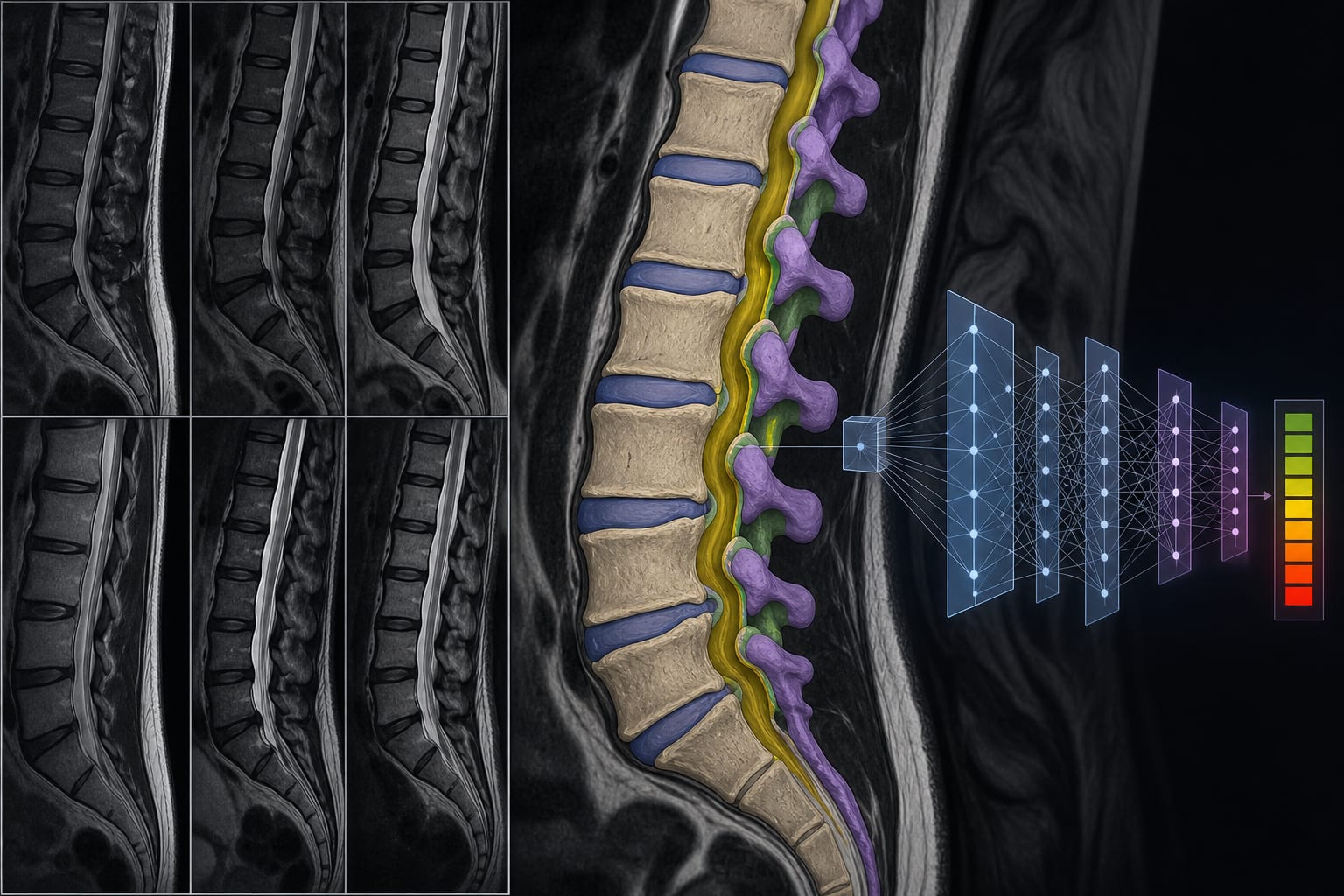
Anatomy-Informed Contextual Deep Learning for Grading Lumbar Degenerative Disorders and Assessing Risk Burden via MRI
-
By
-
Zhijin Chai
-
Chen Liu
-
Rujie Qin
-
Dexuan Zhao
-
Ankang Shi
-
June 26, 2026
Clinical Scorecard: Anatomy-Informed Contextual Deep Learning for Grading Lumbar Degenerative Disorders and Assessing Risk Burden via MRI
At a Glance
| Category | Detail |
|---|
| Condition | Lumbar Degenerative Disorders |
| Key Mechanisms | Anatomy-guided structural parsing, multi-sequence MRI analysis, inter-level contextual modeling |
| Target Population | Adults with low back pain and related symptoms |
| Care Setting | Radiological practice |
Key Highlights
- Proposed framework integrates anatomical priors and quantitative biomarkers for improved grading.
- Achieved a Macro F1-score of 0.783 ± 0.010 and a patient-level AUC of 0.891 ± 0.009.
- Framework enhances interpretability through mask visualization and level-wise attention.
Guideline-Based Recommendations
Diagnosis
- Utilize lumbar MRI as the primary modality for assessing degenerative changes.
Management
- Implement anatomy-guided deep learning frameworks for grading and risk assessment.
Monitoring & Follow-up
- Regularly evaluate the effectiveness of automated grading systems against clinical standards.
Risks
- Consider anatomical ambiguity and inter-subject variation in existing grading methods.
Patient & Prescribing Data
Adults experiencing low back pain and radicular symptoms.
Framework supports standardized and transparent assessment in clinical practice.
Clinical Best Practices
- Incorporate multi-level context modeling in lumbar MRI analysis.
- Use quantitative biomarkers alongside imaging for comprehensive assessment.
- Ensure interpretability of AI systems through visualization techniques.
Related Resources & Content