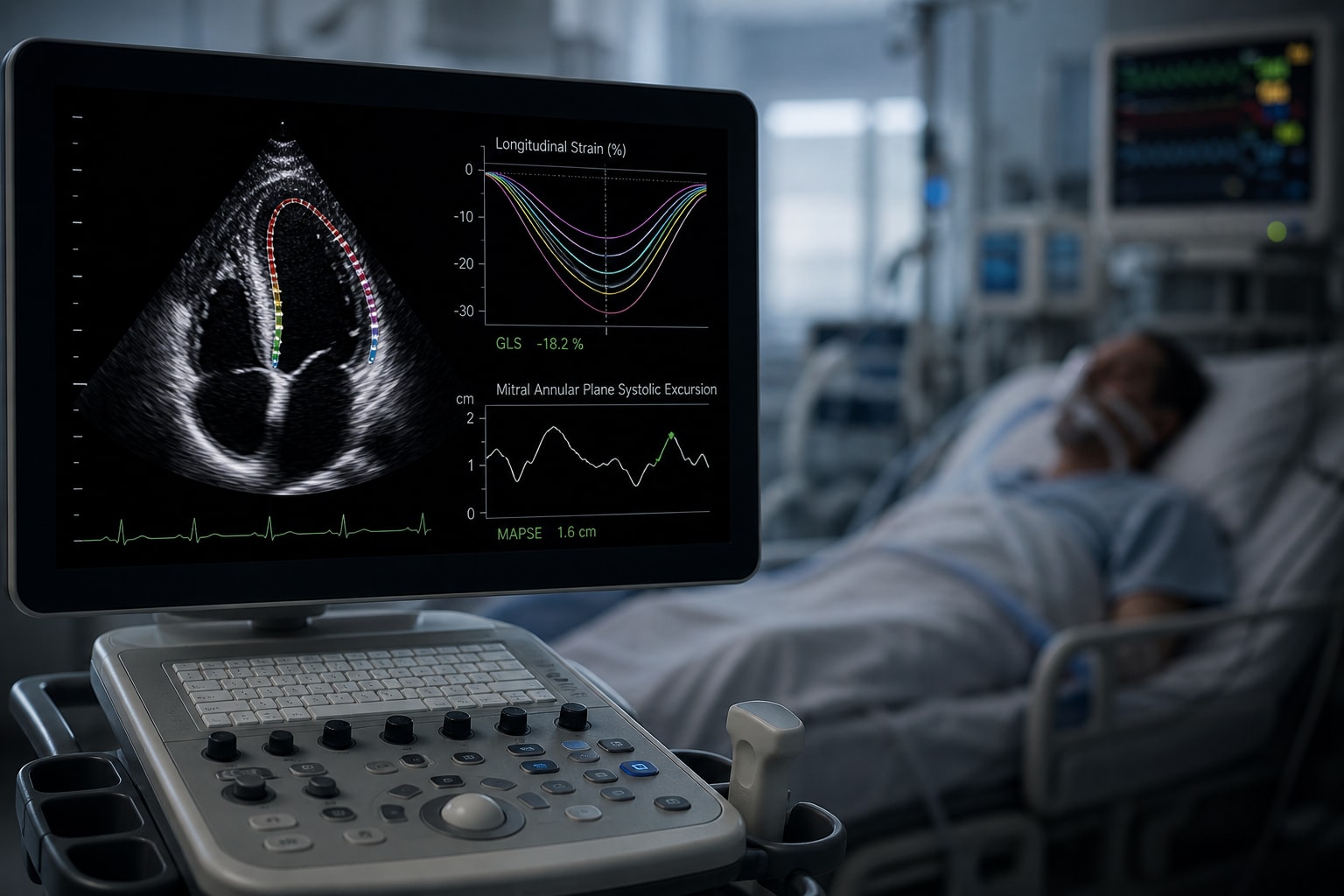
Response to “Left Ventricular Longitudinal Function and Hyperkinetic Profile: A New Echocardiographic Area for Exploration?”
-
By
-
Oscar Cavefors
-
Jonatan Oras
-
October 23, 2026
Clinical Scorecard: Response to “Left Ventricular Longitudinal Function and Hyperkinetic Profile: A New Echocardiographic Area for Exploration?”
At a Glance
| Category | Detail |
|---|---|
| Condition | Hyperdynamic left ventricular ejection fraction and longitudinal systolic function during critical illness |
| Key Mechanisms | The analyses compare LVEF with global longitudinal strain (GLS), mitral annular plane systolic excursion (MAPSE), and S′; the authors note these measures may not represent identical physiological processes. |
| Target Population | Patients in a mixed intensive care unit cohort with available LVEF and longitudinal systolic measurements |
| Care Setting | Critical care echocardiography in the intensive care unit |
Key Highlights
- Among patients with available LVEF, 48 (17%) had LVEF >70% and 177 (61%) had LVEF 50–70%.
- Ninety-day mortality was 27% with LVEF >70% and 23% with LVEF 50–70%; the adjusted difference was not statistically significant (OR 1.36, 95% CI 0.55–3.37; p=0.501).
- The LVEF >70% group had greater absolute GLS magnitude and modestly higher MAPSE; S′ did not differ significantly between groups.
- No distinct MAPSE, GLS, or S′ threshold corresponding to hyperdynamic LVEF was identified.
- High-value GLS, MAPSE, and S′ groups were not associated with 90-day mortality in unadjusted or adjusted analyses.
Guideline-Based Recommendations
Diagnosis
- The article reports exploratory comparisons using LVEF >70% to define the hyperdynamic group and LVEF 50–70% as the comparison group.
- No distinct longitudinal systolic marker threshold corresponding to a hyperdynamic LVEF profile was identified.
Management
- The article does not provide treatment recommendations.
Monitoring & Follow-up
- The authors support further examination of hyperdynamic LV phenotype in relation to longitudinal myocardial function, haemodynamic characteristics, and clinical outcomes.
Risks
- Interpret the mortality analyses cautiously: they were exploratory and included few patients with a hyperdynamic phenotype.
- The mortality difference between LVEF groups was not statistically significant, and none of the high-value longitudinal marker groups was associated with 90-day mortality.
Patient & Prescribing Data
Mixed ICU cohort; 48 patients had LVEF >70% and 177 had LVEF 50–70% among those with available LVEF.
No prescribing or treatment data are reported.
Clinical Best Practices
- Do not assume that preserved or elevated LVEF invariably indicates normal myocardial physiology.
- Interpret the reported associations as exploratory; the authors state that the findings require cautious interpretation.
- Consider LVEF and longitudinal systolic measurements as distinct measures; the analyses did not identify a matching hyperdynamic longitudinal profile.
Related Resources & Content
Based on findings from:
Answer to: “Left ventricular longitudinal function and hyperkinetic profile: a new echo world to explore?”
Oscar Cavefors, Jonatan Oras. Critical Care, 2026.
https://link.springer.com/article/10.1186/s13054-026-06403-0
This content is an AI-generated, fully rewritten summary based on a published scholarly article. It does not reproduce the original text and is not a substitute for the original publication. Readers are encouraged to consult the source for full context, data, and methodology.