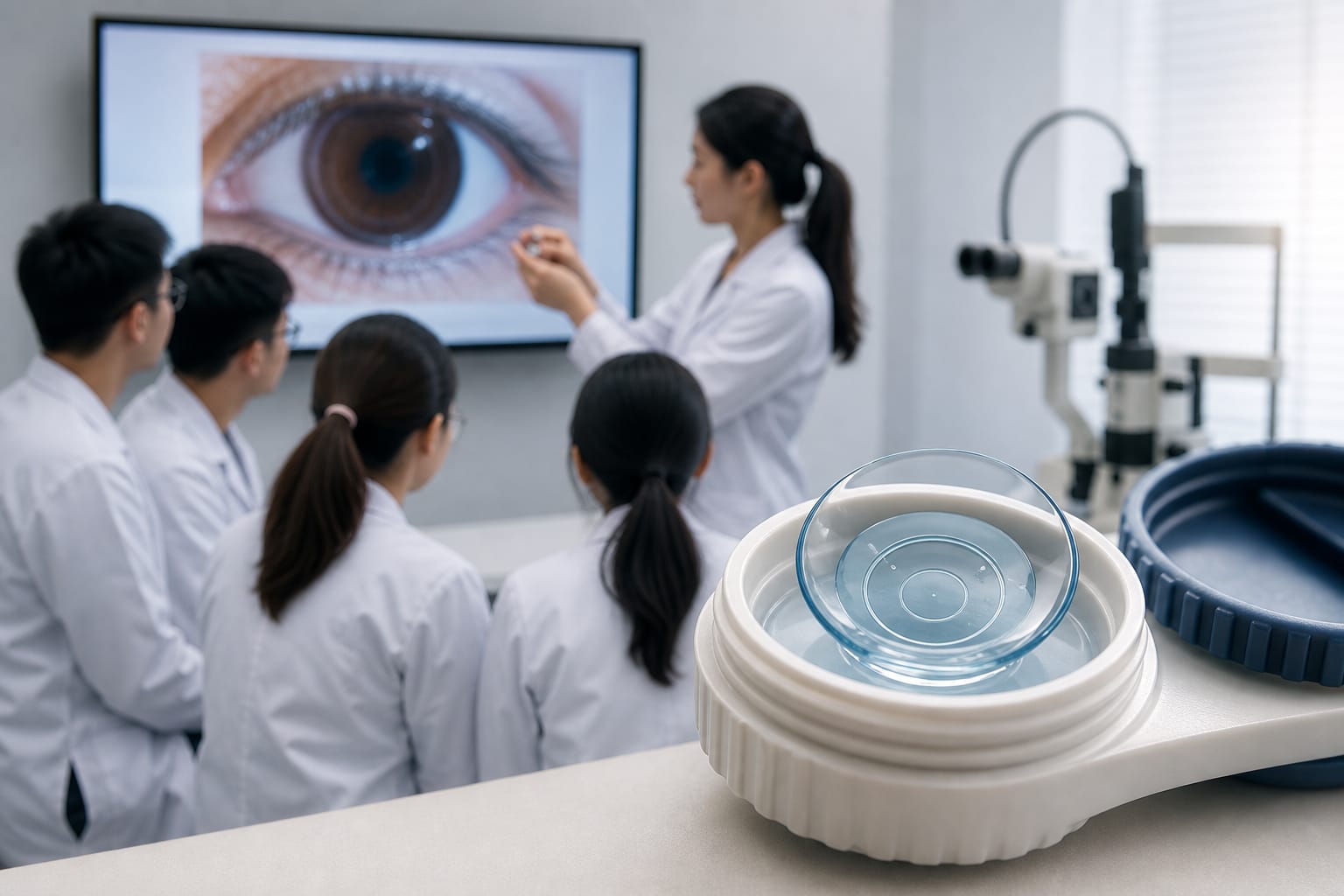
Orthokeratology Today: Topography Tells the Tale
-
By
-
CHERYL CHAPMAN, OD, FIAOMC, FAAO, DIPL ABO
-
March 1, 2026
-
4 min
Clinical Scorecard: Orthokeratology Today: Topography Tells the Tale
At a Glance
| Category | Detail |
|---|---|
| Condition | Myopia and corneal refractive changes |
| Key Mechanisms | Orthokeratology lenses reshape the cornea overnight to reduce myopia by altering corneal curvature and power |
| Target Population | Primarily myopic patients, especially younger patients with progressing myopia |
| Care Setting | Specialized optometry or ophthalmology clinics with access to corneal topography |
Key Highlights
- Topography is the most informative metric for assessing orthokeratology lens fit and performance.
- Tangential maps are critical for evaluating treatment zone size, shape, and centration; axial maps assess power change and optical quality.
- Treatment zone decentration may not require correction and can enhance myopia control, but mechanical fit issues should be addressed first.
Guideline-Based Recommendations
Diagnosis
- Use corneal topography maps (axial, tangential, elevation) to assess lens fit and corneal changes.
- Evaluate treatment zone size relative to pupil diameter to optimize optical outcomes and myopia control.
Management
- Adjust sagittal height or peripheral curves based on decentration direction to improve lens centration.
- Consider increasing treatment zone size in teenage patients to reduce nighttime glare and flare.
- Prioritize correcting mechanical fit issues before making optical changes.
Monitoring & Follow-up
- Use difference maps at follow-up visits to assess treatment stability and progression.
- Monitor treatment zone centration and size relative to pupil size, especially under mesopic conditions.
- Observe corneal health and patient symptoms before deciding on intervention for decentration.
Risks
- Inferior decentration may indicate excessive sagittal height or tight fit; superior decentration may indicate insufficient sagittal height.
- Decentration can cause ghosting or flare, particularly in low light conditions.
- Small treatment zones may increase myopia control but could affect visual quality.
Patient & Prescribing Data
Myopic patients, especially children and teenagers with progressive myopia
Smaller treatment zones are associated with stronger myopia control effects in younger patients; treatment zone size may need adjustment with age to balance control and visual quality.
Clinical Best Practices
- Use tangential maps to evaluate lens fit and axial maps to assess power change and optical quality.
- Interpret difference maps to monitor corneal changes and treatment progression.
- Address mechanical fit issues before modifying optical parameters.
- Consider patient age and symptoms when deciding on treatment zone size adjustments.
- Not all treatment zone decentration requires correction if vision and corneal health are stable.
References
- Gong et al, 2024 - Efficacy of orthokeratology lens with the modified small treatment zone on myopia progression and visual quality
- Wang and Yang, 2019 - Influence of overnight orthokeratology lens treatment zone decentration on myopia progression
- Hiraoka et al, 2015 - Influence of ocular wavefront aberrations on axial length elongation in myopic children treated with overnight orthokeratology
This content is an AI-generated, fully rewritten summary based on a published scholarly article. It does not reproduce the original text and is not a substitute for the original publication. Readers are encouraged to consult the source for full context, data, and methodology.