Development and validation of a prediction model for tuberculous peritoneal effusion
-
By
-
Libin Liu
-
Tingting Fang
-
Qianqian Peng
-
Hui Wei
-
Long Cai
-
June 19, 2026
-
Clinical Scorecard: Creation and assessment of a predictive model for diagnosing tuberculous peritoneal effusion
At a Glance
| Category | Detail |
|---|
| Condition | Tuberculous Peritoneal Effusion (TPE) |
| Key Mechanisms | Diagnosis based on clinical parameters and laboratory tests. |
| Target Population | Patients with suspected tuberculous peritoneal effusion. |
| Care Setting | Primary care and hospital settings. |
Key Highlights
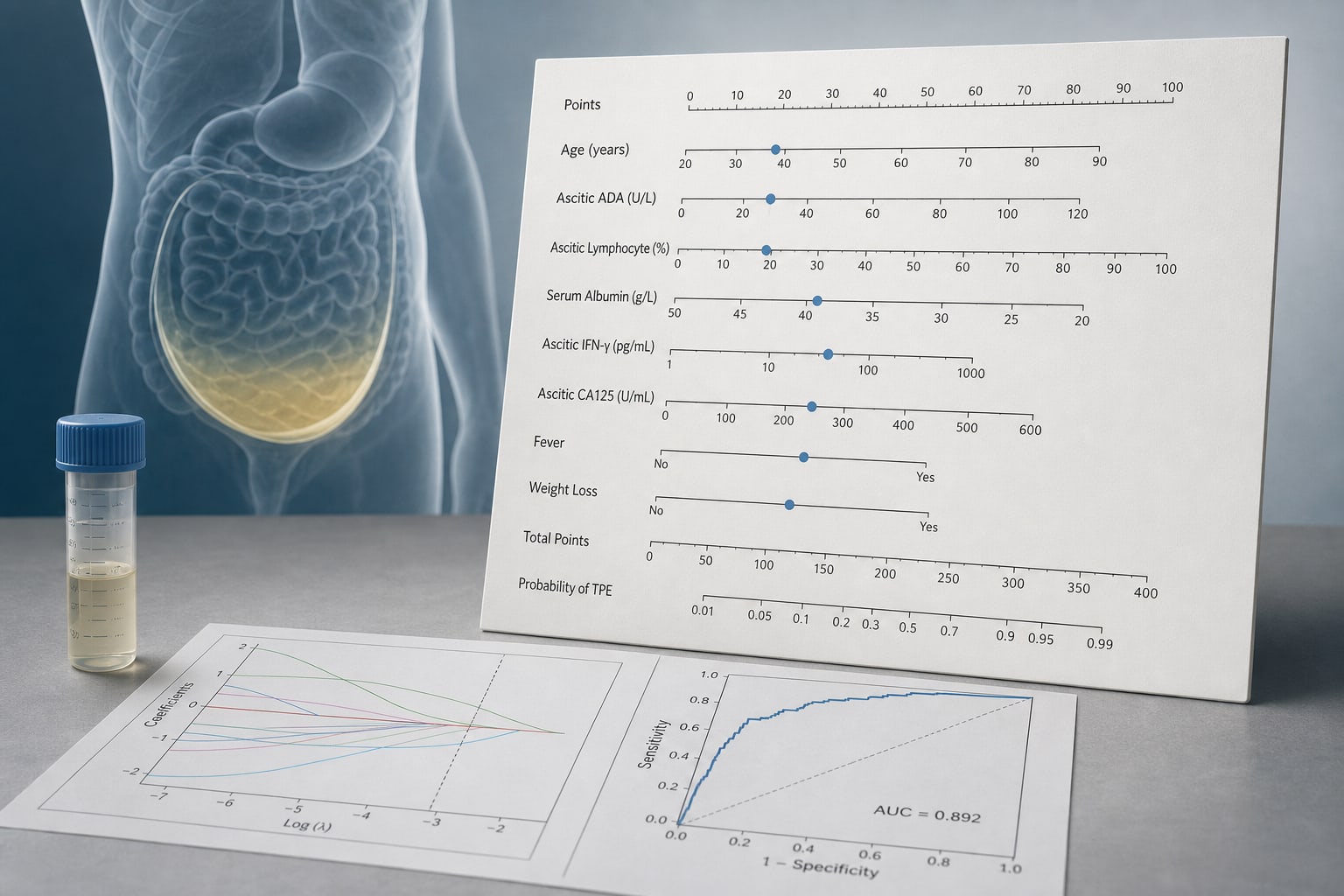
- Developed a nomogram for diagnosing TPE using seven clinical parameters.
- AUC of 0.974 in training group and 0.955 in validation group.
- Model outperforms single diagnostic indicators.
- Involves retrospective analysis of 351 patients.
- Identified independent predictors include age, fever, and ascitic fluid markers.
Guideline-Based Recommendations
Diagnosis
- Use the developed nomogram for diagnosing TPE.
Management
- Consider early differentiation of effusion types for effective treatment.
Monitoring & Follow-up
- Monitor patients for local and systemic complications if TPE is not diagnosed promptly.
Risks
- Delayed diagnosis can lead to complications such as adhesions and bowel obstruction.
Patient & Prescribing Data
351 patients, including 128 with TPE.
Effective response to anti-tuberculosis treatment is a diagnostic criterion.
Clinical Best Practices
- Utilize the nomogram for improved diagnostic accuracy.
- Incorporate multiple clinical parameters in the diagnostic process.
Related Resources & Content