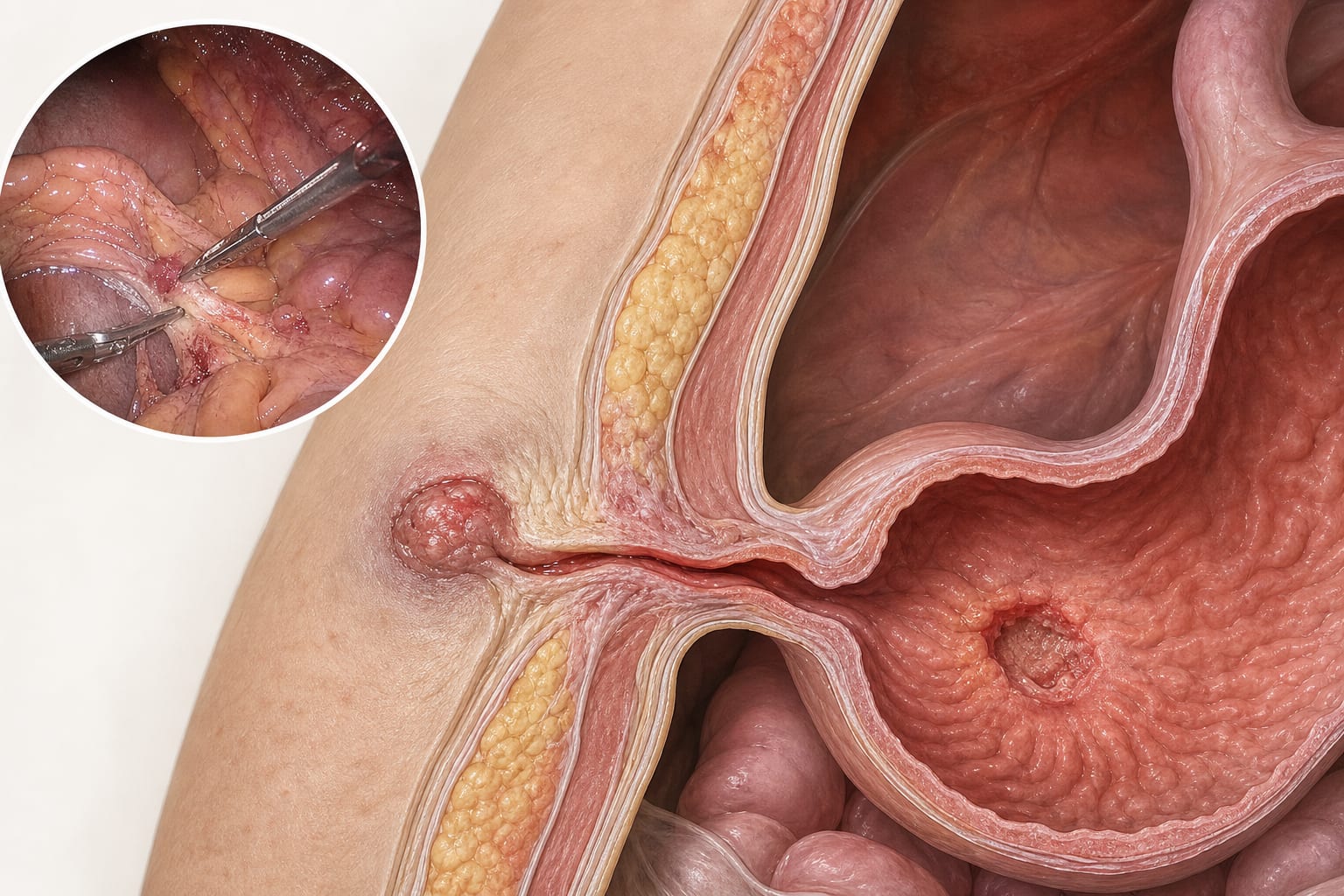
Spontaneous gastrocutaneous fistula presenting as a long-standing abdominal wall nodule: a case report
-
By
-
Qiu-Shi Huang
-
Ran Huang
-
Gang Xiao
-
Jian Shen
-
Shuo-Yang Huang
-
Shan He
-
Jun Bu
-
Xian-Zhe Yu
-
June 4, 2026
-
Clinical Scorecard: A Case Report of a Long-Standing Abdominal Wall Nodule Due to a Spontaneous Gastrocutaneous Fistula
At a Glance
| Category | Detail |
|---|
| Condition | |
| Key Mechanisms | |
| Target Population | Elderly patients, specifically those over 65 years, with chronic abdominal wall nodules |
| Care Setting | |
Key Highlights
- SGCF is uncommon and typically acquired from iatrogenic causes or trauma.
Guideline-Based Recommendations
Diagnosis
- Use imaging techniques such as CT and upper gastrointestinal contrast studies to confirm SGCF.
Management
- Surgical intervention is required for definitive management of SGCF.
Monitoring & Follow-up
- Monitor for complications such as infection or further gastrointestinal issues post-surgery.
Risks
- Potential for malignancy must be excluded through endoscopic evaluation.
Patient & Prescribing Data
Surgical resection is necessary for chronic SGCF cases, as supported by clinical guidelines.
Clinical Best Practices
- Conduct thorough imaging and endoscopic investigations in suspected SGCF cases, as per clinical guidelines.
- Ensure careful exclusion of malignancy before surgical intervention, following established protocols.
Related Resources & Content