Efficacy and safety of parathyroid hormone analogs therapy on hypoparathyroidism: a meta-analysis
-
By
-
Siting Li
-
Yuanfang Zhang
-
Li Zhao
-
Chao Ma
-
July 2, 2026
-
Clinical Scorecard: Assessment of Parathyroid Hormone Analog Therapy for Hypoparathyroidism: A Meta-Analysis on Efficacy and Safety
At a Glance
| Category | Detail |
|---|
| Condition | Hypoparathyroidism (HypoPTH) |
| Key Mechanisms | Reduced secretion of parathyroid hormone (PTH) leading to calcium and phosphorus metabolism disorders. |
| Target Population | Adults with chronic HypoPTH. |
| Care Setting | Clinical trials and systematic reviews. |
Key Highlights
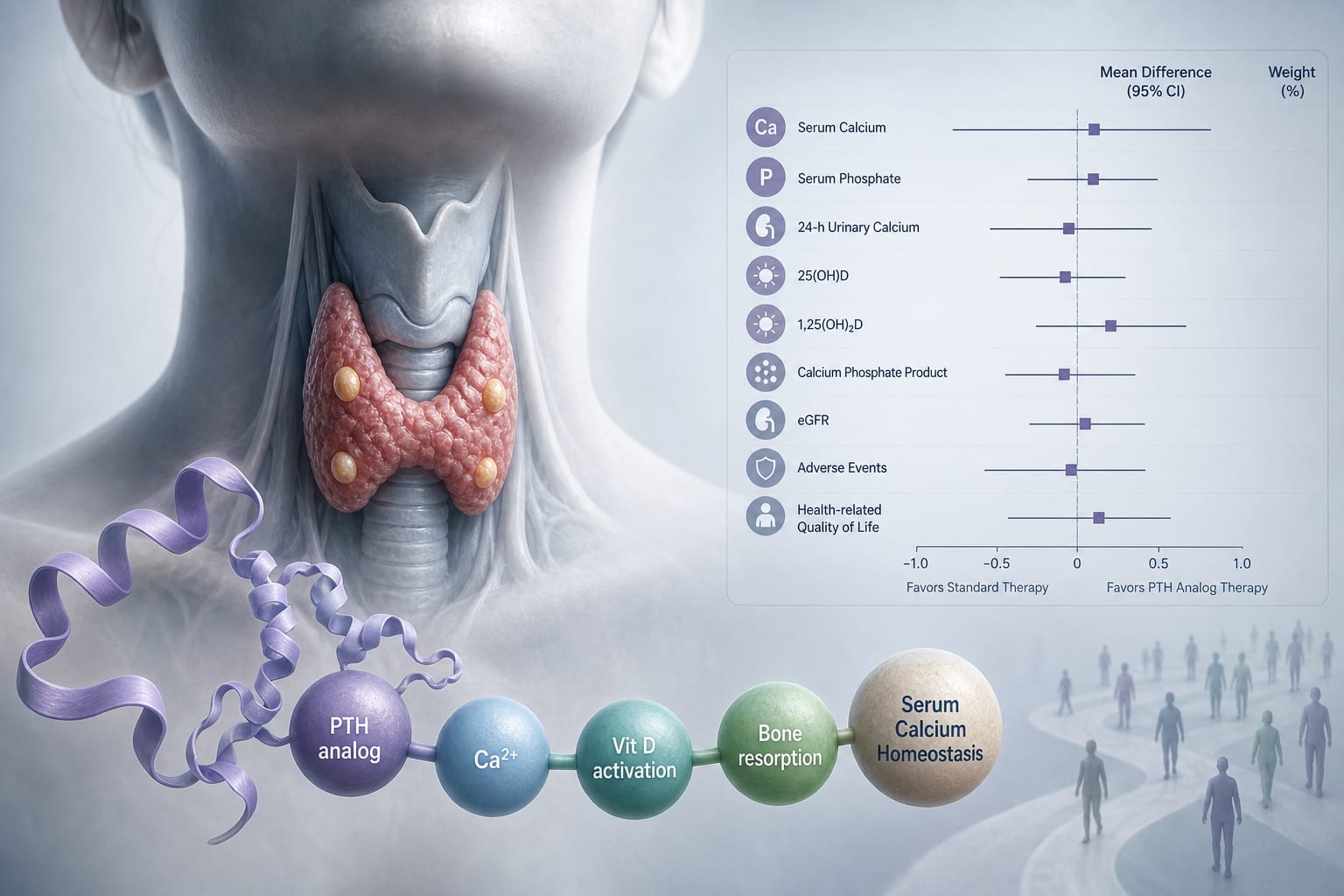
- PTH analogs therapy showed comparable control of serum calcium and phosphorus levels to conventional therapy.
- PTH analogs decreased serum 25(OH) vitamin D and increased serum 1,25(OH)2 vitamin D.
- PTH analogs significantly improved health-related quality of life (HRQoL) as measured by the SF-36 Health Survey.
Guideline-Based Recommendations
Diagnosis
- Diagnosis of HypoPTH is based on clinical symptoms and laboratory findings of hypocalcemia and hyperphosphatemia.
Management
- Conventional therapy includes calcium supplementation and active vitamin D (calcitriol). PTH analogs can be used as an alternative.
Monitoring & Follow-up
- Monitor serum calcium, serum phosphorus, and renal function (eGFR) regularly.
Risks
- Potential complications include hypercalciuria, nephrolithiasis, and renal insufficiency.
Patient & Prescribing Data
Adults with chronic HypoPTH requiring management of calcium and phosphorus levels.
PTH analogs may offer improved regulation of vitamin D levels and HRQoL.
Clinical Best Practices
- Consider PTH analogs for patients with poor control of hypocalcemia on conventional therapy.
- Regularly assess HRQoL in patients receiving treatment for HypoPTH.
Related Resources & Content