On-treatment change in bone turnover markers predicts 2-year bone mineral density after sequential therapy following romosozumab: a real-world cohort study - Scorecard - MDSpire
Conexiant’s news site is now MDSpire News. Learn more
Advertisement
Change in Bone Turnover Markers During Treatment as a Predictor of Two-Year Bone Mineral Density Following Sequential Romosozumab Therapy: Insights from a Real-World Cohort Study
Clinical Scorecard: Change in Bone Turnover Markers During Treatment as a Predictor of Two-Year Bone Mineral Density Following Sequential Romosozumab Therapy: Insights from a Real-World Cohort Study
At a Glance
Category
Detail
Condition
High-risk osteoporosis
Key Mechanisms
Romosozumab promotes bone formation and suppresses bone resorption.
Target Population
Patients with high-fracture-risk osteoporosis, predominantly female Japanese population.
Care Setting
Single-center retrospective cohort study.
Key Highlights
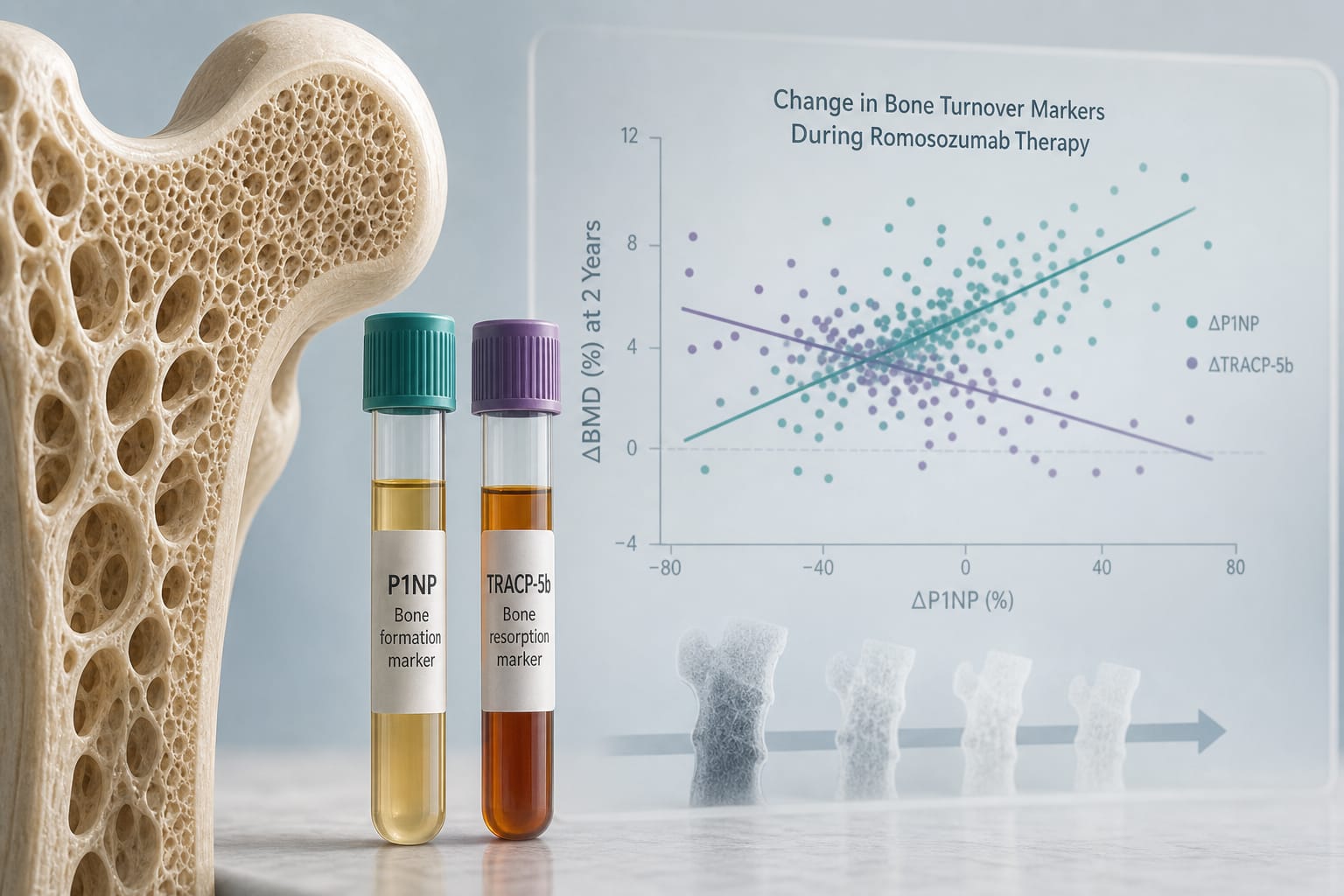
ΔP1NP decline during romosozumab treatment predicts cumulative BMD gain at 24 months.
Optimal ΔP1NP cutoff for predicting good response is −40.3 μg/L.
Greater decline in ΔP1NP correlates with higher cumulative LS-BMD gain.
Predictive value of ΔP1NP is stronger in treatment-naïve patients.
Guideline-Based Recommendations
Diagnosis
Monitor bone turnover markers (BTMs) during romosozumab treatment.
Management
Sequential antiresorptive therapy (denosumab or bisphosphonates) is required after romosozumab.
Monitoring & Follow-up
Evaluate changes in ΔP1NP and ΔTRACP-5b as predictors of long-term BMD.
Risks
Consider residual fracture risk in patients with low baseline P1NP.
Patient & Prescribing Data
315 patients treated with romosozumab for high-risk osteoporosis.
On-treatment ΔP1NP is an independent predictor of 2-year cumulative BMD.
Clinical Best Practices
Utilize ΔP1NP monitoring to guide treatment decisions.
Prioritize treatment-naïve patients for optimal outcomes.
Federal prosecutors allege that a Florida physician and research staff fabricated clinical trial records that were submitted into database systems used to evaluate investigational drugs.