Distress disclosure and health behaviours in patients with stroke: a theory-informed serial mediation model of social support, self-efficacy, and self-management - Scorecard - MDSpire
Coming Soon: Introducing MDSpire News. Learn more
Conexiant’s news site is now MDSpire News. Learn more

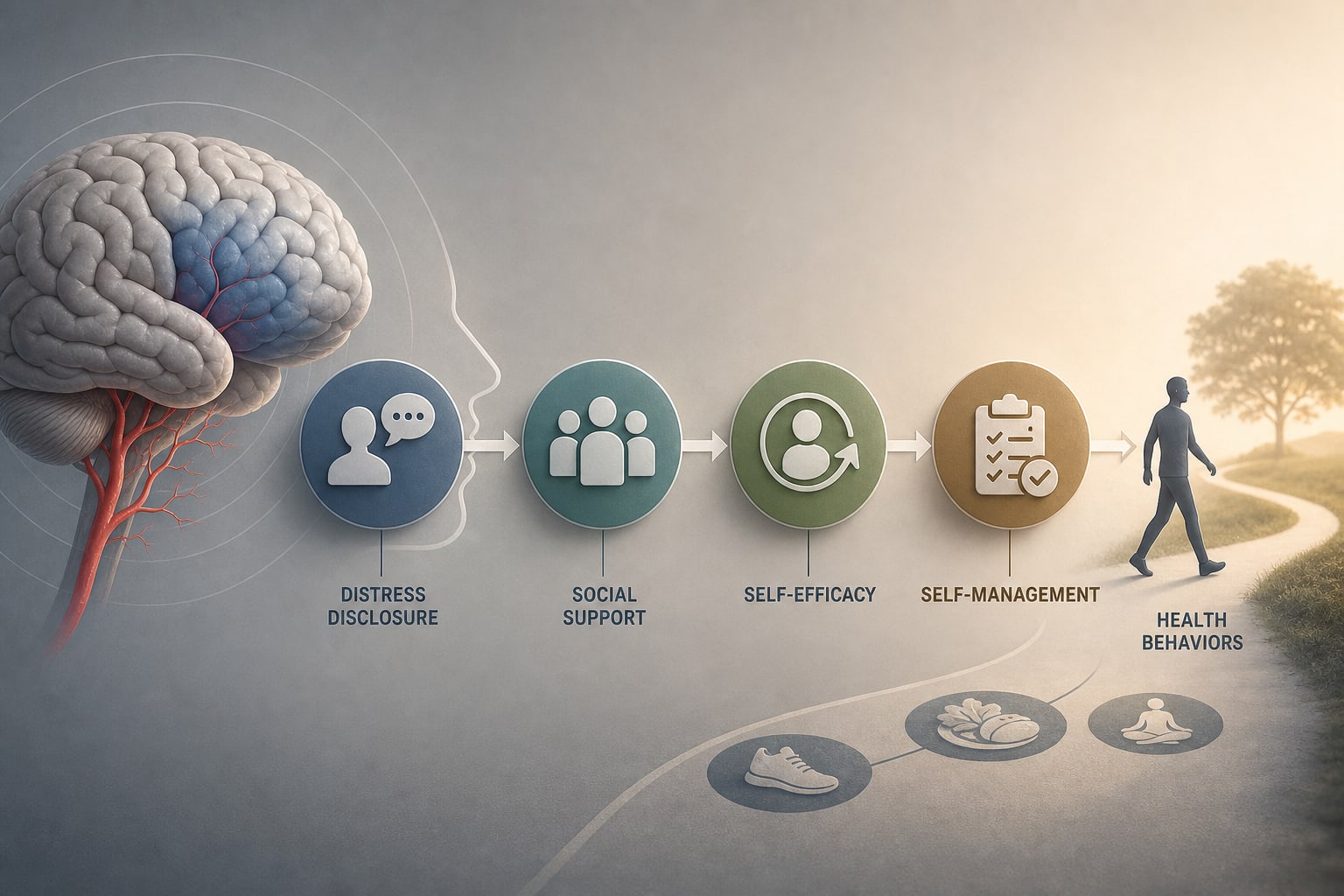
The Relationship Between Distress Disclosure and Health Behaviors in Stroke Patients: A Theory-Based Serial Mediation Analysis of Social Support, Self-Efficacy, and Self-Management

  • By

  • Xiaoqin Yang

  • Yan Han

  • Yuntian Liu

  • Huaqing Fan

  • Jie Wang

  • Feipeng Li

  • Yan He

  • August 21, 2026

Share

Clinical Scorecard: The Relationship Between Distress Disclosure and Health Behaviors in Stroke Patients: A Theory-Based Serial Mediation Analysis of Social Support, Self-Efficacy, and Self-Management

At a Glance

CategoryDetail
ConditionStroke
Key MechanismsDistress disclosure, social support, self-efficacy, self-management
Target PopulationPatients with stroke
Care SettingDepartment of Neurology, Baotou Central Hospital, Inner Mongolia, China

Key Highlights

  • Positive correlation between distress disclosure and health behaviours (r = 0.828, p < 0.001)
  • Significant indirect effects of social support, self-efficacy, and self-management on health behaviours
  • Health behaviours had a mean score of 60.65, indicating a moderate level
  • Social support produced the largest specific indirect effect (effect = 0.4749; 35.63% of total effect)

Guideline-Based Recommendations

Diagnosis

    Management

      Monitoring & Follow-up

        Risks

        • Inadequate behavioural implementation in stroke survivors can lead to increased risk of recurrent stroke.

        Patient & Prescribing Data

        473 stroke patients

        Clinical Best Practices

          Related Resources & Content

          Original Source(s)

          Related Content