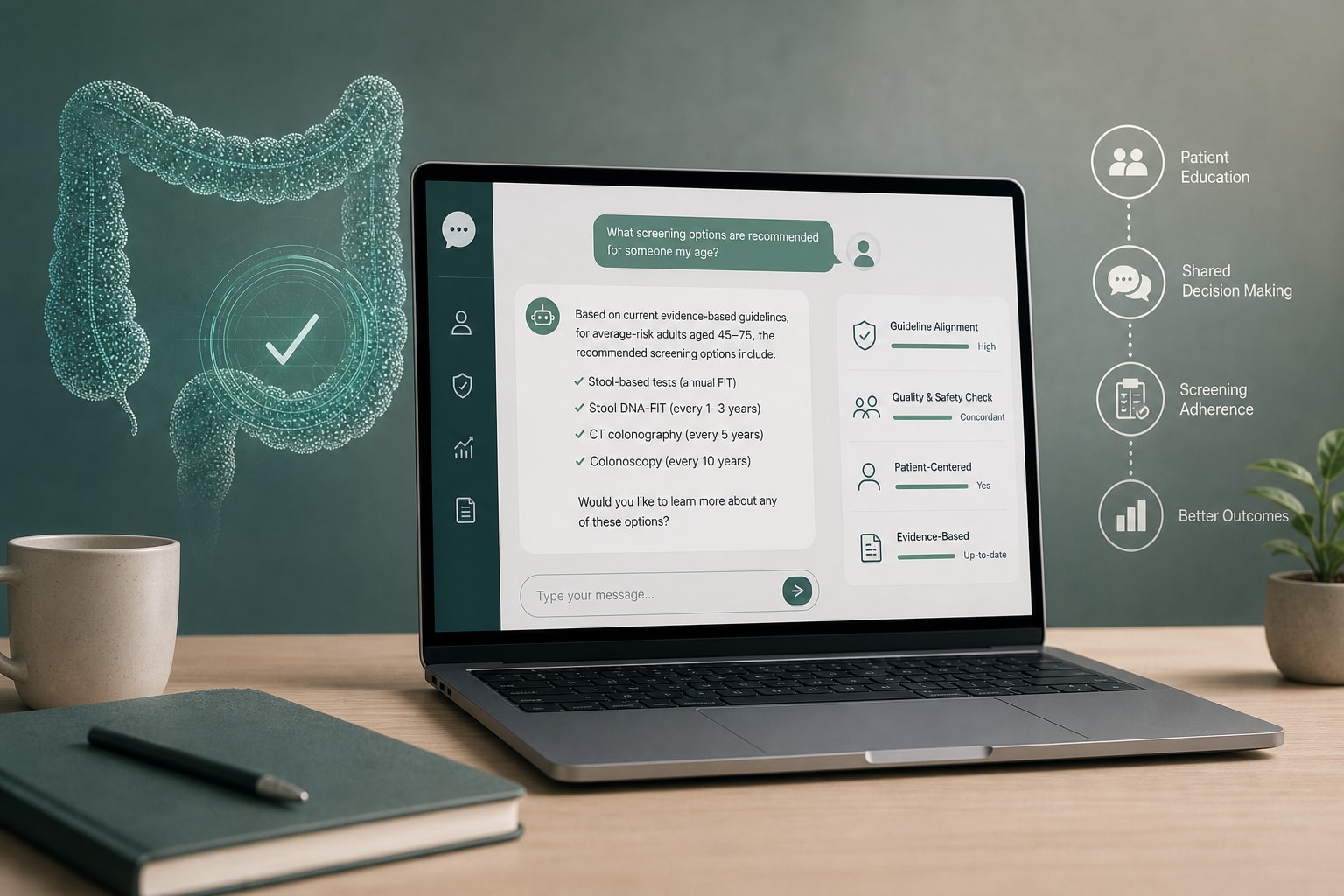
A Structured Chatbot Framework for Colorectal Cancer Screening Aligned with Guidelines: A Multistage Feasibility Assessment
-
By
-
Futao Wu
-
Xue Li
-
Yingyi Zeng
-
Yan Tang
-
Zhenhua Xiao
-
Siqi Yang
-
Kangcheng Wu
-
Side Liu
-
Aimin Li
-
July 16, 2026
Clinical Scorecard: A Structured Chatbot Framework for Colorectal Cancer Screening Aligned with Guidelines: A Multistage Feasibility Assessment
At a Glance
| Category | Detail |
|---|
| Condition | Colorectal Cancer Screening |
| Key Mechanisms | Utilization of large language models (LLMs) for patient education and guideline dissemination. |
| Target Population | Individuals eligible for colorectal cancer screening. |
| Care Setting | Clinical settings implementing colorectal cancer screening programs. |
Key Highlights
- Colorectal cancer is the third most common cancer globally.
- Screening can significantly reduce CRC incidence and mortality.
- Real-world adherence to CRC screening is between 13% and 55%.
- LLMs are increasingly used in healthcare for patient education.
- Evidence supporting LLMs in CRC screening is limited.
Guideline-Based Recommendations
Diagnosis
- Screening for colorectal cancer should follow established guidelines.
Management
- Utilize structured workflows for risk assessment and screening recommendations.
Monitoring & Follow-up
- Evaluate the performance of LLMs in generating guideline-concordant recommendations.
Risks
- Inconsistencies between AI-generated recommendations and current screening guidelines.
Patient & Prescribing Data
Individuals at risk for colorectal cancer.
Awareness and education are critical for improving screening uptake.
Clinical Best Practices
- Ensure alignment of LLM outputs with established screening guidelines.
- Address psychological barriers to screening through education.
Related Resources & Content