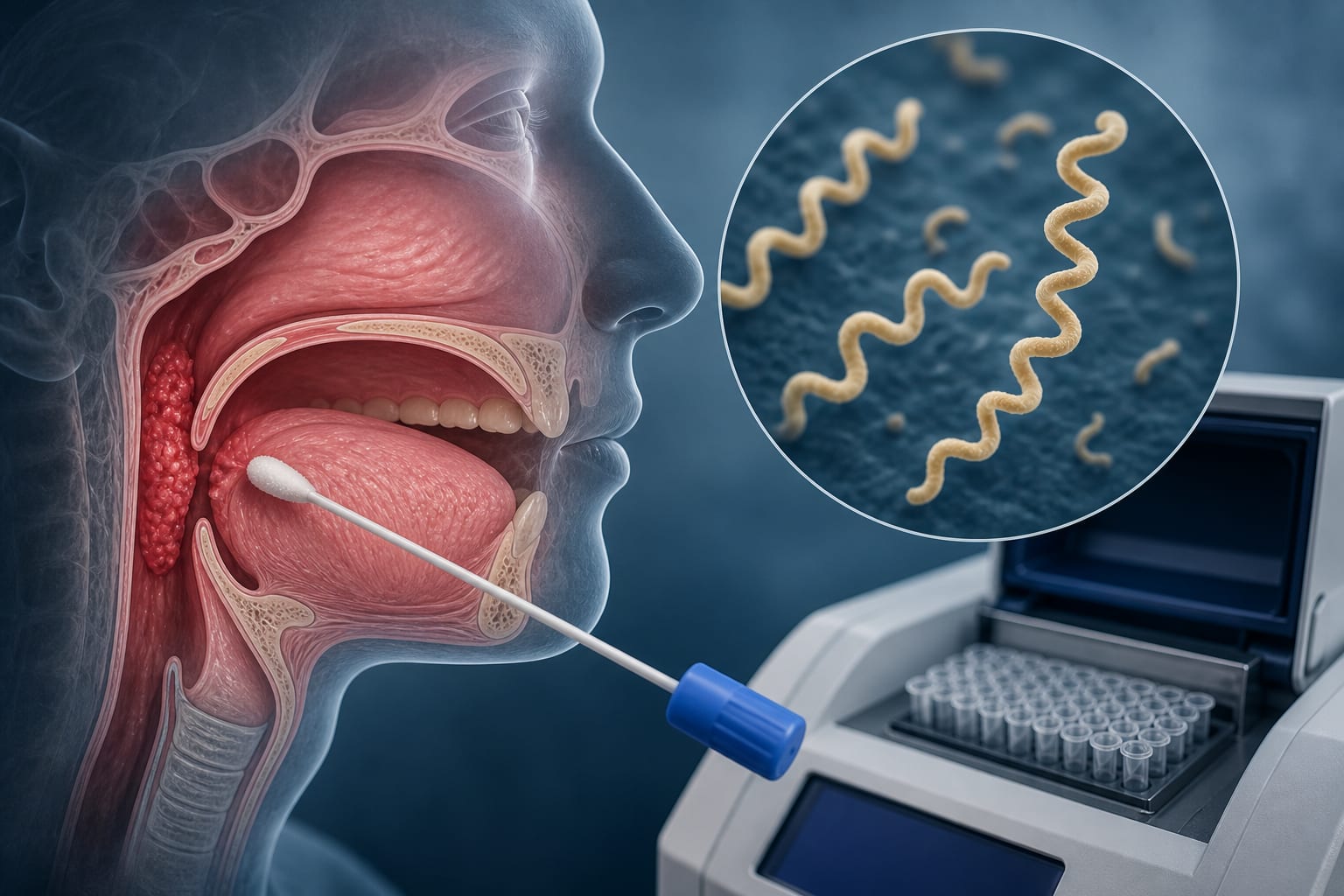
Prevalent Detection of Treponema pallidum DNA in the Oropharynx of Syphilis Patients: A Cross-Sectional Analysis Across Three Anatomical Sampling Locations
-
By
-
Damian Kadylak
-
Justyna Czarny-Kamm
-
Maciej Pastuszczak
-
Małgorzata Sokołowska-Wojdyło
-
September 21, 2026
Clinical Scorecard: Prevalent Detection of Treponema pallidum DNA in the Oropharynx of Syphilis Patients: A Cross-Sectional Analysis Across Three Anatomical Sampling Locations
At a Glance
Category | Detail |
|---|---|
Condition | Syphilis |
Key Mechanisms | Detection of Treponema pallidum DNA by PCR in oropharyngeal, anorectal, and urogenital specimens. PCR positivity indicates DNA detection; it does not establish organism viability or infectiousness. |
Target Population | Adults aged 18 years or older with serologically confirmed syphilis. |
Care Setting | A specialist sexually transmitted infection (STI) clinic in Gdańsk, Poland. |
Key Highlights
The study included 70 patients and 171 anatomical-site samples.
PCR positivity was highest in oropharyngeal samples (27/65, 41.5%), compared with urogenital (13/65, 20.0%) and anorectal (8/41, 19.5%) samples.
Oropharyngeal samples had higher adjusted odds of positivity than urogenital samples.
Positivity was associated with early syphilis and higher VDRL titers.
Of 48 PCR-positive samples, 31 (64.6%) came from sites with neither local symptoms nor objective clinical findings.
Guideline-Based Recommendations
Diagnosis
The European guidelines discussed in the paper place serology at the center of syphilis diagnosis. PCR is used for direct detection, primarily from suitable lesion material in selected clinical settings.
This study identifies oropharyngeal sampling for prospective evaluation as an adjunct when suspected early syphilis cannot be assessed with suitable lesion material. It does not establish routine oropharyngeal PCR testing.
Management
The study staged syphilis according to European guidelines. It did not evaluate treatment or provide a new management recommendation.
Monitoring & Follow-up
Serology remains central to follow-up. For this study, reinfection was defined in part by a fourfold or greater rise in VDRL titer after prior adequate treatment.
Risks
A positive mucosal PCR result does not establish infectiousness. The study could not directly determine the assay’s specificity in oropharyngeal samples because it lacked syphilis-negative oropharyngeal controls and independent molecular confirmation of positive results.
Patient & Prescribing Data
The primary analysis included 70 patients with serologically confirmed syphilis. Eight additional patients who had received systemic antibiotics within four weeks before sampling were excluded from that analysis but included in a sensitivity analysis. The study did not compare treatments or prescribing practices.
Clinical Best Practices
Continue to rely on serology for diagnosis and follow-up, with direct detection from suitable lesions in selected circumstances as described in the guidelines cited by the authors. The study does not support routine PCR screening of asymptomatic contacts or unselected high-risk populations, an HIV-specific testing strategy, or replacement of serology. Prospective studies are needed before oropharyngeal sampling can be recommended for routine practice.
Related Resources & Content
Publication details below come from the supplied paper and its reference list:
Kadylak D, Czarny-Kamm J, Pastuszczak M, Sokołowska-Wojdyło M. “Frequent oropharyngeal detection of Treponema pallidum DNA in patients with syphilis: a cross-sectional study of three anatomical sampling sites.” International Journal of Infectious Diseases. 2026;171:109049.
European Centre for Disease Prevention and Control. “Syphilis.” Annual Epidemiological Report for 2023. European Centre for Disease Prevention and Control. 2025.
Janier M, Unemo M, Dupin N, Tiplica GS, Potočnik M, Patel R. “2020 European guideline on the management of syphilis.” Journal of the European Academy of Dermatology and Venereology. 2021;35:574–588.
Papp JR, Park IU, Fakile Y, Pereira L, Pillay A, Bolan GA. “CDC laboratory recommendations for syphilis testing, United States, 2024.” MMWR Recommendations and Reports. 2024;73:1–32.
Towns JM, Leslie DE, Denham I, et al. “Treponema pallidum detection in lesion and non-lesion sites in men who have sex with men with early syphilis: a prospective, cross-sectional study.” The Lancet Infectious Diseases. 2021;21:1324–1331.
Based on findings from:
Frequent oropharyngeal detection of Treponema pallidum DNA in patients with syphilis: a cross-sectional study of three anatomical sampling sites
Damian Kadylak, Justyna Czarny-Kamm, Maciej Pastuszczak, Małgorzata Sokołowska-Wojdyło. International Journal Of Infectious Diseases, 2026.
https://www.sciencedirect.com/science/article/pii/S1201971226006843
This content is an AI-generated, fully rewritten summary based on a published scholarly article. It does not reproduce the original text and is not a substitute for the original publication. Readers are encouraged to consult the source for full context, data, and methodology.