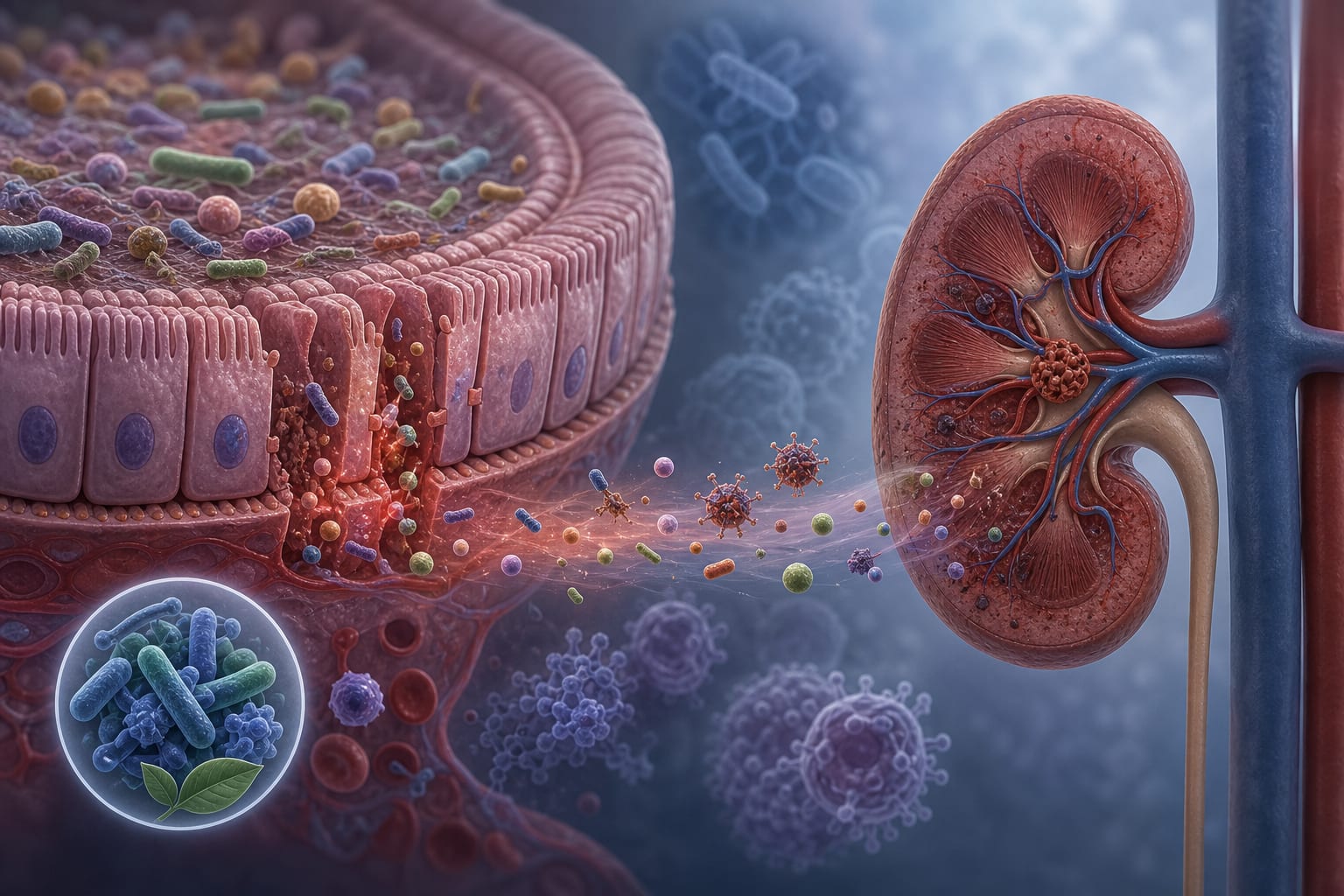
The Role of Gut Microbiota in Acute Kidney Injury Related to Sepsis: A Comprehensive Review
-
By
-
Hui Zhang
-
Bingling Fan
-
Ruze Ma
-
Ruowen Jiang
-
Zan Qin
-
Xueping Qu
-
Junwu Wang
-
Jiawei Xue
-
Caixia Wang
-
Xiaoqin Liu
-
Litao Guo
-
June 2, 2026
Clinical Scorecard: The Role of Gut Microbiota in Acute Kidney Injury Related to Sepsis: A Comprehensive Review
At a Glance
| Category | Detail |
|---|
| Condition | |
| Key Mechanisms | Gut dysbiosis, intestinal barrier dysfunction, translocation of bacterial products, renal signaling pathways. |
| Target Population | |
| Care Setting | |
Key Highlights
- SA-AKI incidence is approximately 40% to 50% with a mortality rate up to 70% in ICU patients.
- Gut dysbiosis leads to loss of microbial diversity and expansion of pathobionts.
- Translocation of bacterial products activates systemic inflammation and renal injury.
- Specific microbial signatures associated with AKI include increased Clostridium asparagiforme and decreased Roseburia spp.
Guideline-Based Recommendations
Diagnosis
- Identify gut dysbiosis and its impact on renal function in septic patients.
Management
- Consider targeting the gut-kidney axis through microbiota modulation.
Monitoring & Follow-up
- Monitor serum levels of uremic toxins like indoxyl sulfate and p-cresyl sulfate.
Risks
- Increased risk of renal dysfunction and systemic inflammation due to gut dysbiosis.
Patient & Prescribing Data
Patients with sepsis and acute kidney injury.
Clinical Best Practices
- Assess gut microbiota composition in patients with SA-AKI.
- Implement strategies to restore intestinal barrier integrity.
- Evaluate the role of gut-derived metabolites in renal inflammation.
Related Resources & Content