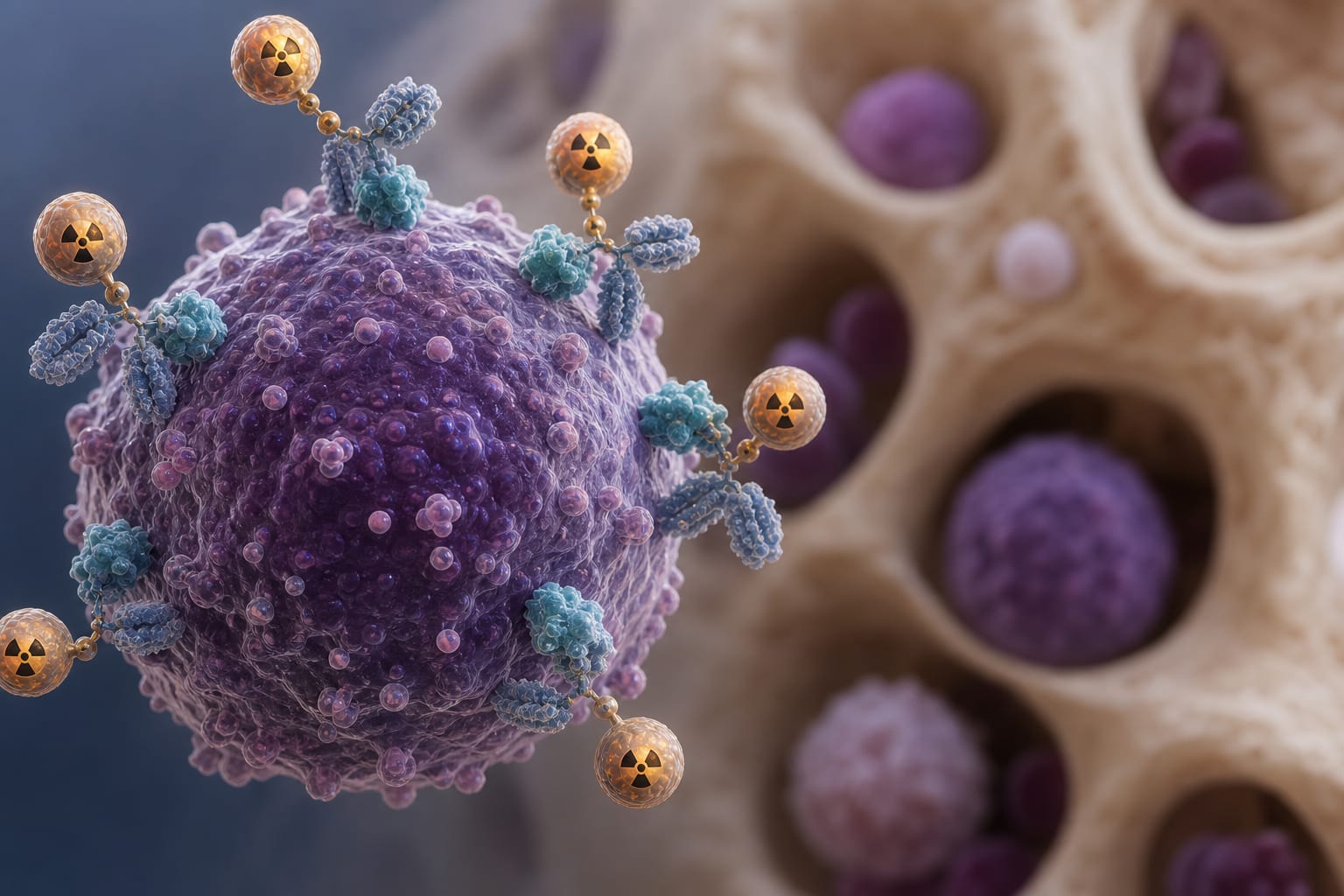
Clinical Scorecard: Utilizing Radioimmunotherapy as a Targeted Approach in Reduced-Intensity Conditioning for Allogeneic Transplantation in Leukemia
At a Glance
Category
Detail
Condition
Leukemia
Key Mechanisms
Radioimmunotherapy (RIT) enhances cytoreductive effects by delivering targeted radiation to hematopoietic malignancies while sparing nonhematopoietic organs.
Target Population
Patients with acute myeloid leukemia (AML) and other myeloid neoplasms, particularly those with adverse molecular/cytogenetics or measurable residual disease (MRD).
Care Setting
Allogeneic hematopoietic transplantation (allo-HCT) with reduced-intensity conditioning (RIC).
Key Highlights
RIC has expanded allo-HCT use in older patients and those with comorbidities.
RIT targets specific antigens like CD45, enhancing radiation delivery to leukemia cells.
Hepatic toxicity is a common limitation of therapeutic doses in RIT.
Emerging interest in α-emitters for localized radiation delivery.
Current evidence is primarily from early-phase studies.
Guideline-Based Recommendations
Diagnosis
Assess cytogenetics and molecular findings in patients with AML.
Management
Consider RIT in combination with fludarabine-based RIC regimens for improved disease control.
Monitoring & Follow-up
Monitor for organ-specific toxicity, particularly hepatic complications.
Risks
Increased risk of treatment-related mortality with conventional total body irradiation (TBI).
Patient & Prescribing Data
Patients with AML and significant comorbidities or adverse disease characteristics.
RIT may facilitate more effective graft-versus-leukemia (GVL) effects without increasing graft-versus-host disease risk.
Clinical Best Practices
Evaluate MRD status to guide transplant decision-making.
Incorporate targeted therapies prior to allo-HCT to improve disease control.
Consider organ-specific dose assessment in RIT to minimize toxicity.
Working at Roswell Park will afford you incredible opportunities to work alongside some of the nation’s foremost clinicians and researchers to broaden your career experiences and be part of a team that eases the burden of cancer.