Asymmetric surge optimization during peak seasons: a discrete-event simulation of centralized fast-track operating rooms at a China National Children's Medical Center - Scorecard - MDSpire
Conexiant’s news site is now MDSpire News. Learn more
Advertisement
Optimizing Asymmetric Surgical Demand During Peak Seasons: A Discrete-Event Simulation of Centralized Fast-Track Operating Rooms at a Pediatric Medical Center in China
Clinical Scorecard: Optimizing Asymmetric Surgical Demand During Peak Seasons: A Discrete-Event Simulation of Centralized Fast-Track Operating Rooms at a Pediatric Medical Center in China
At a Glance
Category
Detail
Condition
Pediatric Surgery Demand Management
Key Mechanisms
Discrete-event simulation for optimizing operating room allocation and throughput.
Target Population
Pediatric patients requiring elective surgeries.
Care Setting
Pediatric medical center during peak surgical demand periods.
Key Highlights
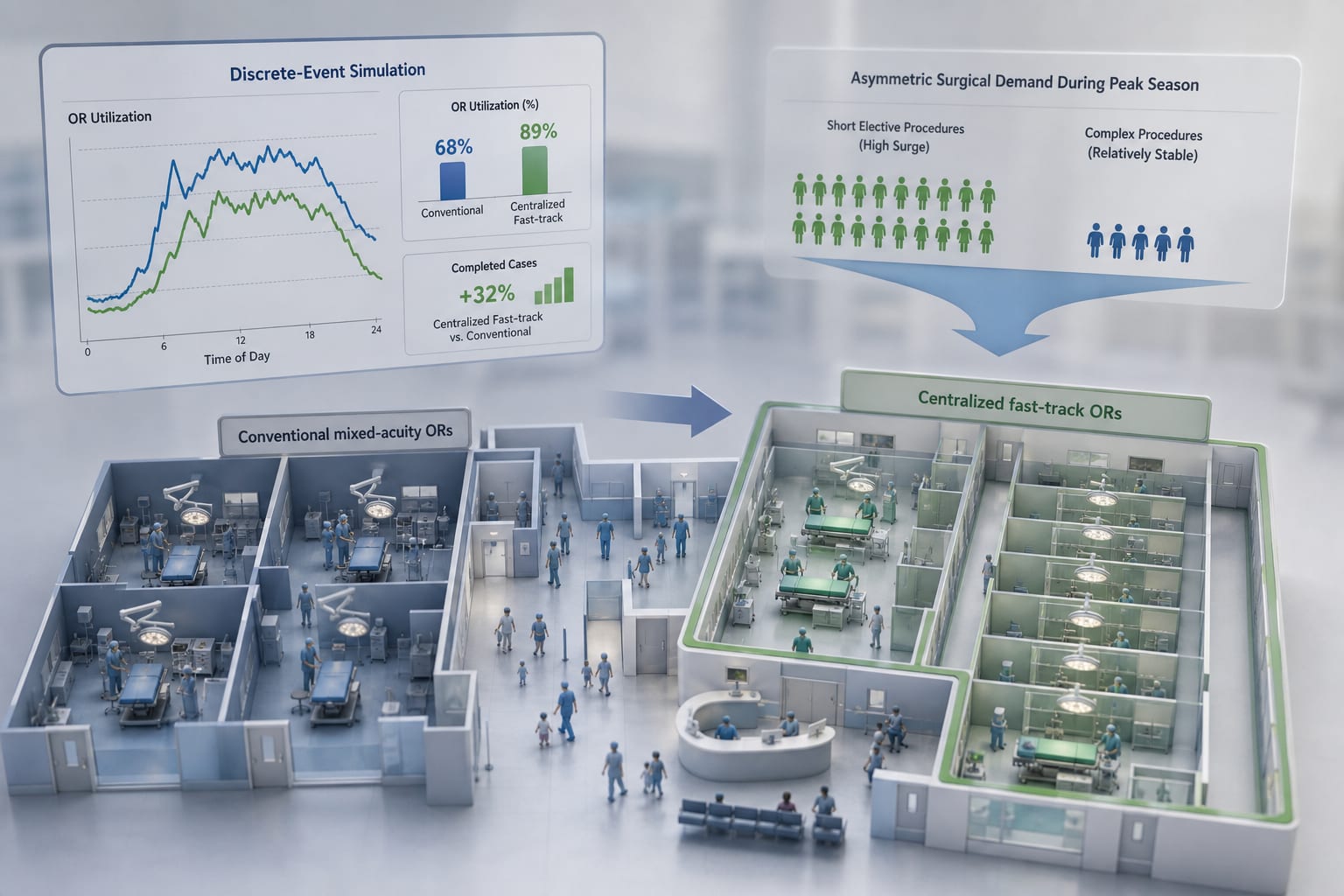
Surge in pediatric surgeries during summer holidays is asymmetric, with short elective procedures increasing significantly.
Centralized fast-track OR allocation improves throughput while protecting complex surgery access.
Optimized turnover times can increase surgical case throughput by over 38% compared to historical baselines.
Guideline-Based Recommendations
Diagnosis
Management
Implement centralized fast-track ORs to manage surgical demand effectively.
Monitoring & Follow-up
Utilize discrete-event simulation to assess OR capacity and throughput.
Risks
Capacity fragmentation may penalize low-volume specialties if not managed properly.
Patient & Prescribing Data
Children undergoing elective surgical procedures.
Fast-track procedures should be separated from complex surgeries to optimize OR utilization.
Clinical Best Practices
Employ dynamic safety-buffer policies in OR scheduling.
Conduct sensitivity analyses to evaluate turnover time reductions.
Baptist Health South Florida will host the Baptist Health Heart & Vascular Care 43rd Annual Echocardiography and Structural Heart Symposium on Oct. 2-3 at the Loews Coral Gables Hotel.