Application of the guidewire anchoring technique in lateral approach transforaminal endoscopic lumbar foraminoplasty: a propensity score–matched retrospective study - Scorecard - MDSpire
Coming Soon: Introducing MDSpire News. Learn more
Conexiant’s news site is now MDSpire News. Learn more

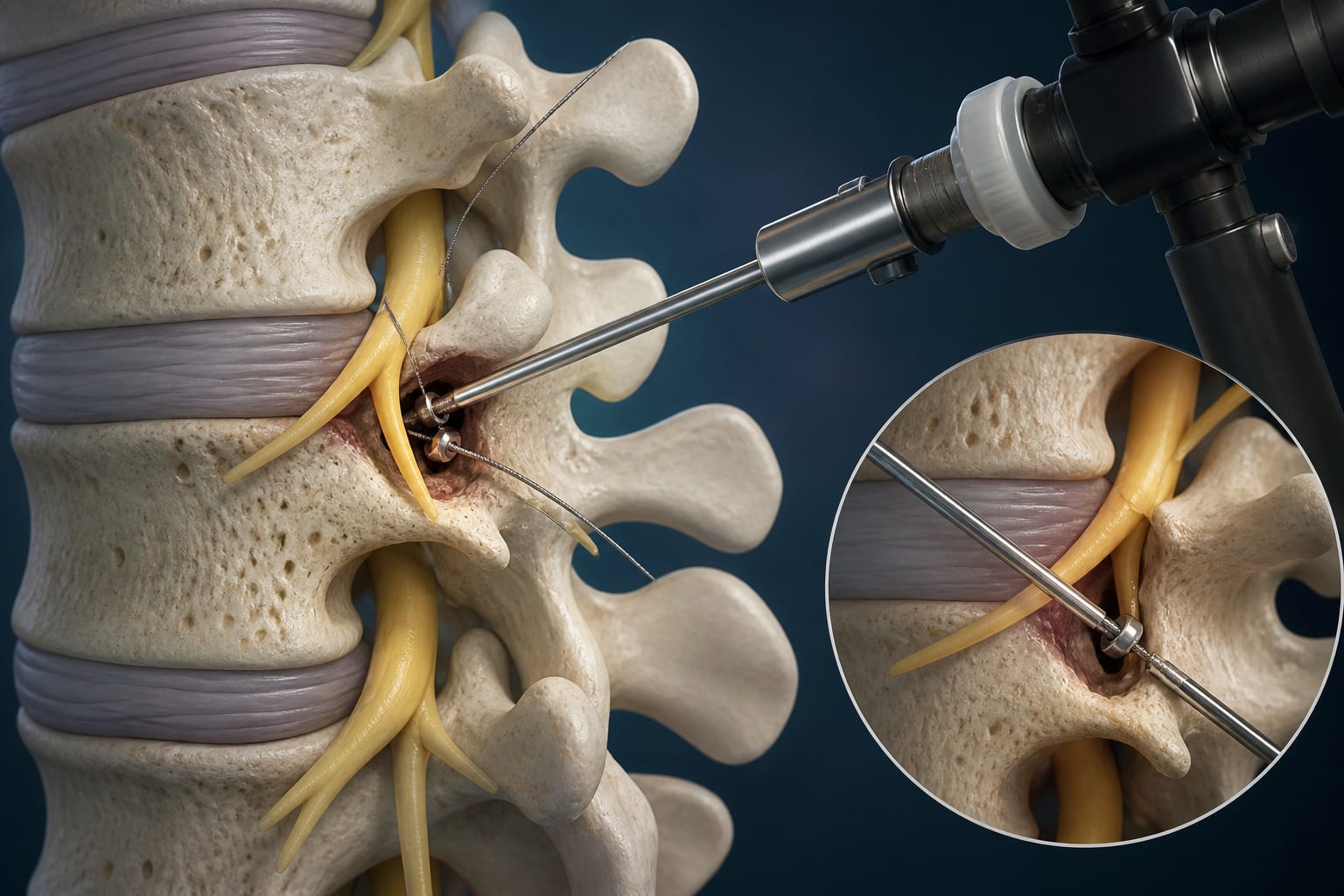
Utilization of a Guidewire Stabilization Method in Lateral Transforaminal Endoscopic Lumbar Foraminoplasty: A Retrospective Study with Propensity Score Matching
  • By

  • Guoxing Ding

  • Huijing Shang

  • Fuhai Yan

  • Weijie Cui

  • Zhi Li

  • Yiheng Zhang

  • Zhan Wang

  • Yifan Feng

  • Junxiao Su

  • Hui Zhang

  • August 27, 2026

Share

Clinical Scorecard: Utilization of a Guidewire Stabilization Method in Lateral Transforaminal Endoscopic Lumbar Foraminoplasty: A Retrospective Study with Propensity Score Matching

At a Glance

CategoryDetail
ConditionLateral Transforaminal Endoscopic Lumbar Foraminoplasty
Key MechanismsGuidewire anchoring technique for bony localization during foraminoplasty.
Target PopulationPatients with single-level L4/5 or L5/S1 disc herniation.
Care SettingSpine Surgery Department at Gansu Provincial People’s Hospital.

Key Highlights

  • Guidewire anchoring technique reduces total operative duration and fluoroscopic exposure.
  • Lower incidence of transient nerve irritation in the anchoring group compared to conventional.
  • No significant difference in NRS and ODI scores between groups at 1 day and 3 months postoperatively.
  • At 12 months, NRS was significantly lower in the anchoring group, but did not reach established MCID.
  • Study involved 60 patients with a 1:1 propensity score matching.

Guideline-Based Recommendations

Diagnosis

  • Confirm single-level protruded or sequestered disc herniation via CT/MRI.

Management

  • Utilize guidewire anchoring technique for enhanced operative efficiency in TELD.

Monitoring & Follow-up

  • Assess neurological complications and pain relief using NRS and ODI scores at multiple time points.

Risks

  • Monitor for transient nerve irritation and nerve injury during the procedure.

Patient & Prescribing Data

Patients experiencing radiating leg pain with a positive straight-leg raise test.

Patients should have symptoms persisting after at least three months of conservative treatment.

Clinical Best Practices

  • Ensure all surgical team members have completed a minimum of 100 independent standard TELD cases.
  • Perform propensity score matching to enhance baseline comparability between treatment groups.

Related Resources & Content

Original Source(s)

Related Content