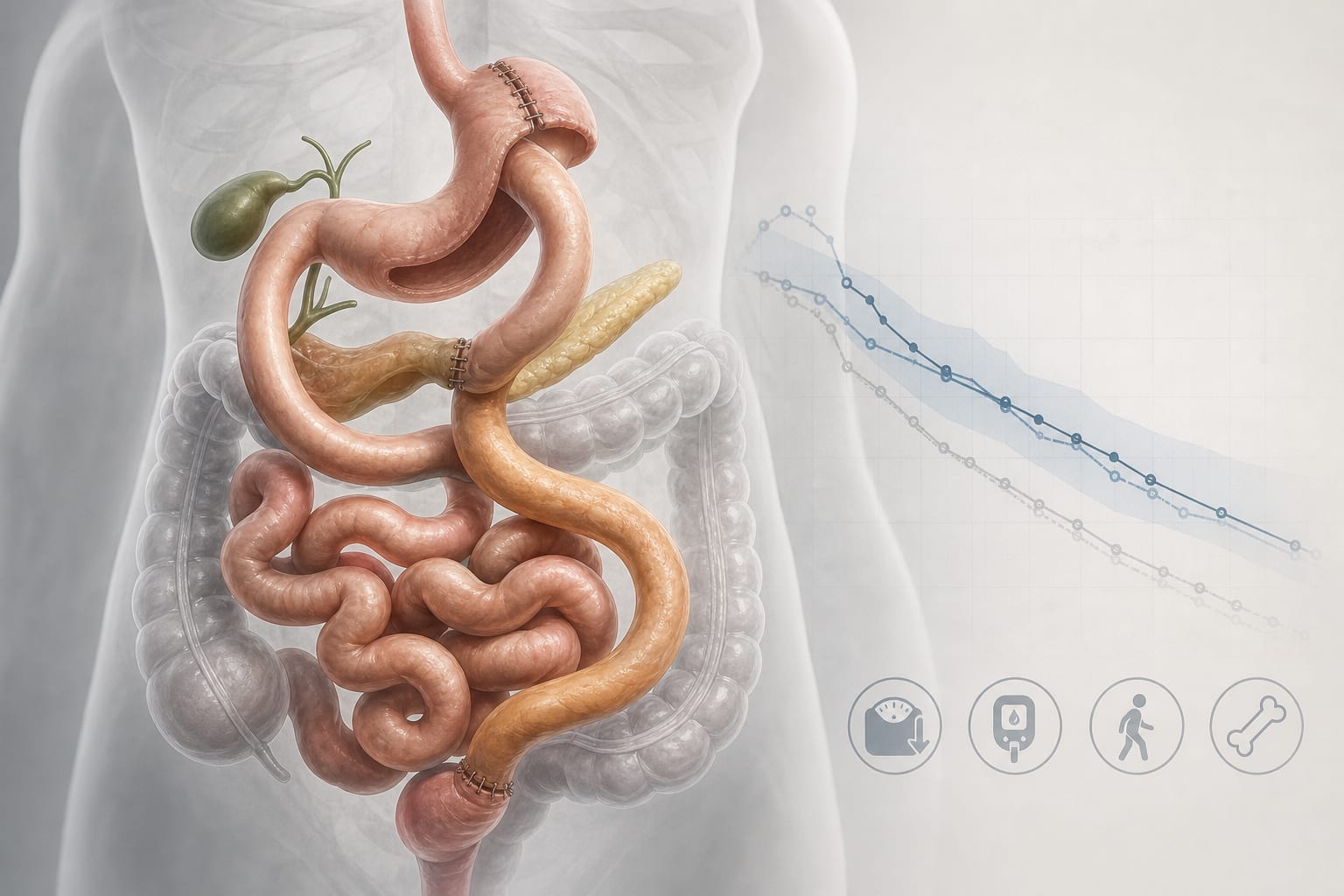
Clinical Scorecard: Outcomes of Laparoscopic Sleeve Gastrectomy After a Decade: A Comprehensive Review of Long-Term Studies
At a Glance
Category
Detail
Condition
Severe obesity and associated metabolic disorders
Key Mechanisms
Restrictive bariatric surgery reducing stomach volume to induce weight loss and metabolic improvements
Target Population
Patients with severe obesity meeting BMI thresholds for metabolic surgery
Care Setting
Metabolic and bariatric surgery centers with long-term follow-up capabilities
Key Highlights
Laparoscopic sleeve gastrectomy (LSG) achieves >20% total weight loss at 10+ years with average remission rates of type 2 diabetes (45.6%) and hypertension (41.4%).
De novo gastro-esophageal reflux disease (GERD) occurs in approximately one-third of patients post-LSG, with a low incidence (0.5%) of Barrett’s esophagus reported.
Revisional surgery is required in about 19.2% of patients within 10 years, mostly conversion to Roux-en-Y gastric bypass to address weight recurrence or GERD.
Guideline-Based Recommendations
Diagnosis
Remission of diabetes defined as fasting glucose <126 mg/dL on two occasions and HbA1c <6.55% without antidiabetic medications.
Hypertension remission defined as blood pressure <140/90 mmHg without antihypertensive drugs.
GERD diagnosis based on symptom assessment; endoscopy not routinely performed in all patients.
Management
LSG is recommended as a stand-alone metabolic and bariatric surgery for severe obesity.
Revisional surgery considered for weight persistence/recurrence or GERD, with Roux-en-Y gastric bypass as the most common secondary procedure.
Other revisional options include duodenal switch, one anastomosis gastric bypass, single anastomosis duodeno-ileal bypass, and hiatal hernia repair.
Monitoring & Follow-up
Long-term follow-up (≥10 years) to assess weight loss durability, metabolic remission, and development of GERD or Barrett’s esophagus.
Symptom monitoring for GERD and consideration of endoscopic evaluation when clinically indicated.
Risks
Development of de novo GERD in approximately 32.3% of patients post-LSG.
Potential, though low, risk of Barrett’s esophagus (0.5%) associated with chronic reflux.
Need for revisional surgery in nearly one-fifth of patients due to weight regain or GERD.
Patient & Prescribing Data
Adults with severe obesity undergoing laparoscopic sleeve gastrectomy
LSG provides durable weight loss and metabolic benefits at 10+ years, but requires monitoring for GERD and possible revisional surgery in a subset of patients.
Clinical Best Practices
Adhere to international BMI thresholds for metabolic surgery eligibility.
Use standardized definitions for diabetes and hypertension remission to evaluate outcomes.
Implement long-term follow-up protocols including symptom assessment for GERD.
Consider revisional surgery primarily with Roux-en-Y gastric bypass for patients with weight recurrence or GERD symptoms.
Recognize variability in surgical technique and definitions of weight regain may affect outcomes.
FOXC1 duplications were the second most common monogenic finding among genetically solved juvenile open-angle glaucoma cases in one registry, supporting the use of copy-number variant analysis in early-onset glaucoma testing.