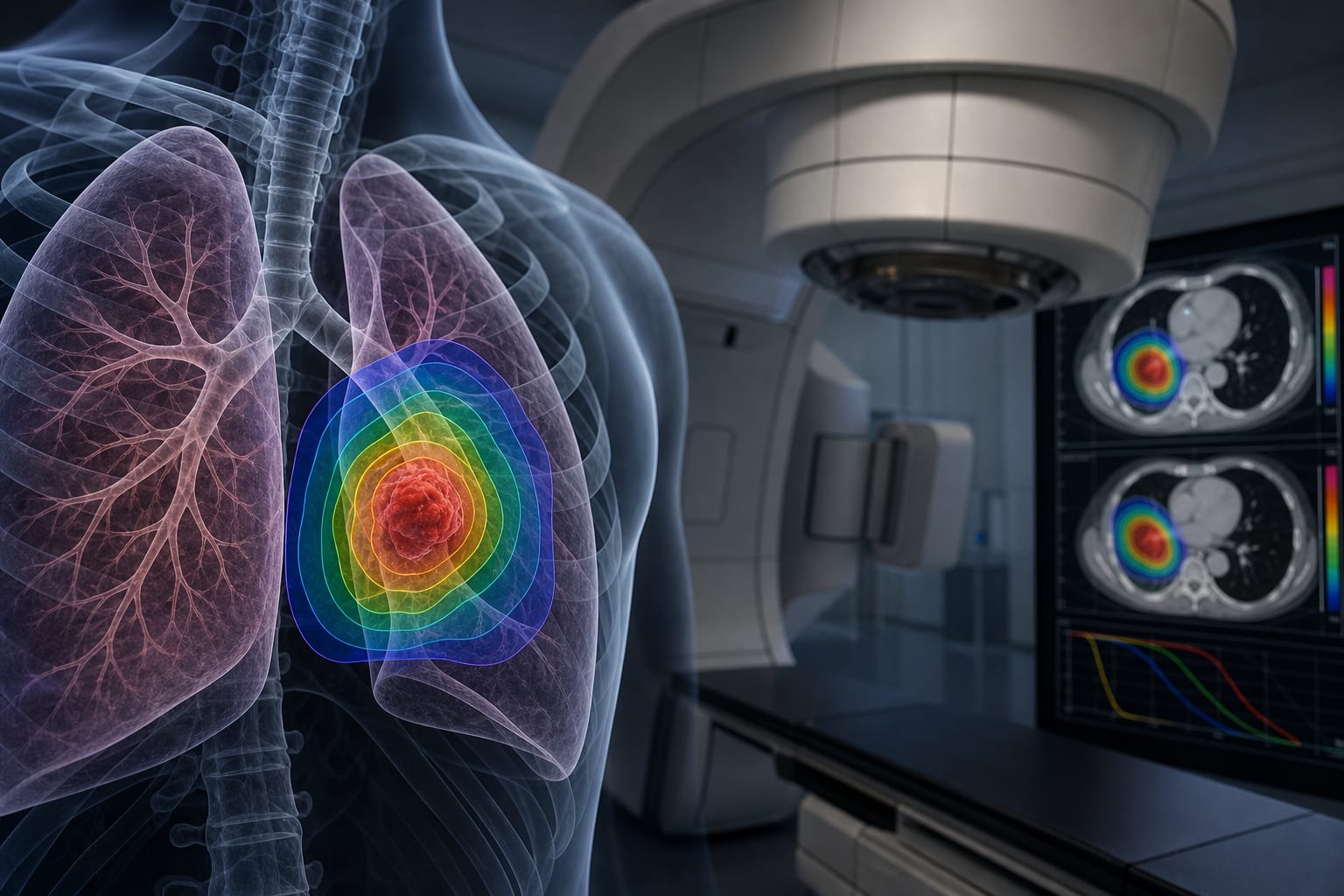
Dosimetric and clinical outcomes of stereotactic body radiotherapy for primary lung cancer: isocenter-based vs. volume-based prescription - Scorecard - MDSpire
Advertisement
Dosimetric and clinical outcomes of stereotactic body radiotherapy for primary lung cancer: isocenter-based vs. volume-based prescription
Clinical Scorecard: Comparative Analysis of Dosimetric and Clinical Results in Stereotactic Body Radiotherapy for Primary Lung Cancer: Isocenter-Based Versus Volume-Based Dose Prescriptions
At a Glance
Category
Detail
Condition
Early-stage non-small cell lung cancer (NSCLC)
Key Mechanisms
Stereotactic body radiotherapy (SBRT) with dose prescription methods
Target Population
Patients with T1–T2aN0M0 NSCLC who are medically inoperable or decline surgery
Care Setting
Retrospective analysis at a single institution
Key Highlights
Volume-based prescriptions show superior dosimetric outcomes compared to isocenter-based prescriptions.
Three-year overall survival rates were significantly higher in the volume-based group (95.0% vs. 64.0%).
Volume-based planning resulted in reduced lung radiation exposure.
Incidence of Grade 2–5 radiation pneumonitis was comparable between both groups.
Guideline-Based Recommendations
Diagnosis
Histological confirmation or highly suspicious nodules on CT with malignant PET avidity.
Management
Utilize volume-based dose prescriptions for SBRT in early-stage NSCLC.
Monitoring & Follow-up
Follow-up duration of at least 6 months post-treatment.
Risks
Monitor for radiation-induced pneumonitis, though incidence is similar between prescription methods.
Patient & Prescribing Data
88 consecutive patients with T1–T2aN0M0 NSCLC treated with SBRT.
Volume-based prescriptions enhance dosimetric quality without increasing pulmonary toxicity.
Clinical Best Practices
Adopt volume-based dose prescription methods for improved clinical outcomes.
Ensure accurate patient immobilization and treatment planning using advanced imaging techniques.