Donor–recipient HLA molecular mismatch and T follicular helper-related genetic variants are associated with dnDSA development after kidney transplantation - Scorecard - MDSpire
Advertisement
Donor–recipient HLA molecular mismatch and T follicular helper-related genetic variants are associated with dnDSA development after kidney transplantation
Clinical Scorecard: Association of HLA Molecular Discrepancies and T Follicular Helper Gene Variants with the Development of De Novo Donor-Specific Antibodies Following Kidney Transplantation
At a Glance
Category
Detail
Condition
De novo donor-specific antibodies (dnDSAs) after kidney transplantation
Key Mechanisms
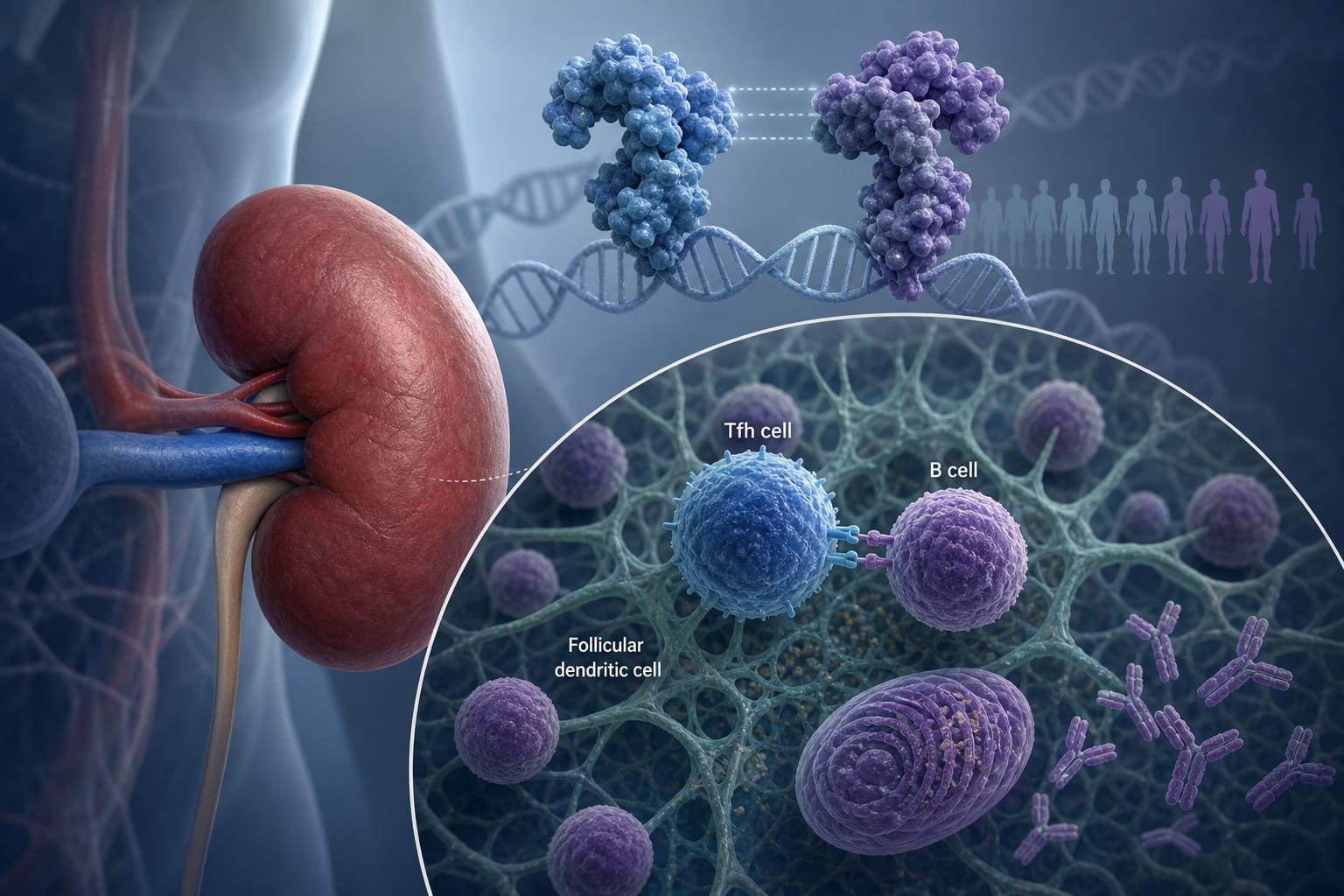
HLA molecular mismatch and T follicular helper (Tfh) cell-related immunogenetic variation
Target Population
Kidney transplant recipients
Care Setting
Transplantation centers
Key Highlights
20 recipients (9.5%) developed class II dnDSAs during follow-up.
Higher class II molecular mismatch loads were significantly associated with dnDSA development.
HLA-EMMA showed the strongest association among evaluated metrics.
High HLA-EMMA class II load and Tfh-related immunogenetic variation were independently associated with dnDSA development.
Recipients with both high HLA-EMMA class II load and Tfh-related polymorphisms showed the highest cumulative incidence of dnDSA development.
Guideline-Based Recommendations
Diagnosis
Management
A
d
d
s
p
e
c
i
f
i
c
m
a
n
a
g
e
m
e
n
t
r
e
c
o
m
m
e
n
d
a
t
i
o
n
s
r
e
l
a
t
e
d
t
o
d
n
D
S
A
d
e
v
e
l
o
p
m
e
n
t
.
Monitoring & Follow-up
Risks
Patient & Prescribing Data
210 kidney transplant recipients analyzed in the study.
Integration of HLA molecular mismatch with Tfh-related genetic variations may improve risk stratification for dnDSA development.
Clinical Best Practices
Utilize molecular mismatch algorithms for assessing donor-recipient HLA compatibility.
Consider recipient Tfh-related genetic polymorphisms in risk assessments for dnDSA development.