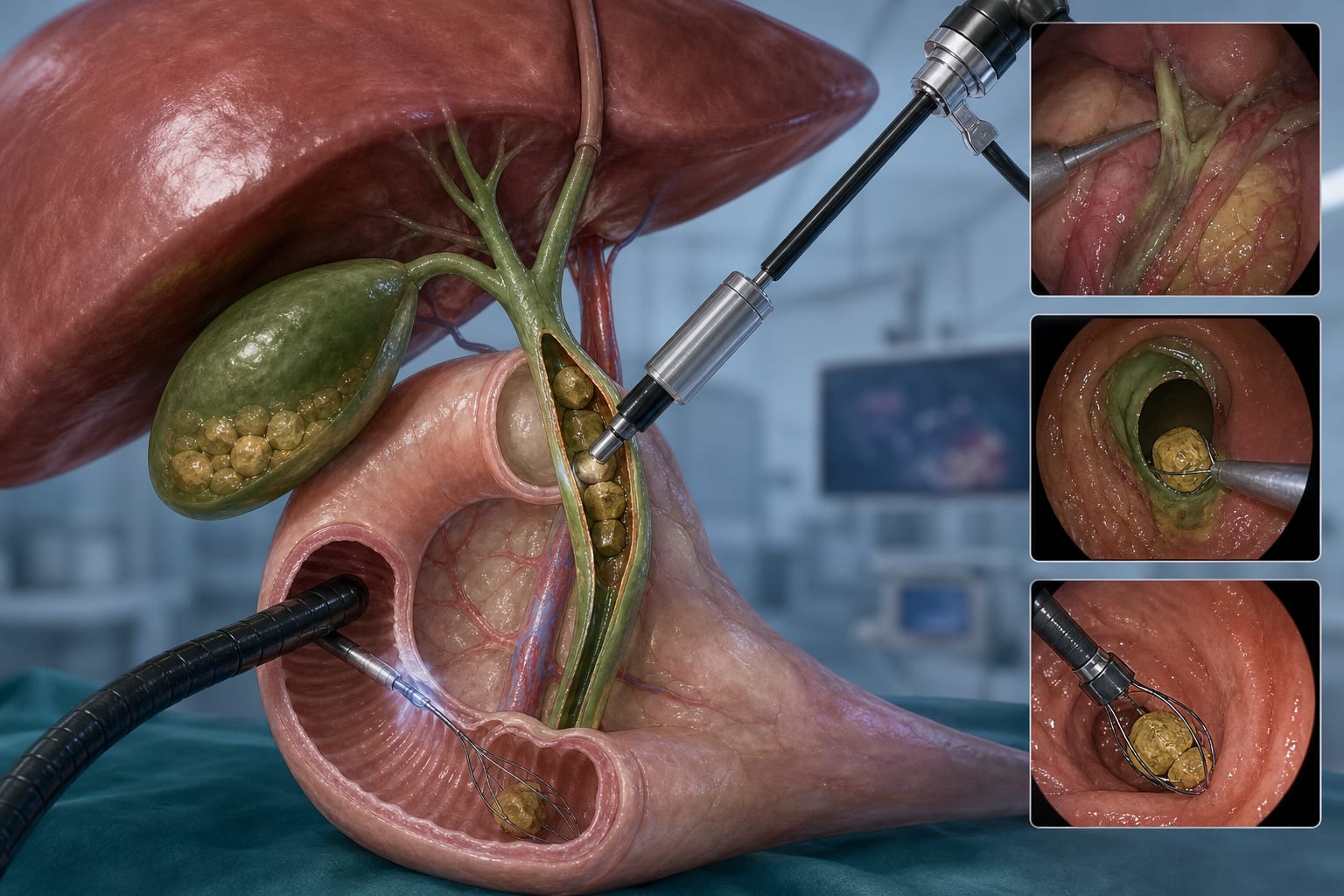
Application of laparoscopy, choledochoscopy, and duodenoscopy in the treatment of gallstones with choledocholithiasis
By
Wei Wu
Xinhua Wu
Rixin Zhang
Xiaowan Li
Ting Li
Ling Zhu
Bing Wang
Zhi Zheng
June 22, 2026
Clinical Scorecard: Utilization of Laparoscopy, Choledochoscopy, and Duodenoscopy for Managing Gallstones Associated with Choledocholithiasis
At a Glance
Category Detail
Condition Gallstones with Choledocholithiasis Key Mechanisms Combined use of laparoscopy, choledochoscopy, and duodenoscopy Target Population Patients with gallbladder stones complicated by common bile duct stones Care Setting Department of Hepatobiliary Surgery, Wuhan Central Hospital
Key Highlights
Experimental group (n=30) utilized a single-stage triple-endoscopic approach Mean operative time was 152 minutes with an estimated blood loss of 46 mL Postoperative complications included 6.7% pancreatitis and 3.3% biliary fistula Hospital stay was significantly shorter in the experimental group compared to the control group No significant differences in other postoperative indices between groups Guideline-Based Recommendations
Diagnosis
Preoperative diagnosis of gallbladder stones complicated by common bile duct stones via imaging examinations Management
Consider combined laparoscopic, choledochoscopic, and duodenoscopic approach for treatment Monitoring & Follow-up
Monitor for postoperative complications such as pancreatitis and biliary fistula Risks
Potential risks include pancreatitis, postsphincterotomy bleeding, and perforation Patient & Prescribing Data
Patients diagnosed with gallbladder stones and common bile duct stones
Single-stage triple-endoscopic approach is a minimally invasive treatment option
Clinical Best Practices
Ensure informed consent regarding surgical risks and procedures Utilize imaging for accurate preoperative diagnosis Monitor patients closely for complications post-surgery Related Resources & Content