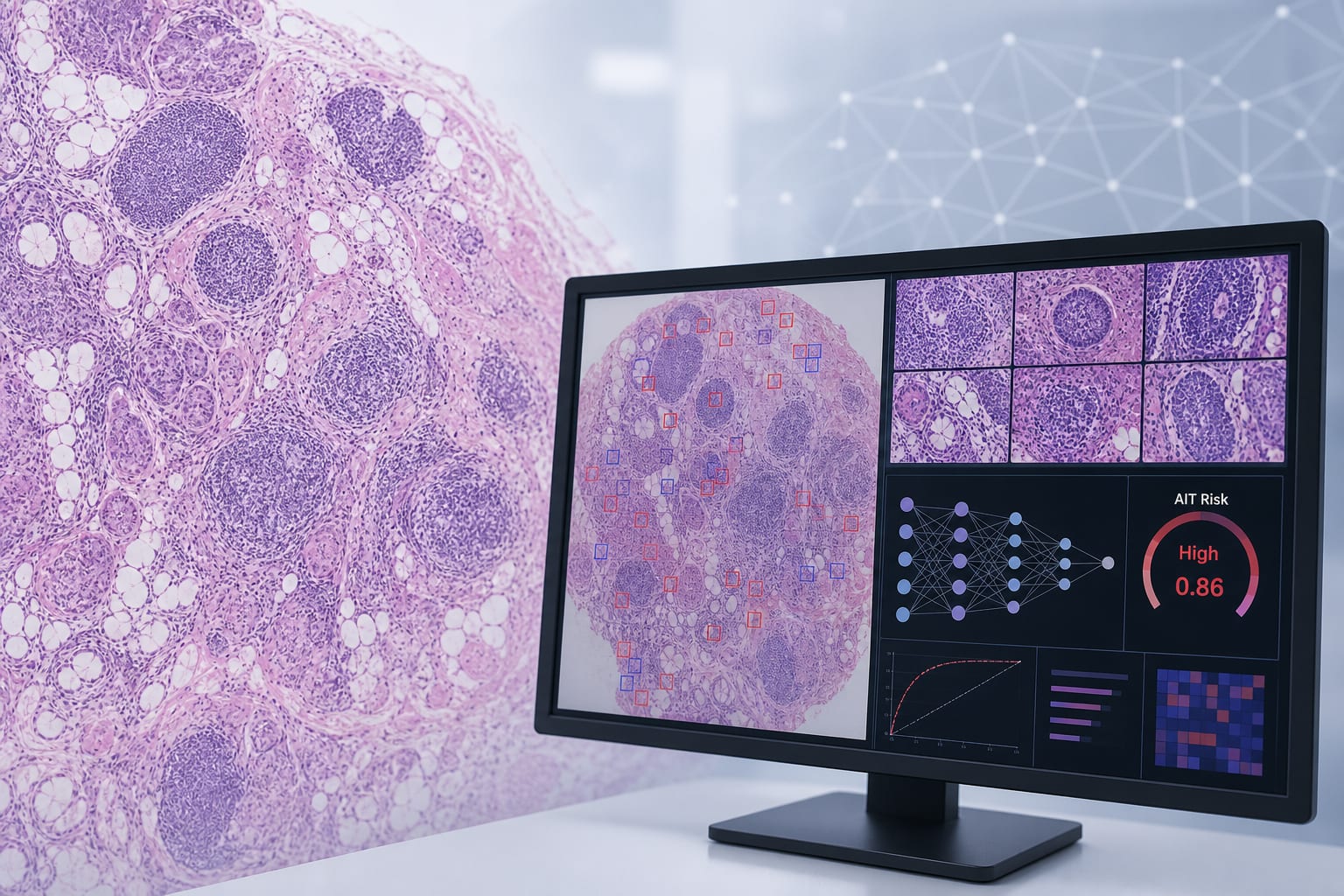
Clinical Scorecard: Artificial Intelligence Model for Screening Autoimmune Thyroiditis in Connective Tissue Disease Patients Using Labial Gland Pathology Images
At a Glance
Category
Detail
Condition
Autoimmune Thyroiditis (AIT)
Key Mechanisms
Deep learning-based prediction model using labial gland pathological tissue images.
Target Population
Patients with connective tissue disease (CTD) undergoing labial gland biopsy.
Care Setting
Retrospective study in a clinical hospital setting.
Key Highlights
Study involved 121 CTD patients with labial gland pathology images.
Model achieved an AUC of 0.829 for predicting AIT risk.
Key pathological features related to AIT risk were identified.
AI model provides support for early clinical identification of high-risk groups.
Study emphasizes the role of Sjogren’s disease in AIT development.
Guideline-Based Recommendations
Diagnosis
Utilize labial gland biopsy as a diagnostic tool for Sjogren’s disease.
Management
Implement AI models to enhance diagnostic accuracy and efficiency.
Monitoring & Follow-up
Monitor thyroid autoantibodies (TPOAb and TgAb) in CTD patients.
Risks
Increased risk of AIT in patients with CTD, particularly those with Sjogren’s disease.
Patient & Prescribing Data
CTD patients, including those with Sjogren’s disease, systemic lupus erythematosus, and rheumatoid arthritis.
AI model assists in identifying patients at high risk for AIT, guiding treatment decisions.
Clinical Best Practices
Incorporate AI technology in the evaluation of labial gland pathology.
Ensure comprehensive clinical assessments including laboratory examinations.